Theosophy kindled interest in Parsis to undertake a deeper study of Zoroastrianism
Parinaz Gandhi
It is easy to accuse a Parsi believing in the law of rebirth, of being a Theosophist…But I discovered this doctrine in Gatha (49-11) in 1908 many years before I joined The Theosophical Society (TS); and the TS does not enforce this doctrine on members as an article of faith; so its members are free to doubt its validity. Besides the Society is barely 80 years old while Zarathushtra’s message has had its influence for 8,000 years,” wrote Dastur Khurshed Dabu, then high priest of the H. B. Wadia Atash Behram in his treatise Message of Zarathushtra.
As commented Sir Rustom Masani in his foreword to Dabu’s book first published in 1956: "Theosophy and occultism afford to the author what he believes to be a clue to the esoteric interpretation of the ancient lore and significance of several Zoroastrian doctrines and rites. He knows his views will be generally criticized and in some quarters very furiously attacked. Men as a rule do not care to abandon cherished notions, particularly in matters of religion.” Even though Masani, like the majority in the community, did not concur with Dabu’s views on reincarnation, he acknowledged, "Among the few religious preceptors of the Parsi community, Dastur Dabu occupies the most exalted position as one splendidly endowed with the spiritual qualities which should, according to the scriptures, distinguish an ideal minister of religion.”
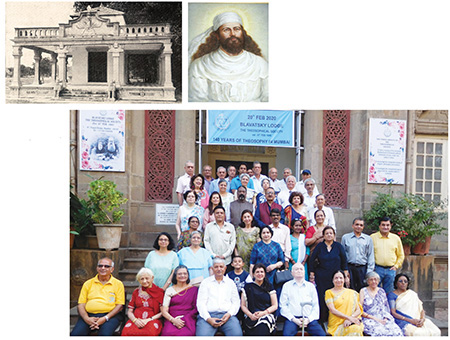
Top, l: Zoroastrian shrine at the international headquarters in Adyar;
painting of Zorathushtra by Manchershaw Pithawalla;
above: members at the 140th celebration of Blavatsky Lodge
Top: Headquarters Hall in Adyar; above (from far l): Col Henry Olcott,
Helena Blavatsky, Dr Annie Besant
Among the other Parsi rationalists known to have been inspired by the teachings of Theosophy in the 20th century have been authors and educationists, social workers and lawyers, artists and musicians. Dr Irach J. S. Taraporewala, a savant best known for his opus, The Divine Songs of Zarathushtra, a 1,166-page masterpiece first published in 1951, and the second principal of the M. F. Cama Athornan Institute from 1930 to 1940 was among them. The respected Avesta, Pahlavi and Sanskrit scholar is known to have made weekly sojourns to Blavatsky Lodge, the premier TS Lodge in India, to participate in spiritual discourses as did his father Jehangir.
Yet another popular treatise in the community, Aek Atmakatha, authored by Dastur (Dr) Maneck Dhalla of Karachi in 1952 was translated into English, An Autobiography by Behram Rustomji, the popular principal of the Bai Virbaiji Soparivala Parsi Boys School, and his wife Gool. The couple worked closely with Jamshed Mehta, the first mayor of Karachi who was considered the maker of modern Karachi, and was the heart and soul of the Theosophy movement in Karachi.
In India too there were some respected educationists who were senior members of the TS. The longest serving principal, for 31 years, of The J. B. Vachha High School was Perin Nagarwalla, a member of the Shanti Lodge, then functioning from Dalal Estate in Bombay. Her predecessor at the School, Meher Engineer was instrumental in starting the Jamshed Mehta Lodge at Cusrow Baug.
Other Parsi residential pockets like Dhobitalao, Rustom Baug, Dadar Parsee Colony, each had a separate TS Lodge for the convenience of members, most of whom were Parsis. Although staunch adherents of Zoroastrianism, they wanted to widen their understanding of their own faith in the light of other religions that came before and after Zoroastrianism. The teachings of Theosophy (the word Theosophy means Divine Wisdom) have continued to appeal to several other Parsis, occasionally three and four generations from the same family. In its heydays there were 15 lodges of the TS in the city that came under the umbrella of the Bombay Theosophical Federation. The number has now reduced to nine.
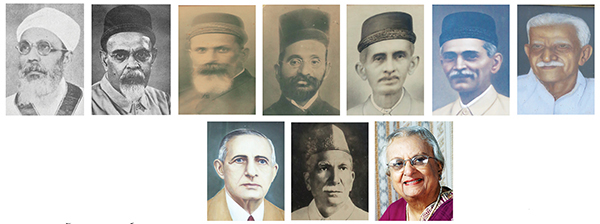
Clockwise from top l: Dastur Khurshed Dabu, Dr Irach and Jehangir Taraporewala,
Kawasji Shroff, Phirozeshah Green, Sorabji Karaka, Minoo Mulla,
Avabai Wadia, Jamshed Mehta, Rustom Alpaiwalla
At the Adyar estate (clockwise from top l): Library and Research Centre;
symbols and bas reliefs of major religions at the Headquarters Hall;
450-year-old banyan tree; Garden of Remembrance
Based on one’s understanding
Inspired by two Masters of the trans Himalayan region of Tibet, the TS was founded by two occultists, Helena Blavatsky, of Russo Germanic lineage, and Col Henry Olcott, an American agricultural scientist in New York in 1875. Giving equal weightage to all religions, they adopted as the Society’s motto: "There is no religion higher than truth.” Members of the Society accept its three objects: to form a nucleus of the universal brotherhood of humanity, without distinction of race, creed, sex, caste or color; to encourage the study of comparative religion, philosophy and science; to investigate the unexplained laws of nature and the powers latent in humankind.
When the founders traveled to India, they established The Bombay Theosophical Society (which was later named Blavatsky Lodge) on February 20, 1880. The first Indian to become a member of the TS in New York was Kawasji Merwanji Shroff who later became a founder member of Blavatsky Lodge. Phirozeshah Green, in whose name a mini hall has been named, had given a major donation for constructing the Blavatsky Lodge building at the foot of French Bridge.
"The seeds of Judaism and Christianity were sown in Zoroastrian esoteric wisdom,” was the conviction of Olcott. His talk at Bombay’s Town Hall on February 14, 1882 kindled the interest of Parsis to undertake a deeper study of Zoroastrianism. Several questions arose as a result of this talk that were answered by Blavatsky. Prospective members were reassured that acceptance of beliefs, doctrines and theories is left to each member’s discretion, based on one’s understanding and interpretation. Thus, while there are some Parsi members who believe in the philosophy of karma and reincarnation and adopt a vegetarian lifestyle, there are others who may not subscribe to these notions.
The contributions of Parsis who joined the TS have been vital in the continuum of activities till today. The Ladies Wing of Blavatsky Lodge was initiated and the first member was Avanbai Shroff. Mithan Lam (née Tata), the first woman bar at law, was an active member of the Lodge too. Barrister Rustom Alpaiwalla who had to cut short his legal career due to his failing eyesight served as co-editor of the Bombay Theosophical Bulletin and was founder president of the National Association for the Blind (India).
Two books by N. F. Bilimoria, Zoroastrian Ceremonies and Zoroastrianism in the Light of Theosophy attracted the attention of educated Parsis of that time. Parsi Social Reforms by Jamshedji Patel, New Message to Parsi Theosophists by Daboo, Light of Avesta and Gathas by Faredun Dadachanji were all published by the Blavatsky Lodge. Pestonji N. Pavri’s book Theosophy for Youths (reprinted as The Living Wisdom) is popular even now. Ahmedabad based Darab D. Kanga, professor of chemistry, compiled two volumes of Where Theosophy and Science Meet. Dr Behram Pithawala authored In Search of Divine Light the Zarathushtrian Way. Keki Palkhiwalla through his talks and booklets including God Bless You, Death and After Life, and many others has continued to propagate Theosophy.
Dosibai R. Dinshaw served as assistant editor of the monthly periodical, The Theosophist. Dr Annie Besant’s book The Seven Great Religions includes a chapter on Zoroastrianism. When she took over as the second international president of TS, her recording secretary was Jal Aria while B. P. Wadia was in charge of the Theosophical Publishing House at Adyar in Madras where lies the international headquarters of the TS. He later formed the United Lodge of Theosophists. Looking after the gardening department at Adyar was Kuverji Jassawala. Several decades later Keshvar Dastur served as international treasurer while Rustom Dalal served as treasurer of the Indian section of the TS at Varanasi and as alternate treasurer of the TS in Adyar. Jehangir Sorabji was associated as general secretary of the Indian section.
Sorabji Karaka donated funds for travel to the annual conventions at Adyar. It was with financial support of Parsi Theosophists that a Zoroastrian shrine was opened for worship at the TS campus in Adyar during the convention of 1925. Welcoming members of all faiths, shrines of the major religions stand on the nearly 250-acre serene estate abutting the Adyar River. On the walls of the Headquarters Hall are symbols and bas reliefs of living and extinct religions. A Zoroastrian ritual, "Sacred Offering Service to the Creator of the Universe,” was published by Irach Taraporewala, then president of the Zarathoshti Theosophical League, and occasionally performed in Bombay by brothers Jal and Khurshed Sanjana.
Avabai Wadia, president emeritus of the Family Planning Association of India, remembered attending international conventions in Adyar in the company of her mother Pirojbai Mehta. Secretary of the Youth Lodge in Ceylon, Avabai acknowledged that she learnt to write minutes at the age of 12 and to give speeches that gave her the confidence to promote causes in later life.
When the well-known educationist Dr Maria Montessori came down to Adyar, among those who studied under her were Gool Minwalla and Tehmina Wadia who subsequently founded Montessori Schools in Karachi and Bombay respectively. Wadia’s Besant Montessori School, started in premises behind her residential bungalow at the Juhu Theosophical Garden Society, continues to function till today, currently in the charge of Dolly Wadia. Among other families of Parsi Theosophists who took up residence on the Juhu precincts were sisters Maneck and Khorshed Minocherhomji who had earned the wrath of the orthodox Parsi community for associating themselves with Indian films, Maneck as an actress and Khorshed as a music director.
Khurshed J. B. Wadia who also resided on the same campus had authored 50 Years of Theosophy in Bombay. For the centennial celebrations of TS in India organized by Rusi Toddywalla at the Juhu Theosophical Colony, there was a congregation of members from different corners of India and the world. At the 140th celebration of the Blavatsky Lodge last year, Kashmira Khambatta was at the helm as president. She continues to be supported by key office bearers, many of whom are Parsis, like secretary Jasmine Cawasji, joint secretary Navaz Dhalla, joint treasurer Ruby Khan and book depot manager Freny Paghdiwala.
Shanti Lodge, founded by Khorshed and Hormusji Cowjiva, has seen a string of Parsi presidents. Currently the president of Vimadalal Bilia Lodge in Dadar is Bombay Parsi Punchayet chairman Armaity Tirandaz. It is named jointly after Faramji J. Bilia who augmented the funds of this Lodge and Jehangir J. Vimadalal who was complimented by Olcott as being a "silver tongued orator.” Homi Coachbuilder donated his property in Bhavnagar, Homi House, that today serves as the headquarters of the Gujarat Theosophical Federation.
The allied activities of the TS have been spearheaded by Parsis too. In memory of Theosophist Minoo Mullan, an elocution competition for college students is held annually. Rusi and Homai Toddywalla were the driving force behind Theosophical Order of Service (TOS), Bombay region which now has Thrity Dalal as president. Lotus Class that was conducted by Cawas Bottlewalla, Sam Cooper and Rusi Toddywalla inculcated Theosophical values in children. Ceremonial activities like the Mystic Star Ritual, Round Table and Co-Freemasonry have seen Parsi members evince a keen interest. Dedicated Parsi homeopaths over the years, right up to Dr Darayus Umrigar, and naturopath Dr Meherwan Bhamgara have given their services gratis at Blavatsky Lodge.
Bharat Natyam dancer and soprano Jer Jussawalla was the livewire of the Juhu Theosophical Colony. At the Blavatsky Lodge, Paghdiwala held a number of musical concerts with her Crystal Choral, frequently donating the proceeds to the Lodge. Tushna Dallas too contributed to the finances of the Lodge by holding her ballet classes at the spacious venue.
Early this year, as part of a virtual series on the major religions of the world initiated by the TS in Ojai, California, Aban Patel who is the president of Shanti Lodge in Bombay, Khambatta and Aban Amroliwalla worked on a presentation on Zoroastrianism. In keeping with the guidelines they received they ensured that they did not submit a scholarly dissertation but one that showed how "the religion is practiced in daily life.” The efforts of the trio will be shared on The Theosophy Wiki website and was also published as a booklet by the Bombay Theosophical Federation and released this February. The funding for this booklet came from the Mehra Dhalla Memorial Fund, created in memory of the petite stalwart who, invariably attired in a sari with her head covered with a sor, would visit different Parsi schools and Lodges in Bombay, Gujarat, East and Central Africa to impart spiritual values. Blavatsky Lodge past president Meherangiz Baria and treasurer Arni Narendran’s comprehensive presentation on "Zoroastrianism in the Light of Theosophy” was incorporated in the "Wisdom Capsule” project of the Virtual Centre for Theosophical Studies.
Blavatsky Lodge has a unique painting of Zarathushtra which was painted by artist Manchershaw Pithawalla under the clairvoyant instructions of Nusserwanji Billimoria. As reiterated by Pavri in his book, the TS wants every person "to live his religion, not to leave it.”
For further enquiries contact Mahazaver Dalal, secretary, Bombay Theosophical Federation, mobile: +91 9833131216, e-mail: mahazaver@hotmail.com
With inputs from Mahazaver Dalal, Meherangiz Baria, Arni Narendran and Parinaz Gandhi