While the vulture aviary at Doongerwadi never took off, Shankar Shinde of village Khorpada in Harsul near Nasik has started an eatery for the winged scavengers. A bhojanalaya (eatery) built on Forest Department land in 2011 and operational since 2015, is where 70-year-old Shinde brings animal carcasses from eight nearby villages for vultures to feast on. Sharing details of his efforts at conservation of the endangered species, Shinde, who is also president of his village’s Joint Forest Management Committee, told Daily News and Analysis (DNA) of November 28, 2016 that they "had to overcome opposition from the villagers, because the vulture is considered ‘inauspicious.’ So I explained to them vultures were descendants of Jatayu in the Ramayana.”
Vultures come to the half-acre fenced ground from nearby Trimbakeshwar, a place of pilgrimage. Shinde told DNA, "We also have to make sure that the animals (carcasses) have not been given diclofenac,” as the veterinary drug is lethal for the scavenger birds. "So we insist on a vet’s certificate before we allow it to be brought to our bhojanalaya.”
There are several successful community led conservation efforts which have won the Maharashtra Forest Division’s Nasik circle the district level first prize from the Sant Tukaram Vangran Yojana in 2012-13 and a consolation prize in 2013-14. As Shinde explains, "This area is home to two of the nine vulture species found in the country — the White-rumped and the Long-Billed.” According to a recent report of the Nature Conservation Society of Nasik (NCSN), the number of vultures in the area has increased by 100% in the last five years, reports DNA.
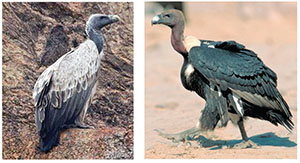
Long-Billed vulture (left) and White-rumped vulturePhotos: Wikipedia
Bishwarup Raha, founder of NCSN, who has been working to spread awareness about vulture conservation, especially among school children by organizing drawing competitions and trips to nesting sites on the cliffs, feels: "The number of Long-Billed vultures has gone up, I’d say by 200%. But these build their nests in the cliffs. There has not been a similar change in the population of White-rumped vultures, which were once very common and are now critically endangered. This is partly because they build their nests on trees and deforestation continues unchecked in these forests,” Raha told DNA.
Homi Khusrokhan, president of Bombay Natural History Society (BNHS) informed Parsiana that they are aware of this vulture restaurant at Nasik, but do not believe that such feeding sites have any conservation value in a country like India where there is no shortage of food for the birds. Also, "because of the highly toxic nature of … drugs like diclofenac, where even a trace quantity of 0.2 mg/kg of body weight of the bird is lethal to the vulture, and the test required to detect such trace quantities is sophisticated, expensive and time consuming, the risks of allowing vultures to feed on cattle carcasses collected from an area where there is a risk of the animal having been treated by unscrupulous veterinarians (despite the ban on its use) 72 hours before the animal died, is too great to take. A single contaminated carcass can kill all the birds feeding on the carcass at the time. Moreover, looking to the large distances vultures can fly in a single day (over 100 km), vulture restaurants can also put at risk birds from neighboring areas who may flock to these restaurants because of the ready availability of food.”
Khusrokhan added that the BNHS feeds "vultures bred by us in captivity in our centers with goat meat from farms where these animals are known to have not been exposed to treatment with any drugs known to be toxic to vultures, before they are slaughtered.”