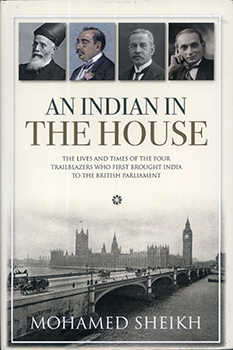
An Indian in the House: The lives and times of the four trailblazers who first brought India to the British Parliament by Mohamed Sheikh. Published in 2019 by Mereo Books, 1A, The Wool Market, Dyer Street, Cirencester, Gloucestershire, GL7 2PR (UK); website: http://www.mereobooks.com; email: info@mereobooks.com. Pp: 351. Price: Not mentioned.
The presence of ethnic minority members in either House of the British Parliament is no longer a matter of novelty or curiosity. But it was both even half a century ago, as this interesting book reminds us. It sketches the lives of four Indians, three of them Parsis, who blazed a trail in making their presence felt on the green benches at the Palace of Westminster as far back as 1892. Dadabhai
Naoroji, the pioneer and a Liberal, was followed in 1895 by Mancherjee Bhownaggree, a staunch Conservative, and by Shapurji Saklatvala, a Communist, in 1922. The fourth, Satyendra Sinha, a Bengali, was elevated to the peerage as Baron Sinha of Raipur, in 1919 after serving on the Viceroy’s Executive Council, the Imperial War Cabinet and as Parliamentary Under-Secretary of State for India. This book contends that, together, the foursome "brought India to the British Parliament.”
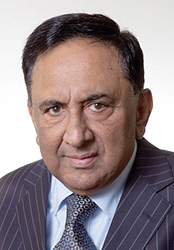
These personages were, of course, quite diverse in terms of their backgrounds, ideologies and political leanings. But they had, argues the author Mohamed Sheikh (pictured) (who is himself a member of the upper house of the British Parliament, having been made a Life Baron by the Conservative Party in 2006), certain common traits:
"(A)ll four men loved and fought for their country, all four shared a passion for justice and equity, and all four were highly motivated and fiercely intelligent. Between them they earned India, and Indians, a long-overdue respect in the West, and opened the door for many of their countrymen to be welcomed into the ranks of government in their wake…”
The book deals with its subjects in four self-contained compartments, essentially offering potted biographies of each of the protagonists. For his research, Sheikh has relied quite heavily on a number of works which should be familiar to readers of this journal, including: Farrokh Vajifdar’s The Twist in the Rope; R. P. Masani’s Dadabhai Naoroji: The Grand Old Man of India; and John Hinnells’s Zoroastrians in Britain (all the sources are duly acknowledged, and there is also a handy back index which enhances the value of the book).
The discussion, though wide-ranging, is sometimes a bit cursory: for example, although Sheikh deals with the "drain theory” for which Naoroji became well-known (this theory argued that British rule had been draining away India’s resources without giving back anything comparable in return — an early criticism of colonial rule which has been adopted and amplified in recent years by the likes of Shashi Tharoor, Congress member of the Indian Parliament), he does not interrogate its popularity or soundness beyond noting that Naoroji’s exertions led to the creation of a parliamentary Select Committee to examine the matter but its life was cut short by a change of government within a year. Many readers would have expected a more extensive treatment of this subject, including Sheikh’s own views of the credibility or otherwise of the "drain theory,” or the strong challenges to it mounted by contemporary analysts such as author and historian Zareer Masani (who has often quoted the works of economists such as Prof Tirthankar Roy to show that British rule was not quite as detrimental to India, in economic terms, as has sometimes been portrayed).
But this should not detract from the readability of the volume. Sheikh offers many nuggets of information which are both illuminating and interesting. There are also a few lighthearted observations. Sample this comment on Bhownaggree’s growing alarm over his ballooning waistline (among other things, the book reproduces a portrait of Bhownaggree which appeared in Vanity Fair in 1897 and which shows him as a short, rotund, albeit nattily dressed, figure):
"As he approached his 40th birthday in August 1891, Bhownaggree must have been surveying his expanding figure with chagrin. He wrote to Sir George (Birdwood, a sheriff of Bombay), a letter undated but probably early 1891: ‘The stoutness troubles me, but perhaps you will find it not yet grown to detestable proportions. Well, how can I keep thin? …Only the day before yesterday I came to Proverbs XXXVIII v. 25 (sic): ‘He that putteth his trust in the Lord shall be made fat.’ This at least is comforting.”
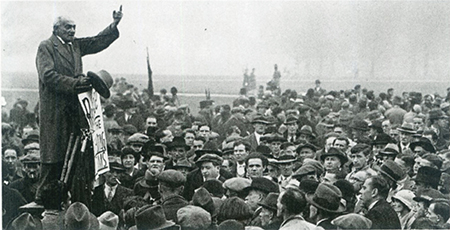
Shapurji Saklatvala addressing a crowd at Trafalgar Square
A liberal election poster of 1906
Top, from l: Dadabhai Naoroji, Shapurji Saklatvala, Satyendra Sinha and Mancherjee Bhownaggree
Sheikh’s research also unearths examples of intra-Parsi bickering of a kind which will not surprise any observer of the community today. When Bhownaggree was climbing up the greasy pole of politics (and making good progress), at least one fellow Parsi, Sir Dinshaw Edulji Wacha, took it upon himself to vocally traduce him, branding him "a tool of the Anglo-Indians” who was harming "India’s cause by his abject slavery to them.” Ironically, Wacha himself does not appear to have been particularly accomplished or popular. According to Hinnells, he was "a rather testy, self-opinionated individual who could not tolerate any views different from his own.” Hinnells has also pointed out, bitingly, that "even the hagiographic biographer responsible for the 1930 Natesan publication Famous Parsis cannot find any contribution Wacha made to the Parsi community, but Bhownaggree labored for nearly three years for the Zoroastrians in Britain.”
The chapters on Saklatvala and Sinha are no less informative. Of the former, a Liberal who turned communist, Sheikh offers the startling nugget that Saklatvala had, at one stage harbored such a deep hatred for India’s colonial masters that he wanted "to kill as many Englishmen as possible,” with his preferred method of achieving that aim being to infect the water supply of Bombay with cholera germs. Saklatvala was also accused by his detractors of hypocrisy "for allegedly concealing wealth while posing as a friend of the working classes,” although a particular charge of installing a marble fountain in his garden was, says Sheikh, unfounded.
As for Sinha, there is the telling story of how he and his brother, despite being from a wealthy and privileged background, had to contend with the formidable Hindu prejudice against crossing the oceans (called kala pani or black water) when they decided to go to England for higher studies. They literally fled the family home early one morning and boarded a London-bound ship before their relatives could thwart their plans. Such was the force of religious customs in those days that when Sinha returned to India five years later after successfully reading for the Bar and having his talents recognized by his English tutors and colleagues, he "received a hostile reception in his old family home,” was "forbidden to enter the household” and was "never allowed to see his parents again.” This experience served, adds Sheikh, to "color the rest of his life.” The author’s overall assessment of Sinha is that "despite his conservative and generally pro-British stance he fought for his countrymen by consistently arguing for reforms which would increase India’s prosperity and independence.”
The sincerity of purpose underlying this book is palpable. Sheikh, it needs to be remembered, was born in Kenya and raised in Uganda, so his familiarity with India is a bit tenuous. Consequently, some minor errors have crept into the book (for example, he refers to Bhownaggree’s wife as "Motibhai” and his sister as "Awabhai” when it should be Motibai and Avabai respectively; likewise, "Manekbhai” for Manekbai, Naoroji’s mother). Despite such flaws, the book remains a useful and inspiring contribution to the literature on the shapers of modern India.
VENKAT IYER
Iyer is a UK-based barrister and legal academic.