The Zoroastrian Charity Funds of Hong Kong, Canton and Macau have donated and continue to disburse millions to community causes
Parinaz M. Gandhi
"Hong Kong no paiso barkati (wealth generated in Hong Kong is auspicious),” observes octogenarian Ruby Master, among the oldest Zoroastrian residents of the island city who being the first lady trustee of the Zoroastrian Charity Funds of Hong Kong, Canton and Macau has witnessed the trajectory of this august institution from within and without.
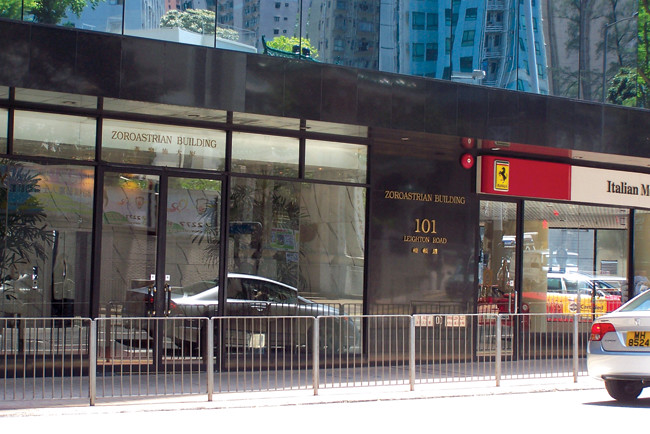
An association, whose name is synonymous with wealth and welfare, its charities have become legendary. The money acquired by the members in nearly two centuries from businesses as varied as trade in tea, silk, cotton, spices, sandalwood and opium, banking, insurance, transportation, hotels, and investment in shares, bullion and commodities markets has stood the community in good stead. Added to this is the income generated by the new Zoroastrian Building, a 23-storeyed, centrally air conditioned, glass and concrete commercial tower where the association occupies four floors and rents out the rest, that permits them to carry out their humanitarian activities. In 2010, the association donated Rs 72 million (US $ 1,600,000) to thousands of needy Parsi individuals and institutions, mentions their official communiqué.
From left: Rustom Jokhi, Viraf Parekh, Jal Shroff, Neville Shroff and Kawas Pavri ; Zoroastrian Building above
"We have been told that addresses of Hong Kong contacts Bombay maa véchaich (are being sold in Bombay),” states Jal Shroff who after 27 years as trustee stepped down as president in May this year. It was during his last week as president that Parsiana visited Hong Kong to interact with the trustees and members of this prosperous and philanthropic community. When he took charge of steering the ship he was the youngest trustee, and his successor Neville Shroff, is likewise the youngest and juniormost among the present board of five. "My personal approach is that if 90 percent of the applications are genuine then we can’t ask for anything more. That’s the way we operate,” Jal conveys the working.
Purviz and Rusy Shroff with Ruttonjee Centre (alongside)
Studying applications for financial aid is a duty shared by all the trustees. "We use Dinshaw Tamboly of the WZO Trust Funds as our Bombay contact,” states Jal. Tamboly sends them appeals with a recommendation on whether the case requires monthly aid or a lumpsum payment. They have box files of appeals that are circulated among all the trustees "where each trustee recommends the amount to be sanctioned; 90-95 percent of the appeals are approved,” explains Neville. Notes co-trustee Rustom Jokhi, "When dad (Keki) was a trustee the association hardly had any money.” With the appreciation of shares, funds grew, wealth increased and philanthropy multiplied. "Now there is a huge workload… Even though a lot of stuff is done on email, where originally the trustees were required to study one file a month, (the number) has now increased” manifold.
The remittance to India is through a local charity when ofttimes the recipients do not realize the identity of the original donor. For education, the Hong Kong association prefers to remit funds directly to universities overseas in 90 percent of the cases to ensure that there is no misuse of funds. As a policy the association sanctions grants for overseas studies only to "postgraduate students, preferring that they get their degree in India first,” mentions co-trustee Kawas Pavri. Educational aid of US $ 3,000 a year is provided to 900 Parsi students each year. Assistance for overseas study "is all given as loans,” states co-trustee and honorary secretary Viraf Parekh adding, "In our accounts, 40 percent is written off as non-recoverable loans. We have to send reminders.” "But when parents offer to pay up, we refuse saying we want it from the students, we don’t want to burden the parents,” reveals Jal appreciating that "Some actually return the loan with 15-20 percent interest.” "In today’s life, it takes time to settle down,” Pavri sympathizes with those who take longer to repay their amounts.
In between there were a spate of appeals from students wanting to train as pilots. Generally, the June-September quarter is the busiest for many educational appeals come during this period. They also come across "professional students” who, happy with the financial aid they receive annually, cannot stop studying. They cite the instance of a Parsi with a Filipina wife who was eventually told that having availed of assistance "for over 10 years he should now look after himself.” There are others like one Iranian Zoroastrian who was given help to complete his doctorate in engineering. Within three months he returned the money for he had earned a scholarship from the university.
(L to R) 1st row: Keki and Javer Jokhi, Jimmy and Ruby Master, Farida Shroff, Pervin Shroff, Roxy Jokhi
2nd row: Noshir Pavri, Yazdi and Chermeen Parekh, Shernaz Kharadi, Ervad Jimmy Sidhwa, Yazdi Bagla (far right) Sue, Delna and Viraf Khan
Lure of lucre
Their own children who go abroad for university education tend to return to their roots. "Family ties are very strong. Hong Kong is a very lucrative and attractive place to come back to,” observes Neville. Fearing Communist takeover a couple of families had left Hong Kong prior to 1997 (when as per the treaty, Britain returned Hong Kong to China after retaining it as a colony for 156 years) to settle in Australia/New Zealand and London "but they are now regretting the move,” points out Neville. With Hong Kong being declared as a Special Administrative Region (SAR) by China, under the one country-two systems policy, the residents of Hong Kong continue availing of the benefits of a laissez-faire capitalist economy, with China holding jurisdiction only on matters of international relations and national defence. In fact the community has seen a rise in its expatriate population with several Zoroastrians coming on contracts for jobs in shipping, banking, insurance and aviation.
The community in Hong Kong numbers 224 members with 167 or three-fourths of it comprising an adult population aged over 21. Females outnumber males by 11 in this age category whilst in the younger category there is parity, with 29 males as versus 28 females. Single members constitute 15 percent of the community, mentions the Directory of Hong Kong Zoroastrians, 2011-12, the annual compilation being the effort of Viraf Parekh and his son Yazdi.
With their population "increasing every year, we are already looking to see what we can do. We are slowly starting to outgrow our present premises,” note the trustees. The present Zoroastrian Building was inaugurated in 1993 after demolishing their earlier three-storey structure in 1991. Most of the redevelopment cost of HK $ 33 million was financed by taking a loan mortgaging the land. With the loan being repaid by November 1996, the ownership of the Building vests with the trust, notes their Directory.
1st row: Interior and exterior of bungli at Parsi cemetery in Hong Kong
2nd row: bust of Sir Hormusjee Mody with his grave and other well maintained graves
As Shanghai develops, they expect more Parsis to move there. This would be reverse migration. "I was born in Shanghai,” recalls Jal referring to the times when mothers in Bombay put their young sons on ships sailing to Shanghai to seek their fortune. "A lot of our grandfathers came here with nothing,” in days when no permits or visas were required. There is a very young expatriate population in Shanghai, reports Neville whose son Nigel is studying intensive Mandarin in Shanghai that is just two hours away by plane from Hong Kong. In fact he is beginning to like it more than Hong Kong, says Neville who guesstimates that there must be around 20 Parsis residing in that metropolis.
Bonding at the Building
"Playing together and praying together” cements the community, appreciates Jal whose wife Pervin who was hitherto on the Social Hall Committee has been elected as the new trustee in the vacancy created by his resignation. Along with Pervin others serving on the Social Hall Committee are Parvez Jokhi, Neville’s wife Farida, Rustom’s wife Roxy, and Yazdi’s wife Chermeen.
Realizing the importance of their own community premises where members of the well-knit Hong Kong community gather every week to socialize over a game of cards or for a gahanbar dinner, the association has responded to the appeals from Zoroastrian associations in other parts of the world striving to build their own community centers. Last year the Hong Kong trustees donated US $ 250,000 for a Zoroastrian center in Southern California and $ 200,000 towards a Zoroastrian center in Dallas. Previously they had contributed towards a Zoroastrian center in New York and have pledged donations for a center in Toronto and an atash dadgah in London.
Just as the long-time residents see the Zoroastrian Building as their second home, even the expatriates and Zoroastrians with NRI (non-resident Indian) status turn to this center when they feel lonely or homesick. Appreciating the efforts of the local community that made her feel welcome when as a new Cathay Pacific recruit in 1996 she was expected to relocate from Bombay to Hong Kong, Shernaz Kharadi looks forward to the social events when she is not on flight duty and can interact with the Zoroastrians. Her husband Malcolm being a jockey retained by the Dhunjibhoys is based in India.
At the social get-together that Parsiana was privileged to attend on May 13 we met Sue Wong, a Taoist by faith who is part-time lecturer at the City University teaching hotel management, her husband Viraf Khan who is an accountant in a trading firm and their daughter Delna who will soon be initiated as a Zoroastrian. Viewing the Hong Kong Zoroastrian community as the "most friendly people,” Sue happily refers to the Zoroastrian wedding rituals "with rice and string” performed for her and Viraf on these same premises around seven years ago by a priest who had come from India. Whilst she enjoys the Parsi food there are times when she finds "it has too many spices and herbs.”
In any given year, 20 dinner functions are guaranteed for community members — on Avan and Adar roz paravs, gahanbars and dinners in memory of deceased members, New Year and Khordad Sal celebrations. At all such events a familiar face is that of Yazdi Bagla who works as their kitchen supervisor. A former resident of Bombay, he has been with them for the last 22 years and resides on the sixth floor of the Zoroastrian Building where their priest and outstation staff are provided residential accommodation. In addition to Parsi food he considers Thai dishes his speciality and has even learnt some Chinese and Continental varieties.
Poleung Kuk center opposite Zoroastrian Building
The youngsters in the community are well catered for and keep in touch through community events or social networking sites or other opportunities for socialization. "Hong Kong is a relatively small place as compared to London where they have to travel long distances to reach their destination or have to complete household chores on weekends in the absence of maids. Here everyone is within 30 minutes of each other,” points out Neville.
"Very open minded” in their views the community in Hong Kong places no bar or restrictions when interacting with non-Parsi spouses or their children at social functions but "draws the line when it comes to religious functions where the sacred fire or priest may be present.” Among their former presidents they had Dhun Ruttonjee who was married to Anne and Sammy Shroff who had wed Irene. After the death of her husband and her Chinese friends, Anne continued to come regularly to the Zoroastrian Building "to play cards and eventually in her will left an endowment for us,” states Jal. Irene who continues to be listed in the Hong Kong Zoroastrian Directory even following her husband’s demise, still religiously goes to the Parsi cemetery every day although she is dependent on a walker to support her.
Whilst refusing to classify themselves as progressive or liberals, Neville jests, "We certainly wouldn’t classify ourselves as backward. We have a happy status quo.” For after death ceremonies they adopt a "compassionate” approach and leave it to the "spouse or next of kin to decide whether they want non-Parsis to pay their last respects at a funeral,” states Neville recalling one instance when a non-Parsi wife of her own accord refused to join in the ceremonies stating that she was complying with the wishes of her late husband.
Stalls at Ngong Ping Village
The famous five
"Anyone who has a Zoroastrian connection is welcome to the association.” They have no membership or subscription system. Zoroastrians who have completed 18 years of age and have been residing in Hong Kong for minimum five years are entitled to vote at elections and those who have completed 30 years are permitted to contest elections. A trustee’s term lasts for five years after which he/she should be reelected by the community. Their long-standing trustees are Viraf Parekh who has served for 30 years, Jal who at the age of 75 stepped down after 27 years, Pavri who has been a trustee for 17 years, Rustom Jokhi for 11 years and Neville for around eight years.
The names of the well established families in Hong Kong — Ruttonjees, Shroffs, Jokhis, Pavris and Parakhs — feature frequently at community meets and on plaques. The prayer hall on the fifth floor of the Zoroastrian Building is named after Pherozeshaw Kawasji Pavri while the social hall on the third floor is in memory of Jehangir Ruttonjee. Some other families that were well established in Hong Kong in earlier years were the Tavadias, Fatakias, Talatis and Karanjias.
"The community here is very small and very ossified,” declares asset management and investment advisor Jimmy Master adding, "We practice Chinese style democracy. The outcome of an election is predetermined before it is held.” Happy that there has been a change of guard he states, "I have great confidence in Neville. He doesn’t get rattled, doesn’t get needled.” Jimmy’s parents Ruby and Minoo Master were both trustees at different times and in fact his father was president of the association as was his maternal grandfather Kawasji Parekh who had been labeled "fosoi” a Cantonese term for petrol because by temperament he was considered "highly combustible.” Unhappy with the unwritten law of appointing "five trustees from the same five families,” Jimmy commented, "The system does not allow for change…We have not made the best use of talents within the community.” But his mother maintains, "The community as a whole is happy with the way things are.” She referred to a change contemplated by the trustees during her tenure to permit non-Parsi spouses at gahanbar dinners but "there was objection from the community. The trustees have to do what the community wants.”
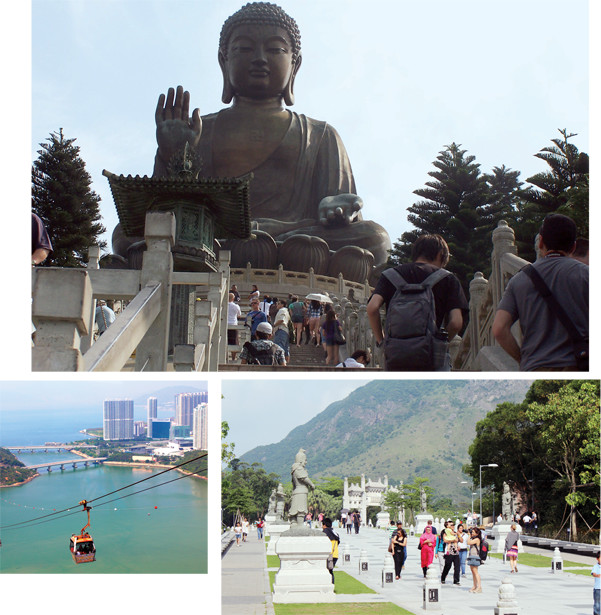
(Top): Imposing Tian Tan Buddha bronze statue; (above) Ngong Ping 360 cable car connecting Tung Chung to Lantau Island (alongside)
Her brother Noshir Pavri (Kawas’ father) who too was president of the association in earlier years but stepped down on the rationale that "you need new blood,” was reminded of the attitude of earlier trustees where "if you were not 70-80 years of age you were not considered trustee material. ‘Tu su jaané (how would you know)!’” was the usual reaction of seniors to any opinion expressed by a youngster. Living in the same building as him and his wife Perin is his 103-year-old mother Tehmina, the oldest Zoroastrian resident of Hong Kong.
Next in seniority comes 93-year-old Rusy Shroff who is permanent managing director of Ruttonjee Estates Continuation Limited. With his deteriorating eyesight he is dependent on others to read to him and his wife Purviz mentions that although they subscribe to over a dozen publications as soon as Parsiana arrives she is expected to read aloud the community news while all the other magazines await his attention. His mobility may be restricted but not his philanthropic gestures. To this day the avid horse racer enjoys his telebetting from his residence and ensures that all the money earned from racing is donated to charitable causes, the Ruttonjee Hospital in Hong Kong being a memorial to the family’s magnanimity.
Well known in India for their community charities are the Jokhis of Hong Kong who whilst taking an active interest in the Hong Kong association matters also perpetuate the memory of their patriarch Shapoorji Jokhi by contributing to the pool of housing and medical facilities in his country of birth. Initially Shapoorji was a trustee of the Hong Kong association, subsequently his brother Keki and presently Keki’s son Rustom.
Among the early Zoroastrian settlers who made a lasting contribution to Hong Kong’s success were Sir Hosmusjee Nowrojee Mody who was the principal donor and founder of the Hong Kong University, the Kowloon Cricket Club and the Soldiers and Sailors Home in Wanchai. To Dorabjee Naorojee Mithaiwala goes the credit of starting in 1888 the first major scheduled cross-harbor steamboat ferry service between Hong Kong and Kowloon that is popular to this day as the Star Ferry. Jehangir Hormusjee Ruttonjee who started Hong Kong’s first brewery was also responsible for building the Ruttonjee Sanatorium, the Grantham Hospital and the Freni Care and Attention Home.
The association got its present nomenclature, "Zoroastrian Charity Fund of Hong Kong, Canton and Macau,” in 1874 but it has its genesis in 1822 when a cemetery was established in Macau. In 1834 was formed the China Canton Anjuman and 11 years later the community met in Canton to create a wider anjuman covering Hong Kong, Canton and Macau, the historical reference is provided in their Directory to explain why their association is believed to be the oldest Zoroastrian association outside of India,
To health and harmony
"To maintain the charitable work we are doing we have to maintain the harmony we have in our community,” stresses Neville continuing, "Harmony is important but without money harmony would be more difficult.”
Within the association, members respect each other’s right to privacy. "We treasure our independence a lot,” says the new president reiterating, "We are non-political.” When pressure is brought on them to form a South East Asian Federation of Zoroastrians they respond, "Leave us alone. We don’t interfere with you, you don’t interfere with us.”
"Our annual general meetings (AGM) are normally very peaceful,” states Kawas. "There has never been a (financial) proposal that we as trustees have tabled that has been turned down by the community,” states Jal for the trustees invariably do their homework and come well prepared with facts and figures. "It’s my practice that once you step down from a post you don’t interfere unless your advice is sought,” Jal is emphatic.
At their last AGM in May 2011, the association sanctioned a sum of Rs 58 million (US $ 1,288,888) to upgrade Bombay’s B. D. Petit Parsee General Hospital’s School of Nursing which will be named the Hong Kong Zoroastrian College of Nursing. The amount will be paid during the course of the next three to four years. This is in addition to over Rs 100 million (US $ 2,222,222) donated to the Hospital by the association in the last 14 years.
Popular Star Ferry cruise connecting Hong Kong and Kowloon
This is not the only medical aid the Hong Kong community extends. When a patient from the poor or middle class is struck by a debilitating illness, the association sanctions a one-time payment of Rs 100,000. In a month there are 50-100 individuals who avail of such a contribution. Further there are 40 retired mobeds who receive a monthly pension and around 430 indigent individuals and families who are given a stipend each month totaling Rs 1,000,000.
Acknowledging the respect that they accord to their own mobeds and their benevolence to the community throughout the world are the priests who have worked with them over the years. While their current priest Ervad Homyar Nasirabadwala was on vacation when Parsiana visited Hong Kong, relieving him of his duties was their erstwhile priest, Ervad Jimmy Sidhwa. Yet another priest, Ervad Burjor Bhada who had served the Hong Kong community for over a decade and is now leading a retired life in Deolali summed up, "Eloko jéva Parsi koi nahi (there are none who can be compared to the Hong Kong Parsis).”
In this world’s most vertical city, as Hong Kong has come to be known, the Zoroastrian residents seem to stand tall, towering in magnanimity over their coreligionists.
(Subsequent issues of Parsiana will focus on the outstanding individuals who have contributed to Hong Kong’s growth and the betterment of the community.)