The Global Working Group supports a
survey that seeks to obtain information to make
relevant plans for the community
Text: Parinaz M. Gandhi Photos: Jasmine D. Driver
A predominantly online Global Zoroastrian Survey to be conducted by the School of Oriental and African Studies (SOAS) should hopefully "provide substantive and authoritative data to understand the state of the community and its aspirations,” asserted Edul Daver, global president of the World Zarathushti Chamber of Commerce (WZCC) at the Global Working Group (GWG) meeting held in Bombay on January 7, 2020. The exercise aims to cover every Zoroastrian over the age of 16. Daver, along with Toos Daruvala and Dinyar Devitre, constitute the core group that is driving this project. They have pledged $ 70,000 (Rs 49,84,175), or 30% towards its cost that is estimated to be around $ 275,000 (Rs 1,95,80,688) for the 18-month duration.
For the balance funding the working group will be responsible to reach out to Zoroastrian organizations, trusts and potentially high net worth individuals. Besides the three project initiators, the working group will include Ervad Zerkxis Bhandara, Nina Mistry, Roshan Rivetna and Arzan Wadia from North America, Ervad Jimmy Madon and Dr Rashna Writer from Europe/the UK; Hoshaang Gotla, Sheherazad Pavri and Yazdi Tantra from India; and Nergish Udwadia from Australia. A separate steering committee comprising representatives from major global anjumans will work with SOAS to build local support and administer the survey in their region.
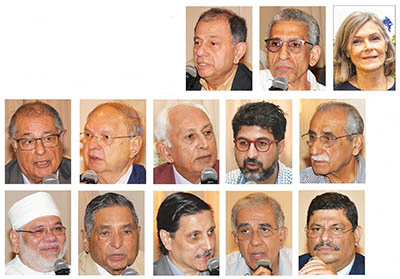
From l, top row: Edul Daver, Kekoo Colah, Dr Sarah Stewart; 2nd row: Alayar Dabestani,
Byram Avari, Homi Gandhi, Arzan Wadia, Rohinton Rivetna; 3rd row: Dastur Khurshed Dastoor,
Burjor Antia, Yazdi Desai, Kersi Randeria, Xerxes Dastur
The participants will be those who have been initiated into the faith as also the spouse/child/grandchild of such individuals. The questionnaire will address demographic issues concerning geographic location, age, sex, marital status, whether married to a Zoroastrian or non-Zoroastrian, household information, education, occupation, economic status. Additionally behavioral questions will gather data on frequency of visits to places of worship and or cultural center, number and intensity of connections with other Zoroastrians/non Zoroastrians. Attitudinal questions will incorporate views on relevance and importance of the community and the religion, adoption, organ donation, growth/shrinkage of the global Zoroastrian community, interfaith marriage, children of interfaith marriages, and acceptance of non Zoroastrians into the fold.
Data input, analysis, compilation and interpretation of findings will be the responsibility of SOAS. The survey will be led by Dr Sarah Stewart, co-chair of the SOAS Shapoorji Pallonji Institute of Zoroastrian Studies (SPIZS) and senior lecturer in Zoroastrianism. Kekoo Colah, executive director of Shapoorji Pallonji and Company Private Limited, who was specially invited to this session of the GWG assured "all support” on behalf of SOAS SPIZS that is "a very credible and neutral platform.”
In response to queries raised by some members Daver mentioned that the online survey will have to be supplemented with on-ground survey for those regions that have no access to computers. Neo Zoroastrians will not be included. The total estimate has included a contingency cost of $ 50,000 (Rs 35,65,781).
Supplemented Wadia, vice president of the Federation of Zoroastrian Associations of North America (FEZANA), "We will need institutional support to spread the word. Whether we will be able to capture the views of every Zoroastrian, who knows?” Foreign associations have mailing lists. "But there are many more who are not members of the local association,” pointed out Farida Irani of Sydney. Wadia wondered whether youngsters from the Holiday Programme for Youth could go from door to door to ensure the 18,000 community members living in Parsi colonies in Bombay fill out the questionnaire. Individual respondents will remain anonymous so that they can give frank and honest opinions.
[Within five weeks of the GWG meeting, a follow-up email sent to Parsiana announced the creation of the new initiative Gen Z and Beyond with a website http//genzandbeyond.com providing detailed information, funding options and answers to frequently asked questions. "What does the Zoroastrian community, especially our youth, seek? How can we preserve our identity and strengthen the community as a whole?” enquired the communiqué advocating the need for accurate data "to develop future projects that will secure, strengthen and further the well-being of the community.”
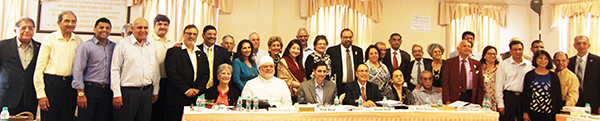
Representatives and observers at the Global Working Group meeting in Bombay
They plan to commence the pilot study in May 2020 in the UK (Birmingham) and India (Madras) on funds collection reaching the trigger point of $200,000 (Rs 1,42,75,910). "We cannot do this without your help and request each association around the globe to support this initiative as well as make monetary contributions and help to create the future of our community,” urged the core team. The actual survey will immediately follow the pilot study and they hope to have the final report compiled by December 2021.]
Hosting visitors
"With Zoroastrians moving from continent to continent on a very wide scale, if we do not connect them (to the local anjuman) they won’t remain a part of the community,” stated FEZANA president Homi Gandhi who has been trying to set up a network of key contact persons from different areas. For Hong Kong, GWG non-executive chair and president of the Zoroastrian Charity Funds of Hongkong, Canton and Macao, Neville Shroff suggested that his wife Farida be the contact person. For Australia, Firoz and Mahrukh Pestonji of Perth offered to be the contact persons. Irani mentioned that the Australian Zoroastrian Association always welcomes newcomers "and introduces them to the Australian way of life.”
The coordination of Byram Avari, president of the Karachi Parsi Anjuman Trust Fund and Cyrus Patel, president of the WZCC Toronto chapter has resulted in 200 Zoroastrians from Pakistan migrating to Canada and settling down to a new way of life. Even food and accommodation is financed for the new migrants for the first two years.
"The Zarathushtis from Iran who want to come to the US are facing a big problem. They need a sponsor,” reported Alayar Dabestani of Seattle who has personally sponsored about 100 of them. "Anything we can do for them would be greatly appreciated,” he added. The official count of Zarathushtis in Iran according to Wikipedia, citing the 2011 census figures is 25,271, "but we know there are only 10,000 real Zarathushtis,” he claimed.
Regarding an International House to accommodate overseas Zoroastrians visiting Bombay, FEZANA founder president Rohinton Rivetna urged the Bombay Parsi Punchayet (BPP) trustees "to consider this seriously” in the interests of the younger generation who may not have family/friends to host them unlike their parents who still have many social contacts with Bombay residents. "If we don’t provide, they will never come to India,” he stated. Instead of arranging for hotel accommodation at reduced tariffs, he made a renewed request for a minimum of 20 rooms, around 300 sq ft each, in some Parsi neighborhood, the cost of construction and maintenance of which could be borne by the international community.
Yazdi Desai, president of the Federation of Parsi Zoroastrian Anju-mans of India and chairman of the BPP insisted "presently that would be difficult as housing is very scarce. I’ve talked to ITC Hotel in Parel.” As per their negotiation they are offering a room with breakfast at $ 125 (Rs 8,877) per night but he is hoping to bring it down to $ 90 (Rs 6,391).
Dastur Khur-shed Dastoor mentioned that families coming to Bombay for the navar/maratab ceremony can avail of a month’s stay at the Dadar Athornan Institute. Former BPP trustee Burjor Antia mentioned that students are welcome to stay at the M. N. Sett Hostel (on Mody Street, Fort) and wondered whether space could be created at the Gamadia Colony hostel in Tardeo run by the BPP. Plus, the dilapidated and nearly vacant Panday Sanatorium at Cuffe Parade has vacant rooms that can be re-done, he felt.
Rusi Dalal, trustee of the Zoroastrian Trust Funds of Europe, wondered if single individuals residing in Parsi colony flats could host foreign visitors on being given suitable compensation. BPP trustee Kersi Randeria felt the Punchayet "could do something… We need to have a detailed plan.” Co-trustee Xerxes Dastur wondered if locked flats could serve the temporary needs. Seeing the advertisements of a Parsi resident of A. H. Wadia Baug who offers accommodation at $ 50 (Rs 3,569) per night (for a minimum stay of one week) Wadia commented that "free enterprise can come out of this.” When Desai remarked that such letting out of premises would be illegal, Xerxes Dastur clarified it is being done in an ownership building.
Those present at the GWG meeting were: Firoz and Mahrukh Pestonji and Farida Irani from Australia; Yazdi Desai, Armaity Tirandaz, Noshir Dadrawala, Kersi Randeria, Viraf Mehta, Xerxes Dastur, Cawas Panthaki, Shehnaaz Khambatta, Dastur Khurshed Dastoor, Burjor Antia, Sam Balsara, Dinshaw Tamboly, Yazdi Tantra, Farrokh Rustomji, Kekoo Colah from Bombay; Kersy and Meher Bhesania from Dubai; Neville and Farida Shroff from Hong Kong; Alayar Dabestani from Iran; Byram Avari from Pakistan; Rusi Dalal, Dorab Mistry and Ervad Yazad Bhadha from UK; Homi Gandhi, Arzan Wadia, Rohinton and Roshan Rivetna, Astad Clubwala, Bomi Patel, Katayun Kapadia, Edul Daver, Behram Pastakia, Rustom Engineer, Farrokh Mistree, Behroze Daruwalla from USA. The Press was represented by Jam-e-Jamshed, Parsi Times, The Parsee Voice and Parsiana.