The ongoing series on the Parsis employed with the railways, starting with "Lineup of legends” (Parsiana, October 21-November 6, 2020), has been a pleasing one to follow for those of us who can trace our family histories in the bells and whistles (quite literally so) of those magnificently long mechanical chariots. The pieces must have been particularly appealing for so many families whose entire generations owe their delightful memories to the romance of the railways.
We had the benefit of growing up in Bulsar, a small town with a rather disproportionate importance for the Western Railway (WR), erstwhile Bombay, Baroda and Central India (BB&CI) since the time of the British. It was the first key station with all the railway trappings: a west yard and an east yard, an electric loco shed (amongst the largest in the zone), a good hospital, a gymkhana and a rather largish railway colony of employees and officers, all of which made it a major hub between Surat and Bombay. The town’s importance can also be gauged from the fact that historically speaking north-bound upcountry express trains almost always had a halt in Bulsar, even if it was merely as a service stop. The fact that all trains paid their obeisance to the town was a matter of some harmless conceit for the Bulsarites (or Valsadis, if you may).
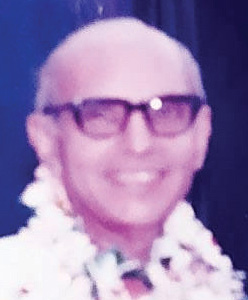
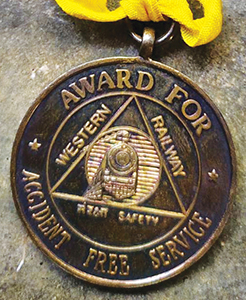
Godrej Hodiwala (left); his medal (right)
My dad Sam, his father Behramsha, and while I am not entirely sure, possibly his grandfather Dinshawji, were all proud railway men. Our immediate and extended families and their large circle of Parsi friends too had a significant chunk of the family genes invested on the BB&CI line, serving in varying capacities as drivers, guards, station masters, controllers, officers, et al. My brother and I grew up with railway terms such as DRM (divisional railway manager), loop line (curve that bends round and crosses itself) and fowling mark (where two lines cross or join one another) peppered over many an evening conversation; and yes, trains were rarely referred to by their names and mostly by their two-digit numerals with a suffix of "up” or "down” attached to them.
I would like to recall an amusing episode from my childhood years. It involves one of my dad’s beloved cousins from Surat, Godrej Hodiwala, who was a respected senior driver of the WR in the late ’80s. He was already a recipient of the silver and, a year later, a gold medal (pictured) for his accident-free service record. In those days, taking the superfast express trains from Bombay was considered impressive and he was a regular on the WR line plying the Frontiers and the Paschims. It was also considered a matter of prestige to drive an express train on its inaugural run and Godrej uncle had his fair share of those inaugurals.
It was on one such inaugural run when we met him literally "on the tracks” at Bulsar station because he was accorded the privilege of taking the 31 Down Kutch Express, on its maiden run, (then steaming in from Borivali to Navsari), when it was forced to make an unscheduled halt at Bulsar. This was because the Passengers Association was demanding a "stop” there. My dad, my brother and I with foreknowledge that he would be there to give us a quick, breezy hand wave as the train would zip past, arrived at the platform and were pleasantly surprised that we now had the luxury of meeting and chitchatting with Godrej uncle right there for over 20 minutes as the agitators held the train back to extract their promises from railway officials. At this point I remember his wry remark to my dad whilst pointing at the agitators: "Chaalo, thoda divaso maa aay Express bi khataaro thai jasé, badha stop upar thhobhiné (In a short while this Express will become a rattletrap, stopping at all stations).”
But honestly, as proud Valsadis, we weren’t willing to settle for anything less, given the fact that neighboring Navsari had the stop already [naak kapaai jasé (we will lose face)]; such was the intensity of small town competition then. Godrej uncle’s words were soon to prove prophetic because within a few years the much-heralded 31 Down resembled a local "passenger” train with a stop just about everywhere, and was an "express” train only in name.
VISTASP SAM HODIWALA
vistasphodiwala@gmail.com