Of all the eminent persons gathered at the Bombay House auditorium on September 29, 2025 for the launch of the biography of noted Tata executive and senior member of the government John Matthai, only his Parsi daughter-in-law Syloo (née Powvala) knew him personally. As she stated in the Foreword to Honest John: The Life of John Matthai: "I turned 94 last November, and I am perhaps not exaggerating when I say that I am the last person alive who knew John Matthai, or at least the last person who can claim to have known him well... It was only after I became part of the Matthai family that I got to know Daddy and Achamma, my mother-in-law, well. What really struck me was the warmth with which I was welcomed into the family. I felt as though I really belonged. An interfaith marriage in the mid-1950s could well have resulted in much friction, but I think that it was the very level of education of both our families that made things so smooth. (This) excellent biography therefore serves two objectives: It not only introduces this generation to an eminent man who I was fortunate to know very well but is also an important account of a nation in the making.”
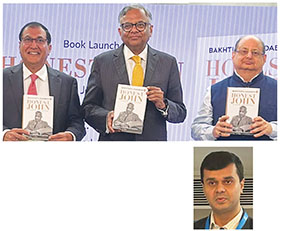
Top, from l: Vivek Matthai, N. Chandrasekaran and
Bakhtiar Dadabhoy; above: Vaibhav Kher
Syloo and Vivek Matthai, with Nawshir Khurody (seated, ext r)
N. Chandrasekaran, Tata Sons group chairman, emphasized at the evening function at the Tata headquarters, Matthai "needs to be better known…he lived an inspiring life” and worked closely with J. R. D. Tata who headed the Tata behemoth for many decades.
Matthai’s grandson Vivek had for several years "nudged” Bakhtiar Dadabhoy, an author of 10 books and a former member of the Railway Board in Delhi to write the biography of his illustrious grandfather. "Our family has had a strong connection with the Tatas from both sides. John Matthai’s Tata connection is of course common knowledge but my maternal grandfather Manek Kavashaw Powvala, too, rose to a high position in the Tatas. He was invited to join Tatas by Sir Dorab Tata in 1927. He had read economics and law at Gonville and Caius College, Cambridge.”
"JRD relied greatly on Matthai’s sagacious advice and sound judgment,” said Dadabhoy in his talk. "In the early part of his career Matthai had applied for a Tata scholarship but it went to someone else. Many years later JRD jokingly said that he would recommend him with retrospective effect!
"One can only imagine the vibrant atmosphere at Bombay House in those times. The other luminaries included Sir Homi Mody, A. D. Shroff and Sir Jehangir Ghandhy. Sir Homi, who was known for his wit, referred to Matthai as ‘Brother John.’ Mody once commented that even if Matthai said ‘Good morning’ it sounded like a papal benediction. Matthai was not, however, lacking in a sense of humor and his wit gave a sharp edge to his sense of repartee.
"The Tata lunch table was witness to some heady badinage between the two. On one occasion while having lunch they received the news that a friend had passed away. ‘Brother John,’ inquired Sir Homi, ‘what do you think you and I will be doing when we are dead?’ After removing the cigar from his mouth Matthai replied in his deep baritone, ‘Roasting, I suppose.’
"Matthai’s name has little resonance for today’s generation but he was a very famous man in his time. He has almost been forgotten by an older generation and today’s millennials and Gen Z perhaps don’t know that he ever existed.
"A man of unimpeachable and uncompromising honesty, he could not tolerate dishonesty or hypocrisy in others. Nehru called him ‘Honest John,’ a sobriquet which provides the title of the book. The viceroy, Lord Wavell, described him as the most level-headed and probably the most capable and intelligent of his ministers. Lord Mountbatten found him an ‘absolutely first-class man, balanced, reasonable and with a sense of humor.’
"Matthai eventually resigned as finance minister over differences with Nehru, ironically, over planning. When confronted with the economic chaos that accompanied a bloody Partition, his first concern was that of a practical economist who wanted to get the wheels of production moving.
"Matthai was married to Achamma who was also an achiever in her own right, having been awarded the Padma Shri for her work in the social sphere. Matthai himself was honored with the Padma Vibhushan in 1959 for his contributions to the nation, making them one of the very few couples to have both received a Padma award.”
A retired senior railway official whose last posting was on the Railway Board in Delhi, Dadabhoy had also written a biography of Tata doyen J. R. D. titled Jeh: A life of JRD Tata. At present he is penning a history of The Zoroastrian Co-operative Bank Limited. Earlier he had written The Barons of Banking.