The North American Mobeds Council has introduced an Athravan program where suitably trained and religiously qualified Zoroastrian aspirants will be initiated as priests
Text: Parinaz M. Gandhi Photos: Jasmine D. Driver
"We have always taken our religion for granted. We have always thought that born into this great religion that we are so proud of… the padshah saheb (sacred fire) will look after us. It is our duty to look after the padshah,” stated Dastur Khurshed Dastoor of Udvada after leading 16 priests in A jashan at the Bhandara Atash Kadeh on the last day of the 18th North American Zoroastrian Congress in Houston that coincided with Bahram roz, January 1, 2025.
Just as an atash behram fire is an amalgam of embers from 16 different households, furnaces and natural sources, in the same way every family should contribute financially to the sustenance of a fire temple, he urged. "One percent of our income should be dedicated to the atash kadeh. Make it compulsory. Parsis are sleeping; shake them up. Appreciate the almost honorary service given by the mobeds.” He felt the community is unduly depending on philanthropists to create and maintain religious institutions instead of contributing their mite.
Thanking the priests, volunteers and delegates who had participated in the jashan, Feroze Bhandara whose two-million dollar (Rs 13.85 crore) donation had led to the inauguration of the Houston Atash Kadeh in 2019 announced, "We want to keep the fire burning throughout.” Currently it is the only place of worship in North America to have a perpetually burning wood fire with three bois offered daily.
The morning jashan was sponsored by Yasmin and Jamshed Ghadiali. Subsequently the lunch was organized at the ZAH (Zoroastrian Association of Houston) Center, less than 100 meters away from the Atash Kadeh, when Ervad Khushrav Nariman, chairman of the Bhandara Atash Kadeh Management Committee and producer-director Nozer Buchia went from room to room seeking donations. Hoping to establish a maintenance fund of two million dollars, they succeeded in securing commitments for nearly one million (Rs 8.49 crore).
Clockwise fron top: jashan at the Bhandara Atash Kadeh; Feroze Bhandara, Dastur Khurshed Dastoor, Boman Irani,
Shernaz Bhandara (front row, 3rd to 6th from r); devotees in the hall; Atash Kadeh interior and exterior
Luncheon at the Zoroastrian Center in Houston
Pool of priests
"There are 169 mobeds… most of whom are in their golden years…and 17 mobedyars (trained men and women, who assist mobeds but are not allowed to perform inner liturgical ceremonies or weddings and navjotes) registered with the North American Mobeds Council (NAMC) of whom 43 mobeds are in Ontario, 29 in Texas and 29 in California. Most mobeds and mobedyars offer their services on a voluntary basis,” stated NAMC president and head of its Institute of Zoroastrian Studies Ervad Tehemton Mirza when moderating the session "Embrace the Future: Initiating Athravans and Consecrating Atash Kadehs in North America.”
He quoted figures from the "Gen Z and Beyond — A Survey for Every Generation,” conducted by the Shapoorji Pallonji Institute of Zoroastrian Studies at the School of Oriental and African Studies, University of London. According to the survey, 25.8% of the North American respondents were from priestly families. Assuming an estimated population of 30,000 Zoroastrians in North America, this would mean 7,740 are from mobed families. Further presuming that 50% of them are males, there should be 3,870 ostas eligible to train and practice as priests.
Keen to broaden the pool of ordained priests, NAMC has created the Athravan program, opening its doors to even those who have no mobed lineage. Currently 16 male and female candidates have signed up for this program. "It is not a replacement for navar training in India or Iran. Tailored to the needs of North American Zoroastrians, it is driven out of necessity,” clarified Mirza.
As specified on the website namcmobeds.org, a Zarthoshti descending from at least one Zoroastrian parent, having performed his/her navjote or sudreh-pushi, respected by the community, law abiding, of excellent moral character and willing to commit to the service of fellow Zoroastrians may choose to become an athravan. Suitable candidates identified by members of NAMC and Zoroastrian associations in North America "will be trained and educated on things that matter to us in North America. Priests in North America are expected to have proficiency in rituals and practices, with knowledge of Zoroastrian ceremonies, doctrines and ability to extend pastoral services, counseling, guidance on spiritual matters and deliver sermons to congregations.”
For athravan initiation, candidates will be expected to undergo two bareshnums (spiritual retreats), adhere to a certain code of conduct and ritual and physical purity, and devote time to meditation, prayers and study. Initiation facilities will be made available at the Bhandara Atash Kadeh and the upcoming Ontario Zoroastrian Community Foundation atash kadeh in Toronto.
When in need of urgent medical attention, do we specify we want a male or female doctor? Today soldiers are men and women. "Why then should we have a problem with women leading our prayers?” Mirza’s query earned a thunderous ovation. In Sasanian times, women were priests, he further reminded.
Clockwise from above l: Ervads Tehemton Mirza and Brig Behram Panthaki (retd);
members of the audience waiting to raise queries; Ervads Porus Pavri and Khushrav Nariman
It is while pursuing their respective careers and interests that most mobeds in North America make time to offer priestly service. Mirza is a certified public accountant by profession as also a recreational pilot and a marathoner. His mobed co-panelists Ervads Nariman, Brig Behram Panthaki (retd) and Porus Pavri similarly have diverse professional interests.
During his 30-year career with the Indian Army, Panthaki was deployed on difficult terrain and an appointment he most cherished was being Aide-de-Camp to Field Marshal Sam Manekshaw. He opted for early retirement from the Indian Army to join his family in the US. Since settling in the tri-state Washington area he has been committed to making the Zoroastrian faith better understood. Having spent several years at the M. F. Cama Athornan Institute that had 60 students when he joined at the age of eight years, he was proficient in prayers and the Avestan script. Panthaki further described the rigors of his navar and maratab training.
When officiating as a priest in USA, he is "strict on punctuality. Whether there are five or 50 members present, I start the ceremony.” To make the prayers meaningful for the attendees, he encourages them to join in the recitation at appropriate times thereby "refraining the audience from talking among themselves.” He has realized that "a priest’s job is demanding; it is a calling requiring a passion to serve the community.” Appreciating that behind every priest is a woman whose sacrifices need to be acknowledged, he requested the mothers/wives/girlfriends of priests to rise. There were seven in an audience of over a hundred.
"If a religion has to survive, we must change. If we don’t change, we will not survive. We need to change our thinking and adapt keeping in mind the environment we live in and the wherewithal available. Changes due to circumstances are inevitable and changes have taken place, perceptibly or imperceptibly while our belief in our faith has remained unshaken,” remarked Panthaki.
Nariman is a seasoned executive and consultant in the oil, gas and chemical industries, having worked over the years with McKinsey and Company Inc, ExxonMobil and now Aecus Inc. When he did his navar training at the Wadia Agiary in Malcolm Baug, he was required to learn 20 of the 72 has (sections of the Yasna). While he learnt the prayers he did not get to understand their meaning or the ceremonies. Only food cooked by a mobed’s wife was to be eaten by the navarias (trainees) but as a 13-year-old he noticed that milk and other supplies were being provided by non Parsis! A facility to train mobeds in North America would be "hugely helpful,” he felt.
An active member of NAMC, Pavri is an incoming sophomore and exercise science major aspiring to become a physical therapist. His commitment to community service in New York saw him raise funds for hemophilia, a genetic bleeding disorder from which he suffers. He too completed his navar from the Malcolm Baug Agiary which he considered manageable, "but a very tough experience for a sixth grader” who "when bored would count the new mosquito bites (he endured) each day!” Brought up in the US since the age of two, "as a 12-year-old I had to teach myself the prayers, piece together everything and figure out what I was doing was right, dad being busy at work.” He was primarily expected to memorize the first three has before being made a navar.
When questions were invited from the floor, there were two parallel lines of standees, not all of whom managed to reach the mike within the allocated time for the session. The interlocutors commended the initiative but some expressed their reservations: Khushru Chothia of Toronto wondered whether the Athravan program would build a religious wall between India and North America, Mirza assured, "We respect the priests in India and Iran and consult them on areas of mutual concern. On shortage of mobeds, their solution is local; so should ours be.” The Federation of Zoroastrian Associations of North America (FEZANA) ex president Homi Gandhi commented, "We have been couch potatoes. We must first run around the block before attempting to run a marathon.” This program would be particularly helpful to those holding a Pakistani passport for it is impossible to get a visa to go to India for navar training, pointed out Bhandara.
Regarding establishing an atash adarian in North America, Mirza explained that currently all Zoroastrian places of worship in North America, even the Bhandara Atash Kadeh in Houston where a fire burns constantly, have a dadgah (household) fire. To create the second grade of atash adarian fire would involve a complex and extended consecration process requiring four types of fires to be obtained, assembled, purified, amalgamated and enthroned by qualified mobeds proficient in inner liturgical ceremonies. Sustenance would require five bois in each gah. Since the Bhandara Atash Kadeh has had a continuously burning wood fire for the last five years, Mirza noted, "We have proven to the world we can do it. Enthusiasm is common; endurance is rare. Our mobeds have done their part.”
He further pointed out that even in the case of atash behrams founded in India several centuries apart, there has not been any similarity in the consecration process. Concluded Mirza, "We can either sit back and do nothing, allowing nature to take its own course or we can all rise together, unite and resolve we will not allow Zoroastrianism to become a social club devoid of mobeds. We are not passive spectators. We are descendants of warriors... believers with religious commitment for transformation. This is the moment, let’s seize it.”
Religious resurgence
Yet another session at the Congress, "Many Flames Build a Fire: Voices on Faith and Spirituality” analyzed how "the winds of change are reshaping the landscape of Zoroastrian practice in North America… With each passing year, the community grapples with the challenge of preserving ancestral heritage while embracing the imperatives of modernity and cultural adaptation.”
Moderator Panthaki explained faith as "something that cannot be proven. It may be based on religious beliefs or philosophical ideals. While faith is individualistic, religion is community driven and has created borders. Spirituality doesn’t require religious adherence.” Leaning on faith helps in times of difficulty, "gives me inner strength and perspective in life… Faith in one’s own capabilities and faith in prayers have carried me through…” He recalled a time when the health of one of his soldiers deteriorated due to high altitude sickness. Worried about him, Panthaki wrote Yatha Ahu Vairyo and put it in the soldier’s pocket assuring him he would be okay as he made the journey to the hospital. "However busy, pray you must, the what, when, where, how may differ.”
To reinforce how meaningful our prayers are and what role religion could play in anchoring a group, Panthaki likes to invite the congregation to join in prayers conducted by him and shares a translation. "Religion should be comfortable for an individual if we want to be relevant.” Panthaki reminded the gathering that the Yenghe Hatam prayer has a line "tascha, taoscha yazamaide (veneration of righteous men and women). Likewise the Satum no kardo specifies that the fravashis of righteous men and women be revered. He added that in Sasanian times women like Queen Purandokht and Queen Azarmidokht ruled Iran in 630-631 CE. "While palaces and courts have been leveled to dust, the doctrines of Zarathushtra still retain their fragrance,” noted Panthaki.
Three youngsters, Ervad Rayomand Katrak, Rozmin Irani and Ervad Burges Unwalla, joined him on the panel. Active with ZAH from a young age, Katrak was its Youth Group president and has participated in numerous muktads, jashans, navjotes and weddings. A third year resident at the Memorial Family Medicine Residency Program, Katrak stated, "As a physician I use objective data based on science, while faith that cannot be measured is the exact opposite. There is no medicine as powerful as prayer.” He admitted that during prayers backstage before performances put up by ZAH "I could feel my heart rate going down.”
He referred to religious practices having evolved or being discarded over generations. "At this Congress I have not seen a single person doing one’s kusti after going to the loo (toilet) or recite the Jamva ni baaj before a meal. Commenting on the gender disparity that continues he regretted that during prayers it is always a father’s or husband’s name that serves as a suffix and never a mother’s or wife’s name. With "high hope for the faith and community,” he referred to "an amazing youth resurgence… While a lot of us may prefer the cultural aspect, what truly binds us is religion, starting at the Sunday School.” Seeing congregational involvement in other faiths, he commented, "There is no reason why everyone cannot pray the Atash Nyaish together. Saying prayers blindly is faith but it doesn’t help us connect with the faith. We need to be proactive and live our faith with its timeless wisdom. The younger people want to live good thoughts, words and deeds. They have seen elders wearing sudreh-kusti being mean.”
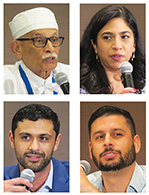
Clockwise from top l: Ervad (Brig) Behram Panthaki (retd),
Rozmin Irani, Ervads Burges Unwalla and Rayomand Katrak
An occupational therapist, Irani previously specialized in neurosciences at Vancouver Coastal Health and currently serves on the provincial Leukemia and Bone Marrow Transplant Program striving to promote holistic health despite injury, illness or disability. While supporting the Zoroastrian Society of British Columbia she has served on various committees of the Zoroastrian Youth of North America (ZYNA).
Saying daily prayers and mantras she finds "therapeutic for it helps restore a meditative state. Praying before an exam or job interview reflects a surrender to divine timing, for one’s best interests.” A congress for coreligionists provides "a sense of camaraderie with instant bonding over shared nuances, jokes, quirks.” Convinced that Zarathushtra and ancient Persia held "egalitarian, super evolved” views on the role of women in religion, she assumed that "the narrative changed during Islamic conquests… We owe it to all women to take on a leadership role.” At ZYNA retreats, she leads a humbandagi style morning prayer that has inspired other young girls to do the same in their respective associations. "We need to ensure equitable access to Zoroastrianism and its resources for men and women. We need to seek out these opportunities, rise to the occasion and reclaim our rights,” believed Irani.
Appreciating that "thanks to our ancestors’ resilience we don’t just survive but thrive,” she recommended introduction of "comprehensive educational programs that are not only religious but spiritual, ethical, moral and have the power to transform. If it is available on a digital platform it could be more accessible. Learning languages like Dari/Farsi/Gujarati could help us connect to our identity. Everybody should feel included or supported irrespective of who they marry. I am nobody to judge or come in the way of anyone wanting to practice this religion. If we cut out pettiness, more people will be inclined to strengthen ties with their community.”
Recently earning his Masters in Business Administration, Boston based Unwalla works in private equity searching for businesses to acquire and operate. Recalling his navar training in Udvada, he revealed that "December 2004 was the scariest part of my life when I was in isolation... Learning prayers and leaning on faith offered me a kind of therapy, a bedrock for my future career.” Empathetic towards women seeking parity, he felt "all men in the room deserve to be their allies.”
He was hopeful that "an institutional change will happen and the meaning of all prayers will be understood.” To bridge the Parsi /Persian practice of the Zoroastrian faith he felt an understanding of festivals like Yalda [celebrating winter solstice, being the longest and darkest night of the year, with family and friends to eat, drink and read poetry (especially Hafez) and Shahnameh until well after midnight] could unify both sides.
The concluding report on the 18NAZC will appear in the forthcoming issue of Parsiana.