Soli Sorabjee once made plans to use Bangalore’s Raj Bhavan for jazz sessions
Stanley Pinto
Soli Sorabjee was one of India’s most eminent men. A leading jurist, who almost became governor of Karnataka, except that the government at the center changed and the new one junked that idea. That was sad. I can just imagine Bangalore’s staid Raj Bhavan rocking to the sounds of American composer and pianist Duke Ellington. But I am getting ahead of my story.
I first met Sorabjee in the mid-’70s. Niranjan Jhaveri, the country’s biggest jazz fan of those times, had the idea of putting together India’s first international jazz festival. And of course he called upon Sorabjee, and me, to join him in that venture. Jazz Yatra it was called.
I was living in Calcutta, running the Lintas advertising agency there, but I came down to Bombay for our first meeting with Niru, as we knew Jhaveri. Sorabjee flew in from Delhi. Together we decided to get the jazz festival off the ground. Sorabjee agreed to use his connections with foreign embassies in Delhi to bring as many jazz greats as possible to India. Some of the greatest names in world jazz arrived — starting from 1978, it was a bonanza for the country’s jazz fans.
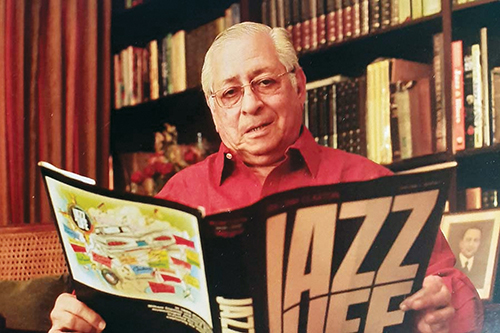
Soli Sorabjee: a true jazz fan
I had decided to hold a parallel international jazz festival in Calcutta. Bengal was then run by the Communist Party of India (Marxist). I met the chief minister Jyoti Basu, a Renaissance man in his own right, through mutual friends, sold him on the idea of an international music festival in a city that more than ever at the time needed to be written up positively in the international Press.
Basu instructed his culture minister to introduce me to the consulates of Poland, Hungary and Russia, Eastern Bloc countries that had flourishing jazz movements. I got their bands for free; the Poles brought an entire plane with three bands — a trio, a quintet and a big band — and all the sound equipment we would need for the festival, which was held on the lawns of St Paul’s Cathedral.
So I connected with Sorabjee again, got him to convince Jhaveri to swap bands with me and send me some of his for our Calcutta festival. It wasn’t easy. Jhaveri balked at sending me 10 famous bands in exchange for five unknowns from the Red countries, but Sorabjee was all for it. A true jazz fan, he was deeply interested in spreading the faith.
There were three or four Jazz Yatras and just as many Calcutta jazz festivals over the following few years. Then I went away to the Far East to run my company’s businesses in Indonesia and Malaysia. My relationship with Sorabjee receded into a speck in the rear view mirror; there was no email or WhatsApp in those days.
But when I returned to India and decided to settle in Bangalore in 1994, I met him again. He had an apartment in Bangalore not far from mine, and we met at the home of a mutual friend. That’s when our friendship really began. It was a friendship that never ended.
Sorabjee came to Bangalore every few months and we always spent evenings together in my home listening to my jazz CDs. His love for jazz had started during his school days, as had mine. Rooted as we were in what was called contemporary jazz in the 1950s, neither of us were fans of the new-fangled fusion jazz that had taken over the genre. We would listen to the greats like Miles Davis, John Coltrane, Dizzy Gillespie and Ellington.
One day, to my delight, the newspapers in Bangalore reported that the central government had decided to appoint Sorabjee as governor of Karnataka. I called him immediately, and his response was he couldn’t wait to lay hands on my collection of a thousand and more jazz CDs. When I told him that Raj Bhavan was a mere hundred yards away from my home, he characteristically started planning jazz listening sessions at the Raj Bhavan itself.
Sadly, it was not to be. The government changed; the new one didn’t want to have anything to do with Sorabjee. Bangalore’s Raj Bhavan lost its opportunity to metamorphose into a jazz club.
As Sorabjee grew older, his visits to Bangalore grew fewer and fewer. We remained in touch on email and an occasional chat over the phone. When on March 9, 2021, his 91st birthday, I called to wish him, his wife Zena asked me to keep it brief as he was growing forgetful and couldn’t keep long conversations going. He sounded tired and frail, but happy to hear from me.
That was the last time we spoke. Now he’s gone, and I look back with sad nostalgia at one of the great friendships of my 78-year-old life. Rest in peace, dear friend. I hope we will be together again one day, alongside Miles and Coltrane and Dizzy and the Duke and all those greats who brought us together over the years.
First published in the online magazine Scroll.in, this article is reproduced here with permission from the publisher and editor.