The art and antiquities collection bequeathed by Sir Ratan Tata and
his family to the Prince of Wales Museum of Western India remains
unmatched and unprecedented
Parinaz Gandhi
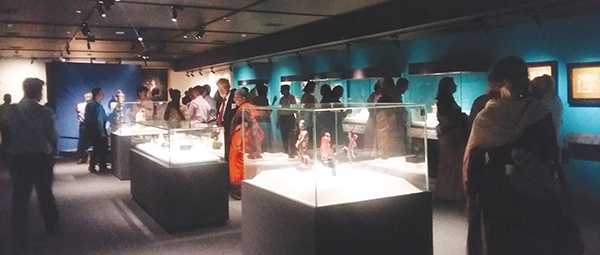
An image of a bronze statue of Sir Ratan Tata at the imposing Rotunda at the Prince of Wales Museum of Western India (now renamed Chhatrapati Shivaji Maharaj Vastu Sangrahalaya) greeted the cultural cognoscenti who had been invited to the inauguration of "An Exotic Encounter,” an exhibition highlighting 90 select non-Indian antiquities from Sir Ratan Tata Art Collection on the occasion of his death centenary.
From l, 1st row: Sabyasachi Mukherjee, Meenal and Eknath Kshirsagar,
Dattatray Padsalgikar; 2nd row: Farrokh Kavarana, Deanna and Shireen Jejeebhoy,
Devangana Desai, Bilwa Kulkarni and Shirin Bharucha
"Today, even after 96 years of the Museum’s existence, the Tata Collection still stands as the largest bequest to the Museum,” observed Sabyasachi Mukherjee, director general of the Museum, at the inauguration on September 7, 2018. "Looking at the quality, quantity and variety of this priceless collection, which in the Museum records total 5,161 objects (including 1,407 objects from Sir Dorab Tata Collection), the Tata brothers’ eclectic tastes and immense love for art are very much evident,” stated Mukherjee who had conceptualized this exhibition with the co-curators being Manisha Nene and Vandana Prapanna.
The Tata Collection at the Museum constitutes nearly one-twelfth of the Museum’s 60,000 multicultural artefacts from Asia and Europe. During the British Raj when national treasures and works of art were being sent out of India, Sir Ratan "was very clear that his collection would go back to his country,” pointed out Mukherjee.
Whilst two art galleries on the second floor of the Museum are named after Sir Dorab and Sir Ratan, numerous other pieces from their collection are in other galleries of the Museum, "silent testimony to the aesthetic sensibility and largesse of two of the most remarkable citizens of Bombay, indeed of India,” stated the director general.
"Today we are going to see a distilled collection. Sir Ratan Tata made various philanthropic contributions during his life and in death left this priceless collection,” commented Eknath Kshirsagar, chairman of the Museum’s board of trustees at the inauguration. "Our Museum would have been much, much less without this collection that was gifted with no strings attached,” appreciated the chairman. "Extending special thanks to the House of Tatas,” Kshirsagar referred to "a very large, generous contribution from Tata Consultancy Services.”
A message from Ratan Tata, the current chairman emeritus of the Tata Group whose father Naval was the adopted son of Sir Ratan and Lady Navajbai, regretted his inability to attend the function as he was out of the country but expressed his confidence that "the priceless antiquities will be much appreciated by the visitors.”
To mark the centenary occasion, Mukherjee’s 32-page booklet titled Sir Ratan Tata – A Connoisseur of Art was released on the occasion as also the 10th anniversary issue of the Museum newsletter.
In her vote of thanks, Nene paid "homage to Sir Ratan whose collection is very close to our heart… the trustees of the Tata Trust who continue to support us…Kshirsagar and Mukherjee who are always after us to take up new projects, the Tata Central Archives and their trustee T. R. Doongaji for sharing rare images and guiding us…and the contribution of our entire team who put up this exhibition in just one month.”
Rare exhibits from Sir Ratan Tata Art Collection
Non-Indian antiquities (clockwise from top l): Dharmadhatuvagishvara, gilt bronze, Nepal;
incense burner, lacquer with silver, Japan; octagonal vase with bogu motif, porcelain, Japan;
okimono of phoenix, ivory, Japan; pair of vases,
probably incense burners with gold, silver and copper gilding, Japan
Non-Indian antiquities (clockwise from top l):
Wish-granting wand, wood, lacquer and nephrite,
China; Lady on a Horseback, oil on canvas by Sir Alfred James Munnings, British School;
Chinese immortal, ivory, Japan;
Art acumen
The invitees were later directed to the Special Exhibition Gallery on the first floor of the Extension Building where they could study the exhibits with the curators and helpful guides ever ready to answer queries, explain the finer nuances of the European paintings, the Chinese and Japanese artifacts and take pride in their show stopper, the ivory Phoenix prominently placed near the entrance.
"The illustrious second son of India’s pioneering industrialist Jamsetji Tata… (Ratan) had little interest in the family business but was committed to art, archeology, science, architecture, education, health and to social and political issues… His innate business skill and acumen were evident in his collection of rare art objects sourced from different places,” stated Mukherjee’s booklet expounding on the benefactor’s persona and possessions.
"The European Painting Galleries in the Museum were actually formed from the gifts of the Tata family. The collection includes paintings of British, Italian, Dutch, French and Flemish origin from the 16th to the early 20th century… No other museum in the country can boast of a similar gallery dedicated to the history of European paintings of the period… According to Prof Richard E. Spear, ‘Ratan’s most expensive acquisition at Christie’s was a Dutch river scene… for which he paid £ 840 in 1917… In the Hope sale that year he spent 535 guineas for a portrait by Lawrence, his second most costly purchase’...
"His immense interest in travel and in diverse fields of art and archeology took him to Japan, China and many countries in South East Asia where he acquired a large number of porcelain and other decorative objects... Thanks to the Tata brothers the Museum is fortunate enough to have a collection of over a thousand objects… of Chinese or Japanese art.” Included in this section is a 19th century ivory okimono of a textile making center, three Inro (lacquer on wood, with gold lacquer, and with zodiac symbols), articulated snake (iron with russet patination and inlaid gold eyes), porcelain vase with eight dragons, an 18th century imperial jade chime, among other incense burners and objets d’art. Sir Ratan was often guided by expert opinion before acquiring any non-Indian antiquities.
Besides, his valuable collections of European paintings and Art Deco objects, the Tata Collection is equally renowned for its Indian paintings of the Deccani, Mughal, Rajasthani and Pahari traditions, Indian textiles of late 19th century and early 20th century brocades, embroideries, printed materials and Kashmir shawls, metalware from Gujarat, South India, Nepal and Tibet including Emperor Akbar’s inscribed personal armor and shield, 18th century silverware…
"In 1906, Sir Ratan bought as a residence York House in Twickenham, London, from the Duke of Orleans. He extensively renovated the house and enriched two large sky lit rooms with a number of pieces of art such as paintings, sculptures and Oriental art treasures (most of which are now in the Museum).
Naval Tata recounted a few stories about York House which he had heard from his adoptive mother Navajbai. In a letter to J. R. D. Tata dated October 26, 1987, Naval wrote, "I recall that she told me that Queen Anne of England was born in York House. My guess is that the house at the time of purchase had a number of statues and Sir Ratan further improved it. He added a little Japanese garden which I recall seeing in an old York House album. He threw numerous parties at York House which boasted of no less than 20 servants in livery.”
Sir Ratan also built Tata House in the Fort precincts in Bombay (bought over by Deutsche Bank in 1990). The architect was Frederick William Stevens of Bath who also designed the Victoria Railway Terminus about 100 m away. Tata House was about 100 m away from Esplanade House, the Tata family home. Due to a sudden illness, Sir Ratan could not use his Bombay residence for long and returned to York House.
Other facets of Sir Ratan’s life also find a mention in the booklet. His nationalist fervor made him donate Rs 1,25,000 to Gandhiji’s non-cooperation movement in South Africa in 1902 when he was little known in India. He was also supportive of freedom fighter Gopal Krishna Gokhale who acknowledged in his letter in 1909: "the deep gratitude I feel for your overwhelming generosity. There is no parallel to it anywhere in the country. I can only say that members of the (Servants of India) Society will ever cherish your name as that of their greatest benefactor.”
In 1913 Sir Ratan extended financial support towards the excavation of the third century BCE archeological site of the ancient Mauryan capital of Pataliputra (now Patna in Bihar) under the direction of eminent archeologist Dr D. B. Spooner of the Archaeological Survey of India. His philanthropies were not restricted to a particular discipline or country. His donation to the London School of Economics aided in the opening of the Department of Social Sciences and to the University of London for instituting a chair for the investigation and research into causes of destitution and poverty.
Knighted two years before his demise in 1918 at the relatively young age of 47 years, he had left a sizeable part of his fortune to a Trust named after him. In his will Sir Ratan had provided "As regards the art collection in the said Tata House and the art collection in my house in Twickenham in the county of Middlesex in England known as York House, the same shall be given after my death to the Prince of Wales Museum… and the authorities take up the same and undertake to maintain the same at their own expense by providing a separate block in respect thereof and calling it the ‘Ratan Tata Art Collection.’”
According to the Museum records, Navajbai graciously waived all her claims to the retention of the collection at Tata House during her lifetime and in fact made periodic donations of valuable and rare gifts and a further donation of Rs 15,400 for the development of the Museum.
The former director of the Museum Dr Moti Chandra is quoted in the booklet, "Had not the distinguished members of the Tata family made it a point to collect art objects from different parts of Asia and Europe, the public of Bombay would have been deprived of the benefit of seeing the arts of other countries which is very essential for liberal education and widening of international understanding, at least in the field of art.”
Commenting on a work of art in a museum, the venerable Jamsetji had once remarked, "You enjoy it even though it doesn’t belong to you. You protect it, even though it belongs to everybody.”
The exhibition will be open for public viewing until October 7, 2018. As part of its year-long commemoration, the First Centenary Commemorative Lecture will be delivered by Neil MacGregor, former director, British Museum, in February 2019.