Among the nearly 1,800 new Freemen admitted to the City of London this year was Dr Zenobia Nadirshaw, a consultant clinical psychologist. She was presented a certificate at "a simple but formal ceremony at Guildhall,” led by Murray Craig, 37th Clerk to the Chamberlain, notes a write-up forwarded to Parsiana by Zarine Commissariat. The Freedom of the City of London is granted to those who have achieved "success, recognition or celebrity in their chosen field,” as stated on Wikipedia. "The City of London is keen to maintain the Freedom as a living tradition. The Freedom is open to all who are genuinely interested and invited or born to it.”
The City Freemen are a very broad cross-section of the population. Nadirshaw was named "Inspiring Woman of the Year” at the Migrant Women Conference and Awards in 2016. With 40 years’ experience in clinical, managerial, academic and research areas in corporate planning, service provision and service delivery issues, she was head of psychology in Hertfordshire and in a number of London boroughs, notes her life profile. External examiner for postgraduate studies in clinical psychology affiliated to three universities, she is also a national assessor on behalf of the Department of Health for consultant posts, a mentor and supervisor. Having lectured widely on subjects related to mental health, disability and ethnicity, she has served as editorial board member of national journals, chair and committee member of The British Psychological Society.
International board member of the World Zoroastrian Organisation, UK, her expertise lies in assessment and formulation of stress issues, anxiety and depression in the work place, team management, new business development, business strategy and risk management, notes the introduction to Nadirshaw.
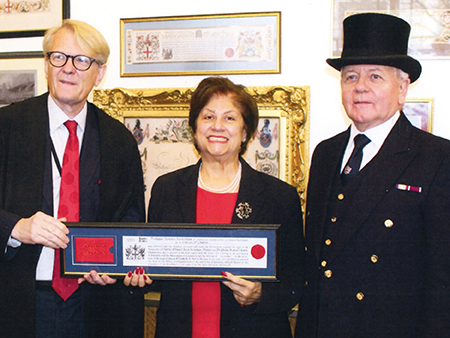

Dr Zenobia Nadirshaw (center) flanked by officials at the Chamberlain’s Court
Prior to 1996, the Freedom of the City was only open to British or Commonwealth citizens. Now, however, it has been extended globally and persons of any nationality may be admitted either through nomination or on being presented by a livery company (any of various London craft or trade associations that are descended from medieval guilds). There is a long-standing tradition of admitting women who were historically referred to as Free Sisters but are now included among Freemen.
The medieval term ‘freeman’ meant someone who was not the property of a feudal lord but enjoyed privileges such as the right to earn money and own land. Town dwellers who were protected by the charter of their town or city were often free – hence the term ‘Freedom of the City.’ In the Middle Ages and the Victorian era, ‘freedom’ implied the right to trade, enabling members of a guild or livery to carry out their trade or craft in the Square Mile. A fee or fine would be charged and in return the livery companies would ensure that the goods and services provided would be of the highest possible standards.
In 1835, the Freedom was widened to incorporate not just members of livery companies but also people living or working in the city or those with a strong London connection. Today most of the practical reasons for obtaining the Freedom of the City have disappeared. It nevertheless remains as a unique part of London’s history to which many people who have lived or worked in the city have been proud to be admitted.