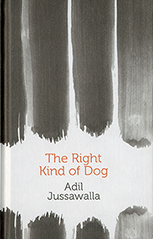
The Right Kind of Dog by Adil Jussawalla. Published in 2013 by Duckbill Books, 61, Silverline Building, Alapakkam Main Road, Maduravoyal, Madras 600095. Pp: 49. Price: Rs 200.
How wonderful it is that, after a silence of almost 35 years, Adil Jussawalla’s The Right Kind of Dog has followed fast on the heels of Trying to Say Goodbye.
Adil Jussawalla: sage advice to students
A letter to readers informs us that the collection has mainly been written keeping the young reader in mind. However, Jussawalla never talks down to these youngsters or even simplifies matters for them; in fact, he treats them in the same measure as he would his "adult” readers. He does admit that some of the poems may be difficult and puzzling for the reader but he hopes that "some puzzles, like some riddles, can be interesting.” The poems are accompanied by evocative, perceptive and charming illustrations by Ahlawat Gunjan.
The title is inspired by a line from Don McCullin’s autobiography Unreasonable Behaviour where McCullin often felt "cast out, unchosen, rather as though I was the wrong breed of dog.” And it is this feeling that Jussawalla so poignantly portrays in many of his poems. Though he does not want to critique his teachers of whom he was very fond, he admits that his school days were not the happiest period of his life; what is anathema to him is the all-pervasive system of education and the need to compete.
Competition has just got worse over the years and in "Against Competition,” Jussawalla uses the background and the imagery of a gym with motifs of body builders "pumping iron” and aiming for "perfect six-packs” and "well-turned calves.” However, the gym could also be a microcosm for student life — the competition one has to face and the consistently high standards one is forced to achieve thanks to doting but ambitious parents. He advises students to follow his example and:
"Drop your weights and glide
to a more comfortable posture
than your nearest competitor’s;
and what is most important ‘enjoy the slide.’”
Similarly in "Their Goal,” he advises readers to avoid getting "bound” to a goal. If parents have a goal in mind for their children they may ruthlessly goad them to achieve it irrespective of the children’s own likes and dislikes and this may put the youngsters "in a spot.”
"A goal, reached, can open its trapdoor
unnoticed
with nothing below it
to stop
you and your feet.”
In "The Good-for-nothing,” the protagonist, who seems to be shunned by all, cannot comprehend his situation; the only way he can cope is to press "his face against glass/ to make it look uglier.” In "Thoughts of an Eight-year-old Girl,” Jussawalla draws a sensitive portrait of a girl who is reluctant to eat and prays that "the Great Indian Family” like the "Great Indian Bustard” was close to extinction.
Not all the poems deal with children. The Right Kind of Dog has a wide variety of poems which show Jussawalla’s keen sense of observation and the imagination through which his protagonists are lifted out of the humdrum of everyday life and transported into the realm of poetry. Though "History Lesson” would seem to be an appropriate title of a poem for school children, it deals with a complex issue: Jussawalla remembers returning from England and when taking a walk on Juhu beach being horrified how the lower strata of society treat their underlings. The bhelpuriwala treats the poor like dogs: "After all that is how the English treated us!”
In "Waiting Room,” the poet draws a succinct but vivid picture of an ageing singer who, hearing the latest hit song on Radio Ceylon, remembers the thrill and the excitement before her performance. She is now "Like a gold medalist perched to dive/ but who’s lost her nerve;” and opens her mouth merely to take in "mouthfuls of air, gulp after gulp.” In "One-armed Man,” Jussawalla’s protagonist refuses to be crushed under the weight of his affliction. The umbrella in his hand is like a "leveled gun” and he wields it expertly to catch a moving bus.
"The art of poetry has a lot to do with the creation of lines that are memorable,” says Jussawalla in an interview with author/poet Jerry Pinto. Most of us have seen vases of flowers during the muktads and yet how many of us can capture this with the perception and the beauty of Jussawalla’s lines:
"…cut flowers shouting their heads off in
vases lined against a wall, see that flowering
adenium, pink and white, standing in a corner
of the great room like a punished spirit, its
swollen foot pressed like an ailing ballerina’s
in the damp soil of a flowerpot?”
"Words happen; I work on them,” writes Jussawalla in his letter to the young reader at the beginning of The Right Kind of Dog. Sometimes the words do not come easily as one sees in "Our Poets and Their Inspiration.” Jussawalla compares the writing of poetry to battering the "unopenable” door of a blank sheet of paper or typewriters beating their fists against a barricade. And when the poem is finally completed it stands in the doorway "open-mouthed, gulping fresh air/ expecting a garland/ and a ladoo” (a blank page later the poem ends with the sad line) "But nobody’s there.”
Not quite true, Mr Jussawalla…we, your fans, are all there waiting for your next collection.