Valiant Parsis in War and Peace by Marzban J. Giara. Published in 2017 by Bapsy and Marzban J. Giara, 667 Dhunmai Building, Lady Jehangir Road, Dadar, Bombay 400014; email: marzbang@gmail.com. Pp; 314. Price: Rs 700.
With a glowing foreword by Air Chief Marshal and former Chief of Air Staff of the Indian Air Force (IAF) Fali Major, Marzban Giara’s 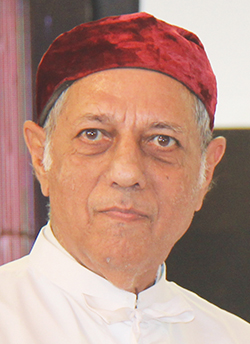 (pictured) Valiant Parsis in War and Peace, is a great addition to the documentation of bravery, valor and service of great Parsi men (and women) who served their country, albeit, under the British or under independent India. The author is by default a historian for the Parsi community. From an early age, as a boy scout he was always interested in finding out the historical aspects of everything.
This book should find a place in every Parsi and armed services home for it lists in detail the great efforts made by a minuscule community that saved not only the country but the British Empire from fascism and communism. Some may even say "they don’t make them like that anymore.” The book would be considered a success if it encourages at least some Parsi youth to join the armed forces like their forefathers did to pursue a life full of adventure and honor.
The story about the brothers-in-arms – the flying Engineer brothers (Aspy, Minoo and Jangoo) is incredible. Even my father, Behramji M. Damania who had a commercial pilot’s license No. 197 (J. R. D. Tata had License No. 1), spoke glowingly of the exploits of the Engineer brothers.
The author also gives several morsels on the Parsi contribution to the police force. A meeting convened by Sir Cawasjee Jehangir Baronet to which the Governor Sir Roger Lumley was invited, pledged the full support of Parsis towards the war effort and the meeting appointed several committees. There was even a "Parsi Battalion” which organized their annual function at the Allbless Baug on June 5, 1943! The obituaries of many Parsis who died serving in the war effort are listed towards the end of the book, and makes reading their exploits nothing short of soul stirring.
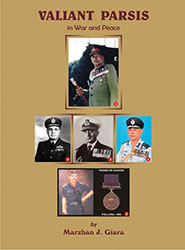 There is a comprehensive index at the end of the book from which the reader can find a name and read the accompanying write-up. The book, more importantly, also contains the various medals and honors bestowed on Parsis from World War (WW) I until almost modern times. Photos of the medals are printed in color and a short explanation on each is given.
Of course, in an undertaking of this size, some names have been missed out and the heroism of certain members of the armed forces has not been fully documented. It must have been a monumental task for the author to keep tabs on all the great men of valor and at the same time track down their photos. However, I wish he had included a photo of a very courageous Parsi IAF fighter pilot Sqn Ldr Jal Manecksha Mistry who was awarded the Vir Chakra in 1972 posthumously. Mistry and his wingman Kurumbaya were to attack the radar station at Sakesar. As the pair was about to take off Kurumbaya’s Hunter developed a problem. But despite this Mistry took off and decided to attack the radar station singly. The attack was successful but while he was flying back to base Mistry’s Hunter was intercepted by two Mirages of the Pakistan Air Force and was shot down. Mistry tried to make it back to base but finally ejected from his wounded aircraft; it was too late and he died on impact with the ground. The next day Pakistan radio announced his name as the Indian pilot who was killed. I have this information from physics professor Nariman Mistry, Jal’s older brother, who used to be my tutor and lives in Dadar. Although the Government of India still lists Jal as one of the 54 officers and men as "Missing Armed Forces Personnel” because his body was never returned to India, it is believed he died fighting.
Also, there were some Parsi men and women in the Indian army who served in non-combatant, but extremely important roles. For example: There was Col Firoze Enti who was in the Indian Army Service Corps in charge of supplies. To be effective, an army relies on wholesome and plentiful food. Then there was my aunt, Lt Col Dr Shirin Ardeshir Lal. After acquiring an MBBS degree, she enrolled in the British Army Medical Corps as a doctor during WWII. Promotions came fast during wartime. She continued to serve later at Poona and at Gwalior in the Indian Army. Although the Medical Corps does not take part in fighting, its role is very important to treat the wounded and help in their recovery. Remember, in February 1942 our own Sam Maneckshaw was grievously wounded in Assam while fighting the Japanese. He was almost given up for dead or dying but for the timely intervention of a medical doctor. He lived to become the Field Marshal of the Indian Army and lead us to victory in the Bangladesh war.
The book could have done with better editing and proofing.
Also an ISBN (International Standard Book Number) is missing which makes it difficult to find this book in regular bookstores. Dr ARDESHIR DAMANIA
Damania is Associate Research Geneticist with the Plant Sciences Department at the University of California, Davis.