It’s a fact that the mythological tales that have come down to us, were seldom written; they were passed down verbally, probably by priests or bards or grandparents from generation to generation, with additional add-ons, as they went along. I am told it’s the same fate of our two Indian epics, the Ramayana and Mahabharata. And I am sure a lot of the Zoroastrian history too is conjecture and myth. Most often no written documentation is available to verify these tales. Recently, a friend lent me a travelog In Xanadu by William Dalrymple. I am reading this interesting book, but what caught my fancy were the three pages on the Zoroastrian religion.
Dalrymple mentions about the "Fire Worshippers” who in all probability adds, Zoroastrians.
Dalrymple quotes from the Travels of Marco Polo: "He found a village there by the name Cala Ataperistan which is to say, ‘The Castle of the Fire Worshippers.’” Then Dalrymple adds, "Polo goes on to tell how the Three Magi (Three Kings) from that place arrived at the place where the child (Jesus) was born… At first the legend looks interesting but wholly mythical. But one or two of the details in the story made me think twice about dismissing it in its entirety. According to Sir Henry Yule the word ‘Magi’ used by St Matthew in his Gospel, does not actually mean wise men, as I had always assumed. The word is Persian, and so stands out in the Greek of the Gospel, as a solitary foreign word. Its meaning is specific. It is the name of the ancient Zoroastrian priestly class. The Gospel text just reads "Some Magi came to Bethlehem from the East.”
"St Matthew’s original audience would have understood that this meant a visit to Bethlehem of fire worshipping priests from Persia… I remembered depictions of the Magi that I had seen on sarcophagi in the Vatican Museum and in the mosaics of St Apollinare Nuovo in Ravenna. The Magi was shown wearing trousers, tunics and pointed felt caps — the distinctive dress of the ancient Persians. And the three Magi were shown in this very Persian dress… too.”
This is the only mention about Zoroastrianism. It would be interesting to know if all this too is a myth or is there any truth in it.
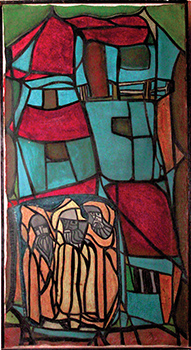
I found this very intriguing and interesting, so I wish to know whether the three Magi were really Zoroastrians? Also, I am keen to know because I have this painting hanging in my drawing room (pictured) since the last 40+ years. It is painted by my late brother-in-law, Eruch Adi Hakim, who was a very good painter and a national award winner. As the painting depicts, we have always called it "The Three Kings of Orient,” who, bearing gifts went to Bethlehem to see infant Jesus.
The editors reply
The story is mythical and there is no way to verify the authenticity of the tale.