Colonial Parsis and Law, A Cultural History. Government Research Fellowship Lectures 2009-2010 by Mitra Sharafi. Published in 2010 by the K. R. Cama Oriental Institute, 136, Bombay Samachar Marg, Bombay 400023. Pp: 98. Price: Rs 500.
Dr Mitra Sharafi’s three lectures record the abiding love affair of the Parsis with courts of law. Whether in the 1860s, or now some 150 years later, this penchant of the community for litigation remains intact. Sharafi aptly labels her lecture series as "the story of a community that has chosen the legal arena as the preferred place in which to settle key social, religious and cultural controversies.” Some may speculate that this "rush to the courts” may be characteristic of other close knit communities. It is not so, concludes the author. As a matter of fact, this pattern fails to appear in other communities like the Jews, Armenians and Boh-ras. She cites very telling statistics. Between 1900 and 1930, Parsis were parties to lawsuits in 19 percent of all reported cases, despite being only six percent of the then population. "Parsis are the life and soul of litigation,” was the appropriate comment of a Parsi law clerk in 1911.
Dr Mitra Sharafi: Parsis "rush to the courts”
After 30 years of practising law in the city, I can testify that Parsi litigants are a formidable lot. One of my first clients, a gentleman of leisure hailing from an illustrious Parsi family was disgusted when I told him to settle one of his numerous law suits. "I hate that word ‘settlement,’” he said. He was a landlord of many properties in the Fort, one of which was tenanted by an old Parsi spinster, who was being advised by a Parsi solicitor whose reputation for demolishing his opponents was legendary. When this old lady died, somewhat surprisingly, this Parsi solicitor phoned me to say that he was instructed by her legal heirs to hand back vacant possession to my client, without charging any money. My client was devastated by this loss of opportunity to litigate and match his wits with that Parsi solicitor. "How disappointing,” he told me, "We have missed a royal legal battle.”
Yet another Parsi client of mine, who was threatened with litigation by a well-known builder, smiled and told the builder: "Welcome to the club. I have 152 suits, you shall be the 153rd.” Litigation just runs in the DNA of the community.
Why did Parsis use the law so often in disputes with other Parsis? wonders the author. The reasons are not difficult to guess. Absence of any central authority in the community, unlike the Syedna of the Bohras. Inferior social status of priests, unlike Roman Catholics. No alternative arbiters of community disputes, and hence the frequent recourse to courts. Also perhaps, the absence of any stigma attached to dragging your fellow community members to court, what Sharafi terms as "washing your dirty laundry in public.”
Nevertheless, Sharafi is somewhat surprised that while highly sensitive religious disputes were taken to court instead of being internally resolved, commercial disputes between Parsis were settled informally and "out of court.” Which priest had the power to decide when an internal door in the Iranshah fire temple at Udvada would be shut or which family in Hyderabad was entitled to keep the keys to the dakhma, were bitterly fought in the courts.
Sharafi’s research further establishes that totally disproportionate to their number, the Parsis have contributed heavily to the legal profession as lawyers, judges, registrars, law clerks, translators, receivers and other high officials. In the early 20th century, 50 percent of all Bombay lawyers and 10 percent of all Bombay judges, were Parsis. This disproportionate contribution to the legal world continues, even though on a reduced scale.
Rangoon fire temple (1930-40s); (right): Jamshed Jeejeebhoy of Burma
Her first lecture on Parsi legal history shows that most suits by so-called "elite” Parsis were about inheritance, libel and religious trusts, while the "non-elite” Parsis, as Sharafi calls them, sued each other in the Parsi Matrimonial Court and the police courts for adultery or assault or in the Small Causes Court for debt or tenancy related disputes.
Parsi judges, in those early days, were largely orthodox in their religious views. The first Parsi High Court judge, Justice Dinshaw Davar, of the famous Davar-Beaman case or Petit vs Jeejeebhoy, was quite conservative. His religious views shaped the ruling against accepting the French Suzanne Tata into the Zoroastrian faith, concludes the author. A then leading solicitor, J. J. Vimadalal, was "responsible behind the scenes” for egging on Davar to give an anti-conversion ruling in this case, says Sharafi. On the face of it, Davar and Justice Frank Beaman held that Zoroastrianism not only permits but enjoins conversion, which seems to negate Sharafi’s theory. However, rather cleverly, the judges seem to sigh that they are helpless to permit Tata an entry, as there was not a single instance of conversion, after the arrival of Parsis in India. The personal predilections and religious leanings of Parsi judges were reflected in the judgments of yesteryears concerning Parsi socioreligious controversies. Sadly for the liberals, had there been a British judge instead of Davar, Petit vs Jeejeebhoy perhaps could have swung the other way. Subsequently, Davar was about to go to Rangoon to testify against Bella, as an expert witness, but died before he could do so. This reinforces Sharafi’s claim that Davar was palpably prejudiced.
In the 1830s, Parsis lobbied hard and managed to get the Parsi Intestate Succession Act passed. This abolished the rule of primogeniture (a rule under which the eldest son inherits all of his father’s immovable property), as also the first Parsi Marriage and Divorce Act.
The often made statement that the Parsis were the favorites of the British is borne out by the author who states that "enormous special privileges were granted to the Parsi community, which no other south Asian community enjoyed then.” One instance was that a jury made entirely of Parsis would decide matrimonial disputes. This system, in a somewhat truncated manner, survives to this day. Even though the jury system was abolished throughout India in 1964, the Parsi Matrimonial Court continues to have a kind of quasi-jury in the form of elected delegates, who assist the judge.
Bella, whose entry into the Rangoon fire temple raised a storm in the community
Sharafi’s second lecture on Parsi matrimonial and gender issues is more fascinating. Even though Parsi women were held up as "the most progressive and liberated of South Asian women,” they had to wage an uphill battle to obtain equal rights. The 1865 Act banned polygamy and the 1936 Act created a level playing field between husbands and wives, so far as grounds of divorce were concerned. Her statistics are revealing. In the 1850s, there were at least 26 cases of polygamy among the Parsis of Bombay. In 16 of these 26 cases, married men took a second wife but in the remaining 10, married women took a second husband. People perhaps became "technical” polygamists as it was hard then to obtain a divorce from the original spouse.
Child marriage was another issue which bitterly divided the community. In those days, if parents of a Parsi child promised the parents of another Parsi child that their children would marry, it was a criminal offence to commit breach of such promise. I recall my grandmother, who was born in the early 1890s, telling me that she was married, when six months old, to my grandfather, her first cousin, who was then 10 years old, and that this was one of the last child marriages in Navsari which was then ruled by Maharaja Sayajirao Gaekwad.
The 1865 Act made polygamy a crime but child marriages, though frowned upon, merrily continued long after.
Sharafi’s research throws light on several areas hitherto unknown to the community. For instance, until as late as 1936, sexual relations by a Parsi with a prostitute did not amount to adultery under the law. In other words, a wife could not obtain a divorce on this ground. In 1923, Prof A. R. Wadia argued that through venereal disease this "prostitute exception” in the law was damaging the purity of the Parsi "eugenic” stock, and that the exception should be eliminated. Almost 100 years later, some Parsi scholars speak the same language as Prof Wadia.
During the 1930s, there were interesting debates among Parsi legal scholars as to how much domestic violence was normal and acceptable. Sharafi cites an 1898 Parsi Chief Matrimonial Court decision which had established the concept of what constituted "reasonable” marital violence: striking one’s wife three times with a cane was fine, but threatening her with a knife was not. Unbelievable though it may sound, even after the passage of the 1936 Act, a husband causing a fracture or dislocation of a bone or tooth or causing severe bodily pain to his wife which did not disable her for more than 20 days was not considered "grievous hurt” and, therefore, was not a ground for divorce for the battered wife.
Left: former Chief Court of Lower Burma where Bella’s case was heard; Punch lampoon about legal costs
Sharafi’s third and final lecture is a very original account of the famous Bella vs Saklat or the so-called Rangoon Navjote Case. Her research has been extensive and Sharafi even travelled to Rangoon and interviewed Parsi families which had migrated from Burma. Some of her conclusions are startlingly unique. She is convinced that Bella’s biological father was a Parsi and there is strong evidence to suggest that even her biological mother was, in all probability, a Parsi. If this fact had been established, the famous case would have never taken place. The author has traced the family history of Bella. She was adopted by her biological father’s brother and his wife after losing her mother soon after birth. The Rangoon priest refused to conduct her navjote, so a High Priest from Poona came to Rangoon and performed the ceremony, despite severe opposition from the orthodox. However, Bella’s entry into the Rangoon fire temple raised a storm and her own biological uncle sued her biological father and adopted father (the former’s brothers). Bella won, on some technical ground, in the lower courts but ultimately lost in the Privy Council at London, which established the paternity principle, namely, if your father was a Parsi, you were a Parsi, irrespective of your mother’s religion. Before the Privy Council judgment, Bella had married a Parsi. However, she took the Privy Council judgment against her quite badly. Sharafi narrates that she secluded herself, chain smoked and died in her mid-thirties, denied, of course, the so-called privilege of being buried in the Rangoon Parsi cemetery, which was then duly bombed, along with the Rangoon Agiary, by the Japanese during World War II.
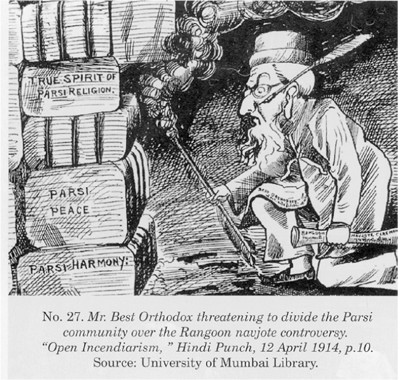
Hindi Punch cartoon of 1914 showing divisive role of the orthodox
Sharafi rightly concludes that even more than Petit vs Jeejeebhoy, Bella vs Saklat is the most authoritative case which answers the question: Who is a Parsi?
Sharafi’s approach is that of an "outsider” and, therefore, more dispassionate. The fine legal historian that she is, Sharafi does not display personal bias or pass any value judgement in any of her lectures. This makes her narration more absorbing and authentic. She is in the process of writing further on Parsi legal history and her contribution will be eagerly awaited by a grateful community.
Sharafi’s lectures will be read with equal interest by lawyers and laypersons. There is no legalese anywhere and her style makes for easy reading. While child marriages and polygamy have indeed been banished, the same obsession with racial purity and racial prejudice, the same trigger happy attitude to litigation and the same paternity principle, very much continue even today, more than 150 years later.
BERJIS DESAI