The World Zarathushti Chamber of Commerce awardees respond at the ceremony in Bombay
Arnavaz S. Mama
"Entrepreneurship is like a medical drug. There are huge benefits, but also side effects. There is immense satisfaction that something useful has been created from an idea. But it is a hard road; if anything can go wrong, it will.”
Viraf Kapadia of Canada, who says he and his wife Poruchisty worked 16 hours a day, seven days a week to establish Star Navigation in 2002 whose technology is now being copied by Boeing and Airbus, was responding to the award of Outstanding Zarathushti Entrepreneur of 2006 by the World Zarathushti Chamber of Commerce (WZCC) at a glittering function at Bombay’s West End Hotel on January 6, 2007. The annual presentation ceremony coincides with the WZCC annual general meeting held in different parts of the world. This year the selection process had been undertaken by Filly Madon and his team in Sydney, represented at the ceremony by Aban Bana.
The evening’s other awardees were: Dr Sam Kerr, a surgeon in Australia, who won as the Outstanding Zarathushti Professional of the year for having developed a unique drainage tube for the ear and for pioneering Head and Neck Cancer Surgery departments in hospitals in Sydney; and Nawaz Kotwal, Young Zarathushti Professional/Entrepreneur, for her uphill work in the preservation and promotion of social justice in Gujarat in the wake of communal carnage in 2002. She had received the first Nani A. Palkhivala Memorial Award for the Preservation of Civil Liberties in India in January 2006 (see "The system is a mess,” Parsiana, March 7, 2006).
(L to R): Kersi Limathwala, Zarine Commissariat, Edul Daver, Pallon Mistry, Rohinton Rivetna, Minoo Shroff and Alayar Dabestani
The WZCC convention to name a senior Zoroastrian entrepreneur/professional as Honorary Member led to Karachi hotelier, diplomat and sportsman Byram Avari becoming the seventh distinguished Zoroastrian to grace the board. Bringing their values of integrity and industry to light the way for others to follow, "we look to them to give us new, wider horizons to aim for,” noted WZCC founder president Rohinton Rivetna of Chicago. The three earlier Honorary Members present that evening were Iranian businessman Alayar Dabestani whose cinemas in North America screen many an Indian film, management guru and Bombay Parsi Punchayet chairman Minoo Shroff and the head of the Shapoorji Pallonji group Pallon Mistry whose civil constructions in the Middle East have scorched a new imprint for Zoroastrian and Indian capability. Absent that evening were Nadir Godrej, chairman and managing director of Godrej Industries Limited, the WZCC’s first Honorary Member who had launched the body with his inimitable penchant for rhyme at the Seventh World Zoroastrian Congress in Houston in 2000; famed jurist and Rajya Sabha member Fali Nariman (2003) who was the inspiration behind the WZCC code of ethics, as noted Rivetna, and London’s Karan Bilimoria, creator of Cobra Beer (2005), co-chair of the Indo-British Partnership who has since become the first Zoroastrian to be raised to the British peerage as Lord Bilimoria of Chelsea.
Responding to the glowing citation, read by WZCC-India secretary Zarine Commissariat, which depicted the Avari Group as one of the 20 top companies of Pakistan and the first to operate internationally, Avari, Honorary Consul for Canada in Karachi, member of parliament who has represented his country at the United Nations General Assembly, champion sailor and music buff (see also "The hospitable hotelier,” Parsiana, January 21, 2007) invited the WZCC to hold its next AGM at his hotel in Karachi. He promised to accommodate all the delegates as well as help with low cost air fares and visas, though Indian applications would need at least two months to clear.
Called upon for a "word of advice,” the reticent Mistry, who described himself as a NRI for 20 years, noted, "There is no place in the world better for investment (currently) than India. Young Zoroastrians have a chance to create fortunes for themselves.” Shroff spoke of his role as facilitator being "one of the more thrilling activities in (his) public life.” Dabestani, settled in the US over 35 years, used the occasion to give fulsome praise to three motivators: his own father, the late Jamshed Pavri of Vancouver and Rivetna. But he had a special word of thanks for Indian Zoroastrians: "Because your forefathers made the best investment in sending Maneckji Limji Hataria to Iran. He not only worked to abolish the Jazia (annual tax the Zoroastrian community was required to pay for each of its members to be able to continue practicing the religion) but set up schools for us. I am a graduate of such a school in Sharifabad. We Iranians believe we owe a great deal to the Parsis and hope someday we can repay the debt. The world of commerce, of business has great opportunities for accomplishment. If I can go to the US with $ 200 and make it work, anybody can accomplish the biggest dream that he may have…”
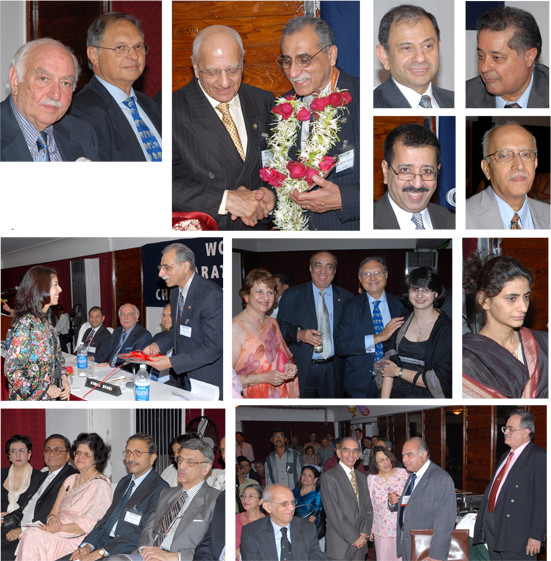
Top (L to R): Mistry and Byram Avari. Alongside: Shroff and Rivetna. Top row, at right: Daver and Dabestani. Second row: Viraf Kapadia and Sam Kerr ; Middle row: Shernaaz Engineer, editor of WZCC-AGM Souvenir, and Rivetna; Goshpi Avari, Kobad Zarolia, B. Avari and Zeena Aga; Nawaz Kotwal. Bottom row: Natalie Wania, Rusi Gandhi, Roshan Rivetna, Farrokh Rustamji and Bomy Boyce; Minoo Mody (seated), Hector and Daisy Mehta, Firdosh Mehta and Zarir Bhathena
Acknowledging his heritage Avari noted simply, "I am what my parents made me.” He spoke with feeling of father Dinshaw’s rise and rise from his growing years in the Petit Orphanage, teaching children there while studying for his BCom to justify his board and lodging, getting a break into Sunlife Insurance where his long hours of work paid off — to the organization’s surprise he sold insurance policies at night, plying his clients with cups of tea, becoming "the highest selling insurance agent in eight months” — until in Karachi he rose to be its highest Indian executive. He had reached the glass ceiling. So Dinshaw collected Rs 50,000 from family and friends, borrowed Rs 50,000 more from banks and bought over the Beach Luxury Hotel from its Jewish owner who wanted to leave India. But the owner of "the first English hotel to be run by an Indian” had to accept stringent conditions: He could charge no more than four rupees for a single room and five for a double and he had to agree to house the Provost Marshal at one rupee a day which included a daily bottle of scotch! Dinshaw and Khorshed accepted all the conditions gamely, doing their own marketing, providing satisfaction to the best of their ability. "My father and mother used to get so tired at the end of the day, they used to shove the money into a cupboard and a friend used to come the next day to count it!” recalled Avari.
But what the honored guest was keen to emphasize is his parents’ injunction: "Do not forget that we come from the poor.” Dinshaw had also written in his son’s autograph book in 1952 which Byram shared with the audience: "Don’t wait for opportunity. Make it happen like Napoleon did on a 100 important occasions. There is a tide in the affairs of men which, taken at the flood, leads on to fortune.”
It has been Avari’s theme that Parsis are so acceptable world wide that job security is making the community lethargic. "We are losing our sense of adventure, refusing to take risks… Discover the meaning of profit,” he told the audience, "it is to make others happy.” The community trusts now catering to a depleting population, can support "venture or adventure,” according to him. He counseled them to export to Pakistan, "a virgin market. Every dollar earns Rs 45-48 here. Pakistan is now open. Get in there first…To sit at home and say ‘Ahura Mazda chhé (Ahura Mazda is there),’ is not going to work…Genius will not work, education will not. There is nothing more common than unsuccessful men with talent. Persistence alone pays…”
But there was also a softer side to his message. Invoking the blessings of his late parents Avari also spoke of love, affection, vibrations: "I believe the tone of voice when you communicate makes a lot of difference – the tone reveals the state of the heart…If you help someone with the expectation of return, you’ll be hurt. Lend money, but don’t expect it back. Do it from your heart. Humility, not arrogance, wins the day,” he noted, narrating an occasion when in a sailing regatta he was so sanguine he’d win because he was barely 15 feet from the finishing line, he felt he was entitled to sit back and relax. An unexpected roll capsized the boat. Avari lost.
The address, peppered with anecdotes, had a particularly telling story. A poor member of the hotel staff who had exhausted his leave had had to rush home when his mother died. Byram and his manager denied him wages for the extra days lost. It was the rule, they told Avari Sr when he questioned them. His humanity intact, Dinshaw chided them "Who made the rule? You made the rule. You change it!”
In a final admission of human vulnerability Avari noted, "Sitting at my desk, I pray Yatha and Ashem. The strong vibrations make everything work!”
Kerr described himself as a person "with little business acumen and not much knowledge.” But one who grew up closely observing his father whose "entrepreneurship and philosophy were legendary.” A destitute from Surat who came to Bombay with barely a few paise in his pocket, Kerrawalla Sr was to spend a few years doing menial jobs but remained highly motivated and observant. He found his métier when he was able to take over a tottering biscuit factory, recalled his son.
Schooling in Nasik, obtaining his MBBS from Indore, Sam Kerrawalla joined the Jerbai Wadia Hospital for Children where he learnt the fine art of surgery from the renowned Dr Rustom Cooper. After working at the B. D. Petit Parsee General Hospital and Sir J. J. Hospital he went on to the Great Ormond Street Hospital for Sick Children in the UK, the University of New South Wales Hospital in Australia and liaised with the Sloan-Kettering Memorial Cancer Center in New York, the University College Hospitals in San Francisco and the Howard House Ear Institute in Los Angeles, earning his FRACS (Fellow of the Royal Australian College of Surgeons) from Perth, as notes the citation published in the WZCC AGM-2006 souvenir.
Adopting the first four letters of his family name, Kerr recalls that when he went to Australia the country did not recognize Asians: "There were no referrals, no contacts, no Indians except in the consulate. There were three Zarathushti families in Sydney, of which two were from Iran.” So Kerr says he gave his services to the neglected poor and aged cancer patients. Eventually his work was appreciated by like-minded surgeons. Now, after "38 years of work and play in Australia,” Kerr, an amateur numismatist and community historian, said the "award symbolizes recognition of the Zoroastrian moral code and traditional Aryan integrity.”
Earning his bread and butter as a cashier-cum-clerk at the Union Bank of India while working for his advanced accounting and auditing degree, Kapadia did a stint with Godrej before moving to England in 1973. There he worked with various firms, proceeding to the UAE to join Finexco Consultants, providing financial and tax advice, until he set up for himself, building up his own practice which included forensic accounting – now carried on by his chartered accountant son.
It was when he started Star Navigation System Group in 2002 that Kapadia moved decisively from professional to technological entrepreneur. Star developed the In-Flight Safety Monitoring System – the first in the world to convey data and diagnostics between the aircraft and ground control through satellite transmission. It is a navigation system that informs both the pilot and the ground of what is going wrong, as it happens, notes the citation. Tested and patented and certified in various countries, the product was dubbed the "Mother of Invention” by a Canadian newspaper, notes the citation. Referring to the Zoroastrian tradition "to contribute to whichever country we call home,” Kapadia emphasized the need to "meet whatever task is assigned to us. Our ability to turn an idea, concept or opportunity into a business has ensured that our children are well educated.”
The reverse of the entrepreneurship coin is the need to take action that can be heart wrenching, said Kapadia, admitting he had to fire the president of his company who was a friend, in the interests of shareholders and employees. "The entrepreneur faces financial constraints, is unable to take time off, contributes to stress within the family unit.” The venture that began with 20 employees with the support of friends and family has been a success. "When I started the company, I didn’t know who to go to for support, get information and funding approval. Now Boeing and Airbus are trying to copy us.” Addicted to the high adrenalin of a startup company, Kapadia sees himself passing on to other ventures. "I am an innovator. An innovator likes challenges.” He also wants to be a part of the group funding young entrepreneurs for, "we wouldn’t be here but for the Tatas, Avaris, Pallonjis. We must encourage our children to read history,” he noted, making a spontaneous donation of Can $ 500 to Kotwal’s work.
Though she said she was "intimidated by all the luminaries here,” Kotwal challenged the India Incorporated’s euphoria about the country’s high economic growth: "More than 35 percent of Indians live below the poverty line. Till we address that, we shouldn’t be proud that India will rival China in the next few years.” Recalling her shock at the state and police complicity in the Gujarat carnage when she went there in 2002 as representative of the Commonwealth Human Rights Initiative (CHRI), she and her colleagues set about getting people to camps and hospitals "in an atmosphere where everyone was against the (Muslim) community…There were obstacles, threats and inducements going on while we tried for access to justice. People who had killed were living in the same locality as the victims – a single person had lost 17 family members. All of us felt that lasting peace can only come from justice, so we picked 10 cases for trial through the courts.” Kotwal recounted the efforts to bring the warring communities together, the paralegal training she set up for the benefit of Hindus, Muslims, Adivasis, Dalits, women. "We had to teach them that whatever they got from government was entitlement, not charity…When conviction came, the look on the victims’ faces made all the threats to life, verbal taunts, emotional drain worthwhile.”
Reiterating her gratitude for the support of her parents Aban and Tehmurasp, sister Roshni and CHRI director Maja Daruwala, Kotwal, her eyes brimming, ended with a spirited appeal to the "luminaries” who gave her a standing ovation: "I am very proud to be a Parsi, to be respected as sincere and honest. But please look beyond the Parsi community. There is so much injustice, poverty, inequality in need of redress. Wherever we go we are respected, people listen to us. It would be the greatest realization of our Parsi commitment.”