A young Bombay based entrepreneur is working
towards making spaces accessible for those with special needs
Farrokh Jijina
"I strongly believe that all faiths should make their places of worship and social spaces accessible for people irrespective of their physical or mental limitations,” states product designer and consultant ergonomist Rashna Engineer. Her proprietorship venture, Include, a social oriented venture ("for profit” she hastens to add) was set up "to design, develop and market products that would allow easy accessibility for people with physical limitations.” She refers to some of Bombay’s fire temples that are not accessible for community members using wheel chairs, either due to steep or narrow staircases, for want of a ramp. When asked how she would make a disabled resident living on the third floor of a building in a Parsi colony more mobile, she thinks for a moment. "Very difficult, unless one constructs a lift,” she says. Electronic moveable chairs would be expensive for trusts, and "anyway there needs to be space on the landings between floors, for maneuverability, which is not there!”
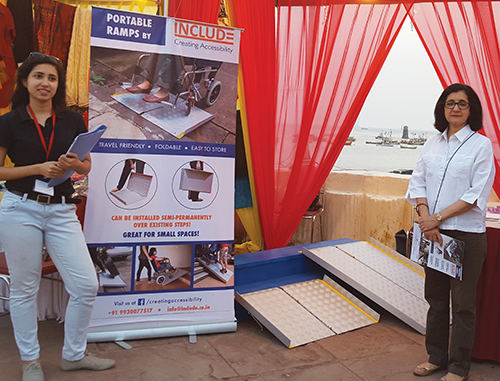
Rashna (l) and mother Shernaz at an exhibition
Include’s ramp at a shop in South Bombay;
six-step ramp at Jamshed Bhabha Theatre
Approached in the past to make ramps for fire temples by wheelchair users who wish to use the premises, she mentions that these projects "are not taken ahead speedily, or given the time and attention they require by the management.” Over tea at a South Bombay club on December 29, 2016, the 27-year-old entrepreneur tells Parsiana that "with our large aging population, it is important for us to focus on making our community spaces like baugs and fire temples much more inclusive.”
"Social inclusion for differently abled people is challenging and, sometimes even impossible, in our country,” says Engineer. Lack of social inclusion "can cause a negative psychological influence on such humans ...they are lonelier than they should be.” Differently abled people would include, besides those with mental or physical impairment, pregnant women, the geriatric population, infants and toddlers, according to the ergonomist.
Include is a design studio and consultancy for products such as ramps, walking sticks and similar products as well as infrastructure that would help ease the difficulties of the differently abled, she informs us. The gamut of products she can source, design and sell are "in the area of healthcare, rehabilitation, daily living aids, geriatric aids, mobility, bed and bath care and public space accessibility.” The entrepreneur acts as a consultant "to make spaces comply with standards and policies for the differently abled,” she amplifies.
Over the last year, the firm has concentrated on the development of its first product line — portable and custom made ramps. Include has standard ramp designs in different sizes and also customizes designs as per the clients’ infrastructure. To assess a client’s needs, she sends them a chart that helps them take the dimensions of their space and asks them to send her photographs. "I then advise them a design, be it the standard one or a customized one. A ramp can take between two to four weeks to fabricate. A two-foot ramp covering one step costs approximately Rs 8,000 whereas one for two steps sells for Rs 14,000. Include’s products are also available on amazon.com. (Engineer can be emailed at
info@include.co.in) "I work closely with my two fabricators in Bombay, ensuring they are well informed about the product and its needs. I also visit the workshops frequently if my designs are in production, to ensure quality control,” she notes. Besides ramps, a small portion of the firm’s income comes from resale of Braille signages; however, "due to lack of product acceptance, not enough social understanding of the product, and less marketing effort from our side,” these comprise a minuscule part of the sales.
The firm received a micro grant from the Massachusetts Institute of Technology under their International Design Initiative Network for USD 1,900 to aid in the prototyping of new designs. The funds were utilized to develop a ramp that can be used on five or more steps. "We implemented this design for the backstage of the Jamshed Bhabha Theatre (at The National Centre for the Performing Arts), to make the stage accessible,” she exults. The designer is working on a range of walking sticks which will be produced in a combination of wood and metal "to make them more visually appealing.”
The businesswoman in Engineer sees great scope in the market for disabled-friendly products. "Nearly 27 million people were termed ‘disabled’ in the Census of India: Data on Disability 2011,” she informs. "I have realized that awareness about accessibility and disability rights among the urban population, educated or illiterate, is low,” she smiles.
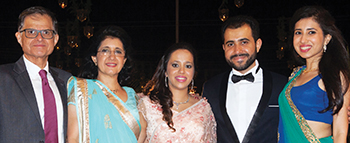
From left: Behram, Shernaz, Zainab, Feroze and Rashna Engineer
Human factors
An alumna of the Srishti School of Art, Design and Technology, Bangalore, where she completed her four-and-a-half-year professional diploma, Engineer specialized in furniture and product design. As part of my "undergraduate project with Godrej Interio Healthcare, I helped research and design hospital room furniture, specifically, Chrysalis, their range of high end hospital beds.” At Vissco Rehabilitation Aids, Bombay-based suppliers of orthopedic products, where she worked after her graduation, she helped research and market some of their products in the foot-care space.
Searching for answers such as, did merely giving an elderly person a walking stick actually aid them in stepping out and walking on our roads or through traffic, the young graduate felt, "There were a lot of infrastructural issues at play which I wanted to be strong in, academically.” This led her to take up a one-year course at Loughborough University in the UK "as it is one of the most renowned for ergonomics and human centric design and research.” She saw firsthand how, "even in a little town like Loughborough, amazing infrastructure allowed its citizens with disabilities to be socially inclusive.”
Armed with a specialization in Human Factors ("the term is used interchangeably with ergonomics”), in the current semester, she will teach the subject as a visiting faculty member at Indian School of Design and Innovation in Bombay. Clear about what she wants to do three years hence, she sees three clear divisions in Include: one that focuses only on products, a research and design division, and one that provides consultancy for public spaces.
Engineer’s list of 35 clients, built up since she set off in the business in 2015 includes Happy Home and School for the Blind, the Willingdon and Radio Clubs and Bombay International School. She has also provided consultancy to Ahura Support which was in the process of setting up a residential facility for the differently abled at Masina Hospital. "I worked in conjunction with the management and architect to provide a report giving recommendations for good ergonomics and safety,” she shares.
"Zoroastrianism is a beautiful faith. I am proud to have such a rich cultural heritage,” states the businesswoman who adds she does "not wear the sudreh and kusti most of the time.” Ambivalent towards interfaith marriages, she states: "It is an individual decision… I cannot be judgmental about it.” Her father Behram, a chartered accountant, retired in November 2016 from his position as secretary of the Royal Western India Turf Club while mother Shernaz is a French teacher. Brother Feroze is a marketing executive, working in London.
The young entrepreneur is skeptical that the Disability Bill introduced in Parliament in December 2016 (with the addition of more categories like cerebral palsy, hemophilia and autism to the definition of disabilities) will make a difference at the grass roots level: "Implementation is very slow in our country, which is why I prefer to keep Include away from the government sector.”