The Indian National Kennel Club
assists dog lovers on how to look
after and care for their pooches
Sherene Vakil
"Being with dogs keeps me active,” says 86-year-old Ratty Javeri, honorary secretary of The Indian National Kennel Club (INKC) founded by her father Jehangir Daruvala in 1957. She has been secretary since the Club’s inception. "The purpose of the INKC was to promote purebred dogs through championship shows and thus encourage the breeding of sound dogs. In the 1950s, very few people had any knowledge or access to quality, purebred dogs,” says daughter, veterinarian Dr Freya Javeri Kharawala, now based in Ahmedabad where she resides with her husband Lochen, a consultant for pet product distributors and an animal behaviorist. "Mummy has been most active in spreading knowledge and promoting the ethical breeding of well-bred dogs and to ignite in Indians a true love of dogs. Always supported by Daddy (architect and dog lover Phiroze Javeri), between them they have an abundance of experience and knowledge which has taught and encouraged generations of dog enthusiasts in India. Thanks to their efforts, the number of well-bred dogs in INKC soared while other clubs have been promoting puppy mills and farms.” Fully supportive of Ratty’s involvement, both father and daughter play vital roles in the INKC.
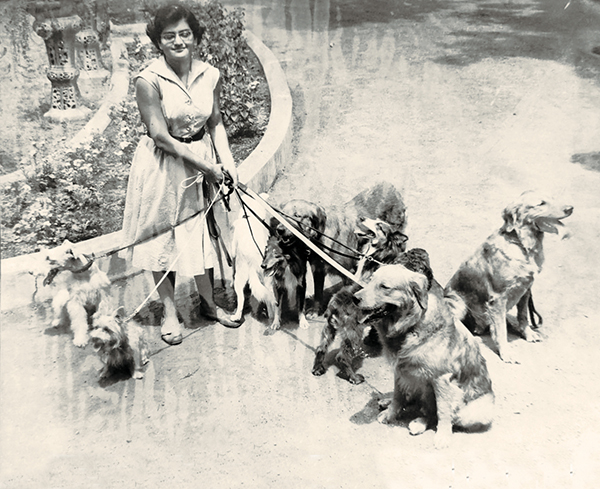
Ratty Javeri conducting a training class for dogs at Adenwala Baug
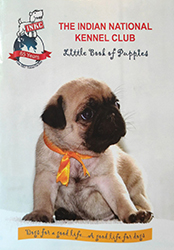
"Dogs for a good life; A good life for dogs” is the motto of the INKC. Its main aim is to spread the love of dogs which is beneficial to human society. Having a dog as a companion helps people relate to nature, and children need to be exposed to dogs at an early age, the Javeris believe. The Club helps dog lovers learn how to rear and train puppies and offers free advice to anyone who intends to acquire a dog. INKC was the first to invite foreign trainers to India, revolutionizing the manner in which training was imparted. It also organizes workshops and seminars to spread the latest knowledge on the subject.
With palpable excitement Phiroze, an avid reader and collector of books, pulled out an old tome of The German Shepherd Dog by V. Stephanitz, a seminal work on the breed, translated from German, to show us. The opening chapter has a reference to the important place occupied by the dog in ancient Persia: "Together with the cock and fire, the dog had become the dispeller of evil spirits and of magic, the vanquisher of the enemy, the dark and evil of the night, and thus a greatly valued companion. ‘His voice destroyed the evil,’ says the Bundehesh, the ancient Persian tale on the origin of creation, when speaking of the dog. The Vendidad already distinguishes between the most valued shepherd dogs — more probably the herdman’s dogs — the watch or yard dogs and finally the bloodhounds which were kept exclusively for personal protection.”
Dog shows serve as a barometer to gauge the standard of breeding of pure bred dogs, mentions a booklet published by the Club on its 50th anniversary in 2007. Such authoritative evaluation of a cross-section of the specimens of all breeds is essential to ensure breeds as they should be. Shows also prove to be educative for the uninitiated as they showcase the world of purebred dogs. They are occasions when exhibitors meet, fraternize and exchange notes with fellow dog owners. Eschewing unhealthy competitiveness, INKC believes that fair and healthy competition is the name of the game. Notable among the VIPs who attended/inaugurated shows were former Prime Minister Indira Gandhi along with her sons Rajiv and Sanjay, erstwhile President Fakhruddin Ali Ahmed and his wife Abida Begum.
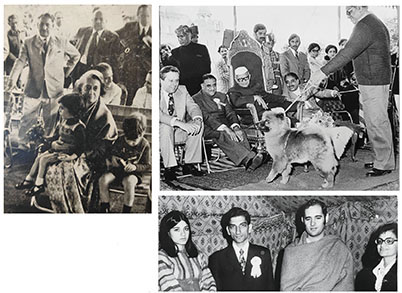
At INKC dog shows, clockwise from top l: Indira Gandhi with grandchildren;
Fakhruddin Ali Ahmed, 3rd from l; Ratty, Sanjay Gandhi, Phiroze Javeri, Maneka Gandhi
Ratty and Mahipendra Singh with show winners
Young Ratty and Phiroze with Pomeranians
In addition to the Dog of the Year trophy which INKC awards, a Breeder of the Year prize is given to encourage knowledgeable and responsible breeders, thereby countering the import of expensive dogs by the wealthy merely to win awards. "Unfortunately, people encourage breeders who do not maintain pedigree records or standards. They pay large sums for unregistered dogs without registration papers,” rues Ratty. Also, "nongovernmental organizations that look after stray dogs often promote their rescued animals for adoption by debunking pure breeds.” she regrets. "But conscientious and reputable breeders take care of good pedigrees.” Their own breeder name is Darbaxco.
"The early 2000s saw a boom in pet ownership and pet products, many of them being imported. I was fortunate to start my veterinary career at a time when more and more canine and feline specific products were available in India and, though limited, we had some access to pet friendly diagnostic centers like X-ray, ultrasound, blood tests,” Freya notes, adding, "However, it occurred to me that a greater and greater percentage of dogs were poorly bred to cater to the growing demands of certain breeds and hence the role of the INKC has become even more relevant and crucial to the welfare of purebred dogs. So I started taking a more active role in INKC affairs. We are proud of our large, extended INKC family of sincere, loving dog enthusiasts spread across the country and will always welcome more such people to join our cause.”
INKC was the first to introduce agility testing in India. It is also the only Club to allot odd and even numbers to the male and female exhibits to help prevent confusion in the ring so that judges, ring stewards and spectators can immediately identify the sex by the number tag. Though pure breeds are judged for their qualities at dog shows, cross breeds are permitted to enter for obedience tests.
A written, internationally recognized breed standard needs to be followed. Several breeds have evolved due to their utility which has given them their characteristics. These characteristics need to be preserved — appearance, behavior, movement. At dog shows judges decide on which dog comes closest to the prescribed standard in order to maintain its characteristics, Phiroze explained.
"Many large breeds suffer from hip dysplasia and elbow deformities which are partly genetic. Freya is qualified to do hip and elbow scoring (investigation using X-rays) to identify the genetic faults and ascertain the degree of deformity,” reveals Phiroze. "The level of deformity is based on an internationally recognized scale chart. Responsible breeders can have dogs tested before breeding them and thereby avoid the transmission of painful faults.”
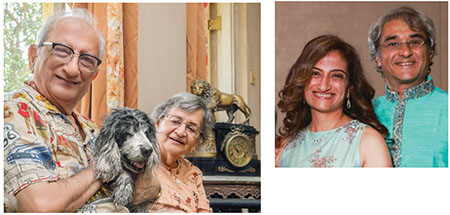
L: Phiroze and Ratty with Tracy Photo: Bhavesh Karia; above: Dr Freya and Lochen Kharawala Photo: Arish Patel
"The more well-bred a purebred dog is, the more predictable its characteristics in looks and behavior,” explains Freya. Her father adds: "The ultimate barrier is not the divide between ‘adopt’ and ‘shop’ as presented by the promoters of adoption, but an intelligent and dispassionate analysis of the dog’s characteristics with reference to its compatibility with the family.
"Any dog that’s brought into a family needs companionship, food, shelter and understanding as a dog. Our advice to all is: ‘Love your dog as one of the family, but understand it as a dog.’ An Indie or a rescue dog may be available free, while a pure breed may cost anything from Rs 15,000 to Rs 2,00,000. Thereafter, the maintenance cost of anywhere between Rs 3,000 and Rs 6,000 per month, and the commitment required, remain the same. Many rescue dogs and street Indies have a strong survival instinct that is ingrained and reinforced over several generations.”
In response to city dwellers’ concerns, Freya says, "Apartment size is not an issue as long as the dog gets adequate outdoor exercise. Even dogs in large apartments need to go outdoors daily.” Regarding dietary requirements, the veterinarian advises, "Dogs may be able to survive on a vegetarian diet but they do not thrive on it. A good quality dog food works best for most dogs.”
On grooming, Phiroze shares, "Fleas and ticks can be a major problem which can be controlled by regular grooming (and not by preventing the dog from exercising outdoors). Also, don’t shave or clip the coat of a dog in the belief that it’ll keep it cool in summer. The natural coat is as much an insulator against heat as it is against cold. If you cannot groom and manage a long coat, first question your decision to buy a long-coated breed.”
When queried about the new trend of adoption of strays, what Freya refers to as "random bred dogs” her insights are: "Though there is no predictability of physical or behavioral traits, they can make good pets too. Adopt a stray only if life on the streets is difficult for that individual. Do not rob a happy stray of his independence. Instead, care for them in their own environment. These are what we call our community dogs.”
In the 1950s, disillusioned at the manner in which the Bombay Presidency Kennel Club (BPKC) was being run, Jehangir established INKC as an independent entity. The Kennel Club of India, to which BPKC is affiliated, did not permit subsidiary clubs to exist outside its umbrella until a much later date. Ratty, then aged 19, worked on the BPKC committee.
The INKC’s founder members included Dady and Dina Baxter, Capt Marzban Choksi, Macca Choksi, Rustom Dadachanji, Sam Siganporia, Fali Kumana, Mani Kumana, Ratty, her brother Dinshaw Daruvala, Adi Khurshedji, Mehroo Cursetji and Jehangir Shroff, the spry octogenarian recalls. Ratty’s late mother Shera too was actively associated with the Club.
In recent years, Mahipendra Singh, Maharana of Danta, was president of the INKC till his demise on July 16, 2023. At a meeting on August 11, Phiroze, who was vice president, took over as president; Rustam Kumana is the new vice president; Ratty remains secretary while Chetan Vengurlekar has been inducted as joint secretary; Sohrab Vazifdar remains treasurer and Freya, editor of the Club’s publications. They are assisted by an active managing committee. Associated with over 30 kennel clubs worldwide, dog registrations with INKC are recognized by all affiliated clubs. Qualified persons are often invited to come from abroad to judge the shows. There are plans to hold championship shows abroad, and those of other countries in India — giving Indian dogs a chance to earn titles from other countries.
"There is a bright future for our Club,” the Javeris aver. INKC is reportedly the first club in the world to go completely paperless. "Online registrations can be done from anywhere in the world. Fees are paid online and certificates sent virtually,” Ratty says. From April 1 this year, INKC TOP (totally online process) on its website
www.inkc.in and Android app, Dogylocker are available for free download. This makes it easy and quick for dog owners to apply for and receive their certificates, with no leeway for fraudsters to falsify and manipulate records.
"The Club has a database of dogs with microchips embedded in them registered with the INKC. If such a dog is lost, whoever finds the pet can scan him, send the microchip number to INKC and the Club will promptly give them the contact details so the pet can be reunited with their family,” says Freya.
The Club’s newsletter, started as an eight-page cyclostyled publication later evolved into the printed Canine Review edited first by Ratty and later by Freya. The Children’s Corner of Canine Review printed items like "Sirius the Dog Star” about the ancient Egyptian belief that dogs have a special influence on human destiny; they not only honored but worshipped dogs. Subsequently, an online newsletter was sent to members by email. Since the last four years the handsome, illustrated INKC Dog’s Annual edited by Freya and printed on art paper has come into being. There are other publications as well, including the informative booklet brought out for the Club’s 50th anniversary and Freya’s Little Book of Puppies, which was released at her alma mater, the Bombay Veterinary College in Parel on May 12, 2022 during INKC’s 65th year. It is a treasure trove of valuable advice covering the gamut of how to choose a dog, why registration matters, how to raise a happy, healthy puppy, socialization and early training, play and exercise. Freya has an active veterinary practice in Ahmedabad and as consultant to Ahmedabad’s Zydus Cadila Research Centre looked after their laboratory animals for 20 years. Her services are sought after all over Gujarat.
Ratty’s love of dogs is reflected in the fact that she has never lived without canine companions. Her very first dog was an Irish setter, followed by golden retrievers, Pomeranians, Shetland collies, collies, German Shepherd dogs, cocker spaniels, pugs. And the family has place in their hearts for all, including Girlie and Bambi, street dogs who "adopted” them.
Ratty’s interests are far-ranging. An artist, she paints, her subjects being mostly, no prizes for guessing, dogs! She would drive the family’s sturdy Studebaker sedan with elan, her diminutive form barely visible behind the wheel! An enthusiastic cook, she derives pleasure in scouring through her collection of recipe books and preparing gourmet meals. Gardening is another hobby, as is sewing, though she does not find much time for the last.
"I am proud to be a Zoroastrian,” says the sudreh-kusti wearing Ratty who, however, is not a regular visitor to the agiary. Airing her views on the community, she says, "I strongly feel that there should be no discrimination against girls who marry out. There must be gender equality. Also, if our religion is so good, why should anyone prevent those who wish to become Zoroastrians from doing so? Ours is a very simple religion: the tenets of ‘Good thoughts, good words and good deeds’ embody this.”