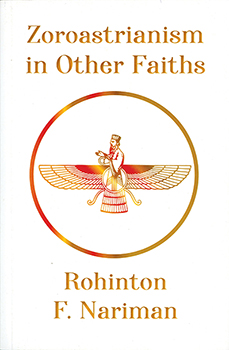
Zoroastrianism in Other Faiths by Rohinton F. Nariman. Published in 2021 by the author. Pp: 267. Price: Not for sale; for private circulation and reference purposes only.
Like his erudite and acclaimed judgments, Justice Rohinton Nariman’s (pictured) objectives in writing his second book on Zoroastrianism are crystal clear. "It is my endeavor to inform the reader what I consider to be the elements of Zoroastrianism as reflected and practiced in other world religions,” states the scholar-judge in the Preface.

An ordained priest at 12, and a senior advocate when only 37, Nariman was one of the first to be elevated directly from the Bar to be a judge of the Supreme Court of India. In his relatively short career on the Bench (seven years; he retires on August 13 this year), the workaholic judge has penned more than 340 judgments of great learning. Hence, it is a mystery how Nariman finds time to write such deeply researched treatises on our religion. His first book on the Gathas, The Inner Fire: Faith, Choice and Modern Day Living in Zoroastrianism, is among the most authentic interpretations of the divine verses believed to be composed by the Prophet himself.
This second book, on the impact of Zoroastrianism, the world’s oldest monotheistic religion, on other faiths is also fascinating. Nariman’s scholarship of Avesta, Vedic Sanskrit and comparative religion can stun the reader.
Avesta was a sister language of Vedic Sanskrit and Zarathushtra’s influence over the Rigveda looms large. The author cites Mandala 10 from the Rigveda where: "Agni, or the God of Fire, is placed on a pedestal and as many as 339 Gods honor him.” The author’s free translation of some of these Vedic hymns is lucid and sublime.
The reviewer has often wondered how our Ameshaspandas and Yazads appear in other religions. Is Sroasha, the guardian of souls, the same as Shiva of the Hindus; and is Behram Yazad, the same entity whom the Sufis called "Mushkil Aasaan?” How is Anahita, the boon granting goddess, dealt with in Hindu cosmology? Maybe, in a future book (unlike other judges, he is reportedly not going to function as an arbitrator but devote his time fully to scholarship of both the law and Zoroastrianism), Nariman will hopefully throw light.
The Zoroastrian faith influenced most of the Abrahamic religions (Judaism, Christianity and Islam), as it was the official religion of the Sasanian Empire. However, the influence of the Achemenids on Judaism is perhaps the greatest. Cyrus the Great freed the Jews, after he conquered Babylon, and Darius the Great built a new temple in Jerusalem out of Persian treasury funds. Cyrus is referred to as the "Anointed of the Lord,” an appellation given only to Jewish prophets, observes Nariman.
It will warm the cockles of orthodox hearts that the Book of Ezra was inspired by Cyrus to "force Jews who had married foreign women, to divorce them” as "mixed marriages were proscribed.”
Many months, like Adar, are to be found in the Hebrew calendar even today. The important Persian feast of Farvardigan became the feast of Purim, for the Jews. Of course, there were differences too. Unlike Semitic faiths, Zoroastrianism and Confucianism are among the world religions which do not believe in fasting — no one who does not eat has the strength to do heavy work of holiness, says the Vendidad. Jews obviously disagree. In modern day Tel Aviv you will not get hot meals on Saturdays, even in some five star restaurants.
The author cites from a book titled Zoroastrianism and Judaism by George Carter: "Each was proclaimed by a prophet. Each worshipped one God. Each believed in an evil power. Each forbade images. Each laid emphasis on a moral act. Each was intolerant towards other systems. Each developed priestly cults, and emphasized ceremonial cleanliness. Each had something like synagogue worship. Belief in angels and demons and in the future life were ideas common to both.”
However, Judaism never adopted the dualism of Zoroastrianism between Ahura Mazda and Ahriman, observes the author.
In Jerusalem, this reviewer was repeatedly asked about the sudreh and kusti, very similar to what is worn by the ultra orthodox Jews. "This now forgotten religion (Zoroastrianism) profoundly influenced Judaism, both in its belief and in its practice,” concludes Nariman.
Large is also the impact upon Christianity. While it is widely believed that the three Magi who bore gifts for the infant Jesus were Zoroastrians, the author’s version is quite fascinating. Citing from the Greater Bundahishn, the author states: "In point of fact, in Zoroastrianism, the three Soshyants or saviors are said to be born at a different point in time, from virgin women, the only difference being that instead of the Holy Spirit entering Mary’s womb, the Seed of Zarathushtra preserved in a holy lake is said to enter each of the virgins.” The world’s first IVF (in vitro fertilization) procedure, perhaps.
The Infancy Gospel of the Christians clearly states that the three wise men were fire worshippers who came from the East to Jerusalem, "according to the prophecy of Zoradascht.”
Equally absorbing is the impact of our faith on Islam. The following passage from Prof Louis Gray’s book is cited by the author: "The influence of Persia on her Arab conquerors was profound. Even before the defeat of Yezdegird III, the last of the Sasanids, in 642, this innovation had begun, for Muhammad himself had incorporated, whether consciously or not, certain features of Zoroastrianism into the teachings of Islam.”
Similarities between Islam and Zoroastrianism abound. The figure 33 is considered holy in both faiths. Originally, Muslims prayed three times a day, like the Jews. "Emulating Persian custom (our five gahs), this was changed to five,” observes the author. Of course, some striking dissimilarities remain too. Zoroastrians consider the dog to have a divine gaze; Islam abhors the dog. So also the severe fasting during Ramadan and abstinence from alcohol.
Coming to lesser faiths and figures, it is no wonder that the judge in Nariman is fascinated by Mithra, the judge. The author analyzes the Avestan hymn to Mithra (Yasht 10).
The author has devoted many pages to Mithraism, which will be of interest only to research scholars. On the other hand, the relation of Zoroastrianism with Buddhism merits hardly a few pages. An interesting observation being: "The older Zoroastrian ideas, most notably the famous holy triad of good thoughts, good words and good deeds, were imparted to Buddhist monks and… the Buddhist Canon.”
Two so-called Persian prophets, Mani and Mazdak also fascinate the author. Mazdak was clearly a false prophet; the jury is still out on Mani. "He took from Iranian religion its light-dark symbolism, its ethical dualism and much of its cosmic hierarchy, along with the commandment not to lie, but challenged the legalistic authority of the Zoroastrian priestly class, the magi. From Indian traditions he borrowed the principle of non-inquiry, a belief in reincarnation; the Manichaeans’ ideal of worldly poverty was common to both the Christian and Buddhist-Jain ascetic tradition. Mani taught Gnostic ideas such as the pairing of humans with their heavenly twins.”
The icing on the cake is a chapter on Zoroastrianism and Emperor Akbar (who attempted to "find” a universal religion called Din–i-Ilahi).
It is widely known that the First Dasturji Meherji Rana (born 1540 AD in Navsari) met the Emperor and had a dramatic impact on Akbar, who perhaps found Zoroastrianism to be the real thing — "with so much effect that he was regarded by many as having become a convert… Akbar introduced a new calendar, Tarih-i-Ilahi, in which the months and days carried Zoroastrian names.”
An interesting question is, did the great Dastur consciously try to convert the Emperor in keeping with his Prophet’s command to spread the religion to all corners of the globe?
Nariman’s conclusion in the book is equally riveting.
"This religion which influenced, directly and indirectly, the great Semitic faiths has now, in turn, been influenced by Hinduism as is practiced in India. In fact, the word ‘Hindu’ is itself a Persian word and does not exist in the Sanskrit language.
"The Parsis in India are no exception to this (caste system). Whereas, in Persia, anyone can become a priest even today, in India, only one born in a priestly family, so to speak, can aspire to become a practicing priest. Many practices that were followed by the Hindus were also followed by the Parsis till the 19th century AD. For example, child marriages were common.
"The Parsis of India, as a refugee community in this country, have done what the Jews did in Achemenian Persia — assimilate with the religious practices of their overlords.”
In a future book, perhaps, the scholar-judge will deem fit to analyze to what extent elements of other faiths have impacted Zoroastrianism over the last 1,300 years in India. Extra-religious worship, decried by the fundamentalists, has so surreptitiously found its way into so many of our customs and rituals being scrupulously followed by some of the orthodox themselves. As compared to his treatment of Judaism and Islam, little is devoted to Hinduism, despite Nariman being superbly equipped, as an Avestan-Vedic Sanskrit scholar, to delve deep. A third fascinating book is awaited soon.
Berjis Desai, author of Oh! Those Parsis and The Bawaji, occasionally practices law.