For the last 88 years, ownership of the Mumbai Samachar has remained with the Cama family
Berjis Desai
The Mumbai na Shamachar made its debut in 1822, nearly 42 years after the advent of Indian journalism. For the first decade of its existence it was a weekly published every Monday. In 1832 it experimented as a daily and was renamed the Bombay Samachar. However it was compelled to become a bi-weekly after a year and was published on Sundays and Wednesdays for the next 20 years. In 1855 it became a daily and was renamed Mumbai Samachar. Barring a brief period in 1841when two Maharashtrian brothers, Janardan and Vinayak Vasudev who were fluent in Gujarati, were appointed editors, the editors of the daily Samachar continued to be Parsis as late as 2000.
Clockwise from top l: Muncherji Sr, Nusserwanji,
Muncherji Jr and Rustomji Cama
A creditor of the bankrupt paper, Muncherji Cama, a leading merchant from one of the aristocratic families of Bombay, took over the reins in 1933. His transition from a successful businessman to a newspaper owner was not easy. Every day he continued to discover a new hole in the Samachar’s balance sheet. Wages were in arrears and the workers threatened to go on strike; advertisers wanted unsustainable discounts. Early one morning, when Muncherji went to office, he was shocked to find the entire staff sitting on the road outside the office building which had been sealed by the court for non-payment of rent to the landlord. To add fuel to the fire, those were the days of the Great Depression when markets around the globe had crashed and unemployment had soared to astronomical levels. The Indian economy was in the doldrums.
Spartan and upright, Muncherji was known in the trade to honor every promise. He would neither exploit nor be exploited. He never defaulted on a single payment and he soon restored the financial health of the newspaper. Fair, honest and just in his approach, he was also a disciplinarian. Senior employees brazenly flouting his orders were instantly sacked. Succumbing to blackmail of any kind, regardless of the economic consequences, was simply not in Cama’s DNA. When, out of the blue, one of the main operators of his printing press threatened to quit unless his salary was doubled, Cama asked him to leave immediately. He then went on the shop floor and personally repaired the machine with the help of others. When the lucrative cine advertisers boycotted the Samachar for its strict ‘no-credit’ policy, he refused to negotiate.
Along with the financial mess, Cama inherited from Naoroji Belgaumwala, the veteran editor Sorabji Kapadia, who was a soft-spoken, low profile, conservative Parsi. He would be the Samachar’s longest serving editor for four decades from 1921 to 1961. During his stewardship, Mahatma Gandhi, Vallabhbhai Patel and Jawaharlal Nehru often dropped in at the Samachar’s office, to meet Belgaumwala, and then Muncherji, to garner support for the Freedom Movement and the Indian National Congress. Nehru and Muncherji struck up a personal friendship over the years and when the former’s wife, Kamala, was recuperating in a Swiss sanatorium, attended to by their daughter, Indira, Nehru requested Muncherji to look into Indira’s well-being during his visits to Switzerland.
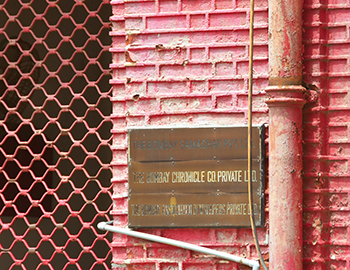
Nameplate at the entrance
Clockwise from top l: machinery used in the printing of Samachar:
Goss Rotary, Imperial, Heidelberg and Stanhope
First edition of the paper in 1822
Clockwise from top l: Mobed Furdoonjee Murzbanjee,
Mulla Feroze, Minoo Desai, Sorabji Kapadia
Online edition of Samachar
Sometime in the early 1940s, after finishing their graduation, Muncherji’s sons, Noshir and Rusi, joined their astute father. Though not an engineer, Noshir would often be found underneath the giant German made Goss printing machines, tackling a technical problem. Rusi was a much loved public relations man who managed advertising and public interaction. The compatible trio functioned as a single unit until the patriarch passed away at 87 in 1982.
While Muncherji paid wages above the market rate, he was hyper allergic to trade unions. In the late 50s, journalists and staff of the Bombay Chronicle, founded in 1879, initiated industrial action demanding unrealistic wages; sanguine in the belief that the Chronicle was a highly profitable and prestigious venture and Cama would ultimately have to relent. The journalistic world was stunned when overnight Muncherji paid full closure compensation and permanently closed down the Chronicle. Obviously, this did not make him very popular with the Bombay Union of Journalists who published a booklet called The Cama Combine in which his so-called capitalist style of functioning was rather unfairly assailed. The ever smiling Muncherji though was unperturbed.
A few years later, in May 1963, an aggressive trade unionist, R. J. Mehta led the Samachar’s workers to strike for 72 days. This ended with the Camas offering to pay much more than the wages demanded by the strikers provided they quit Mehta’s union. The workers left the Union. Post that episode, the newspaper has enjoyed excellent industrial relations.
An interesting aside regarding the strike is that it was called off after 60 days and the workers resumed work. The editorial in the Samachar stated that the workers had unconditionally withdrawn their strike. The workers objected to this adjective. There was a stalemate at midnight and the presses were stopped. Many urged the management to concede. Neither Muncherji nor the editor would budge and the strike went on for another 12 days, after which the workers finally dropped their insistence. None can ever interfere with the contents of the editorial, asserted the Camas.
The Samachar was always in the forefront in times of great public distress. Whether it was the 1962 Indo-China border skirmish or the famine in Kutch or the Koyna dam burst due to an earthquake or the devastating floods in Surat, the Samachar’s fervent and emotional appeals to its readers resulted in a flood of money pouring in; a tribute to its credibility and impeccable integrity. Mumbai Samachar townships to rehabilitate the victims of these natural disasters were often set up in Gujarat in coordination with the Ramakrishna Mission.
During the Emergency imposed by Prime Minister Indira Gandhi in 1975, the Samachar was the only leading newspaper in Bombay in whose offices no member of the Censor Board was stationed, even though the Samachar was no apologist for the Emergency. As a matter of fact, sometime in 1970-71, the Samachar bitterly opposed the introduction of a Bill in Parliament by the government to delink ownership of newspapers from management and editorial control, which bill was a brazen attempt to nationalize newspapers by the back door. Fortunately, it was dropped under the pressure of western opinion but was a clear indicator of the Prime Minister’s growing authoritarian tendencies.
In the 1970s the third generation of Camas joined the publication starting with Muncherji, who passed away on July 3 this year, followed by Mehli and finally Hormusji. As a matter of policy, three generations of the Cama family have never interfered with editorial independence. To appoint an editor was their prerogative; once appointed, how to run the newspaper was the editor’s prerogative. In April 1961, when Kapadia died in harness, the Camas appointed 41-year-old Minoo Desai as the editor of the daily and 39-year-old Shantikumar Bhatt as the editor of the Sunday Samachar. Desai, an accidental Parsi from Navsari, was a first generation Bombayite who had little in common with his upper class Parsi predecessors. A parti- cipant in Gandhi’s Quit India movement, he was a Gujarati poet, playwright and critic and a lifelong Gandhian who penned 28 books in Gujarati. Bhatt too authored books in English and Gujarati.
The duo professionalized the editorial set-up and ensured that the Samachar’s language was purged of any remnants of the Parsi dialect. The Gujarati was Brahminized. The patriarch of the Cama family though was unhappy about the use of any difficult word. He once summoned the Sports Editor to tell him that suvarna chandrak, for gold medal, was too difficult for the common reader to fathom, and he should say sona no chaand. When US President John Kennedy was assassinated, Muncherji argued with the editor that instead of using the word hatya, he ought to have said, khoon; whereupon the irate editor is reported to have told him that had the patriarch been murdered, the correct word would indeed have been khoon, but for Kennedy, the appropriate word was hatya. Every morning, over a cup of coffee, Desai and Rusi, who looked after advertising, bantered about how much advertising space was to be allocated. It was a problem of plenty.
Under Desai and Bhatt, the Samachar’s circulation soared from 62,000 in 1962 to a career best 1,48,000 in 1975, when suddenly, at 55, Desai succumbed to cancer. Jehanbux Daruwala, a retired development officer with the Life Insurance Corporation of India and a part-time journalist with the Parsi community daily, the Jam-e-Jamshed, the second oldest continuing newspaper in Asia, founded by none other than Furdoonjee Murzbanjee’s descendant, was appointed as the editor. Under Daruwala, who adopted a distinctly liberal stance in Parsi controversies, the Samachar vigorously espoused several civic causes including Parsi and Bohra socioreligious reform. He continued the "Parsi Taari Aarsi” column started by Desai.
Under the current editor Nilesh Dave, the newspaper has begun to focus greatly on civic, municipal and socioreligious issues affecting mainly the Gujarati and Jain communities. It has become a mouthpiece to address the woes of the owners of small and medium enterprises in Bombay. Murzbanjee’s tradition of the Samachar being a merchants’ newspaper is still very much alive. While it steadfastly retains its political neutrality, its editorials have become more scathing and the undertone is at times a little shrill. Some of its exclusive stories have become spicier. This is in accordance with the tastes of its present readership.
Samachar has never been affiliated or biased in favor of any political party or community or Indian corporate group or business house or industry. Advertisers, however large, received no special favors. The editorial undertone was always subdued and never strident or virulent. Successive governments held the Samachar in great affection. This newspaper may not be known for investigative journalism or many sensational scoops. Its credibility was however so great that readers believed that whatever was published in its columns was the gospel truth. If you are not sure of the authenticity of your source, you will not print, was the diktat to its young journalists.
Until the 1990s, the Samachar was in an enviable position as having the largest readership of all Gujarati newspapers published from Bombay. An eveninger, Janmabhoomi, was hardly any competition. However, with the advent of the internet and technological changes, the leading Gujarati newspapers published from Gujarat, the Gujarat Samachar and Sandesh, decided to bring out Bombay editions. It was followed by the Gujarati newspaper of the nationally largest, Dainik Bhaskar chain, namely, Divya Bhaskar, as also the Gujarati Mid-day. In the next three decades, Samachar lost its premier position in the increasingly crowded market. While its competitors print multiple editions from various cities of Gujarat, Samachar is published only from Bombay after it stopped publication from Ahmedabad. According to the statistics released by the Audit Bureau of Circulations, the average qualifying sales for the period July to December 2019 for the Divya Bhaskar was 7,92,022, while Mumbai Samachar was at 57,957. Needless to add that the fall in circulation and readership translated in an erosion of advertisement revenue.
In a strange manner, the proliferation of social media has helped the Samachar. People buy it not so much for the news, which they garner from much better and faster sources, but for its views and opinions as well as for social and religious stories which are not in the public domain. In the last decade, one does find some dissipation of its staid exterior; the language is at times a bit colorful and that occasional sensational story, particularly if it is an exclusive, makes its columns more interesting. In the struggle to remain relevant, its famed sobriety is being gradually shed.
Extracted from a talk delivered online by Desai on August 12, 2021 under the auspices of the Mumbai Research Centre of The Asiatic Society of Mumbai.
A future issue of Parsiana will carry a profile on the path-breaking efforts by Mumbai Samachar founder Mobed Furdoonjee Murzbanjee.