In a quest for an elusive model, many
paintings of the Parsi community by Raja Ravi Varma were examined
Ganesh V. Shivaswamy
In November 2019 I stepped out of an air-conditioned car into the haloed premises of the Chhatrapati Shivaji Maharaj Vastu Sangrahalaya (formerly the Prince of Wales Museum) and, as a Bangalore boy unaccustomed to the Bombay heat, quickly rushed into the auditorium where I was to speak on 125 years of the Ravi Varma Print Legacy. The speech completed, the floor was open to an interactive session when, quite predictably, the question of the authenticity of the movie Rang Rasiya, based on the life of celebrated artist and portraitist Raja Ravi Varma, an aristocrat from the Kingdom of Travancore, came to the fore. I answered it in the same fashion I had done in the five cities I had spoken earlier — more fiction than fact. The following day, I received an email from Parsiana enquiring if the character "Frenny” was indeed someone who had played a part in the artist’s life. I replied that I would delve into my notes on the painter and embark on "Finding Frenny.” Cabbin’d, cribb’d and confin’d during the coronavirus pandemic, I commenced the search.
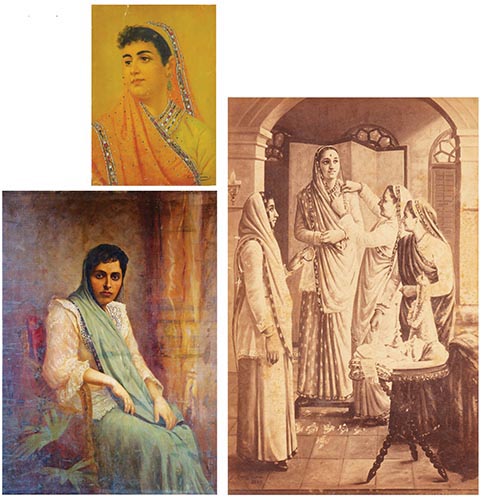
Paintings by Raja Ravi Varma (clockwise from top): Parsi Beauty; Decking the Bride and Parsi Lady
First on the list was to watch Rang Rasiya again. The disclaimer stating that the film was a work of fiction stared at me and I wondered if I should even continue. I persevered. The flamboyant Ravi Varma (played by Bollywood actor Randeep Hooda) was in the witness stand and there she was, flashed before me on the screen — Frenny! Played by the British-Asian actress, Ferhyna Wazheir, Frenny was seated in the courtroom. She was enamored with the artist — if ever there was a ‘fe’male gaze, this is the one! Later in the movie, in an incense-filled temple the aptly named Sugandha, Ravi Varma’s model, made her appearance. Was she a real person or a fictional character? Played by Nandana Sen, Sugandha was slim and fit, and on that score alone, fiction! That apart, there is no reference to Ravi Varma being acquainted with anyone by that name. But what about the elusive Frenny? "Finding Frenny” continued.
Ravi Varma travelled across India with this brother C. Raja Raja Varma who wrote extensively. The diary of C. Raja Raja Varma and his book entitled A Narrative of the Tour of Upper India of His Highness Prince Marthanda Varma of Travancore offer us a direct view into the life of the artist. Original source material from the various archives and repositories are an invaluable source of information.
In the Narrative of the Tour of Upper India, there is a reference to a litigation which Prince Marthanda Varma, Raja Ravi Varma and his brother attended. C. Raja Raja Varma writes: "Among other public buildings visited was the High Court, where the Prince was given a seat on the Bench between the lion, Justice Jardine, and Justice Ranade, who were hearing a case of an interesting nature. It was an appeal from the City Magistrate of Poona who had convicted the accused for having sold obscene pictures which were cheap German oleographs, representing nude figures of females. The judges were, it appears, of opinion that naked pictures of classical subjects were not obscene, in that the artists had higher ideals than those of merely exciting the sensual appetites of the spectators. The pictures in question might have been classed among them, had it not been for the introduction into them of modern silk umbrellas and apparel which divested them of their idealism.” Clearly, the accused was not defended by taking shade under that umbrella! Be that as it may, Ravi Varma was not the accused in this case.
Back to the search: Ravi Varma did have many models. One of the earliest photographs of a girl posing for one of his paintings is that of his own daughter, Mahaprabha. With a child in hand, she strikes several poses for the famous 1893 painting There Comes Papa. Another model was a Goan kalavant (classical singer, performer) Rajibai Mulgaonkar who posed for several paintings including Ahalya and Lakshmi which captured the religious imagination of the people of the Indian sub-continent. The other Goan kalavant was Anjanibai Malpekar who was an indomitable woman and also a proponent of the Bhendi Bazar gharana (school of music).Yet, no Frenny. Focus, I told myself. I began to examine the association of Ravi Varma with the Parsi community.
Raja Ravi Varma and C. Raja Raja Varma were captivated by the Parsi community and were greatly patronized by them. In the Narrative of the Tour of Upper India, the latter writes: "One of the Parsi customs against which the enlightened girls of the present generation revolt is that which enjoins them to hide their beautiful raven locks under a white head band. It is certainly very hard that the hair, which is one of the chief attractions of women, should be so cruelly dealt with. The young Parsi ladies are, however, pushing the band farther and farther back on the head, and I think in another quarter of a century it will altogether disappear.” Trichophilia (hair fetish)? Oh yes, but prophetic too for the custom has all but vanished.
Ravi Varma’s fascination for an accurate rendering especially of Parsi attire is best summarized by Priya Maholay Jaradi in Parsi Portraits from the studio of Raja Ravi Varma where she observes that "Ravi Varma carefully rendered the kor (border with floral motifs), the muslin or Victorian lace sudreh (muslin vest), Edwardian blouse, jama pichori (gathered muslin garment with the part crossing over the chest and fastened with ribbons held at the waist with a cloth belt), the daglo (black coat) and pughree (starched and lacquered headgear). As was the custom with the more orthodox women of the community, her hair is covered with a scarf, the mathabanu, over which the sari rests. Since the left ear was the only one exposed when the sari was draped, Parsi women wore only one earring as seen.”
Ravi Varma was a socialite when he was in Bombay where the stringent protocols of royalty and aristocracy did not apply. He went to the theater, for drives in the evening, visited homes and on one occasion drove a long way to see a new gas lamp! Everywhere he went he carried his sketchbook and captured images of the common person in all his or her domesticity.
In 1893, Ravi Varma sent a set of 10 paintings for the World’s Columbian Exposition at Chicago. One of the paintings was entitled Decking the Bride and is described as a Parsi maiden being adorned by her mother and sister before the marriage ceremony. The painting made its way to Chicago and returned to India and is now on display at Kerala’s Raj Bhavan. While general images of the Parsi community abound, what about specific people? And of course, where’s Frenny? My search for her continued and I encountered a few names.
The first is Aloo Patel (née Khareghat) — an exceedingly graceful and proficient pianist. Jaradi is of the opinion that she may have been the "Parsi model” whom several authors referred to. Rupika Chawla in Raja Ravi Varma — Painter of Colonial India says Aloo was the lady in the 1899 painting Going Out in the collection of the Government Museum, Madras.
The second is a chromolithograph from the Ravi Varma Press entitled Parsi Beauty. This depicts a young woman, with visible "raven locks,” a single earring and draped in a pink sari. This sublime chromolithograph is one of the finest from the Ravi Varma Press. Portrait collector Anil Relia is of the opinion that this lady could well be Lady Dhanubai Cowasji Jehangir.
Investigating further, I found references to paintings by Ravi Varma of many members of the Parsi community. Important among them is the portrait of Dadabhai Naoroji which is in the collection of the Sree Chitra Art Gallery, Thiruvananthapuram. Recently, a stunning 1896 portrait of Bai Sunabai Temuljee Nariman was offered for sale.
Sifting through all the folders of images which I scanned and photographed over the past couple of years, I discovered beautiful Goan kalavants. I was drawn to the beauty of Zoroastrian raven locks. I was also apprised of the economies of a single earring. I would have to summarize my great expedition of "Finding Frenny” to be exactly like the similar sounding movie. My journey ends with the conclusion that after all of this, Frenny could not be found!
Ganesh V. Shivaswamy, a fifth generation lawyer from Bangalore, has taken up the task of structuring the artistic legacy of Raja Ravi Varma. He established the Ganesh Shivaswamy Foundation in 2019, one of the youngest Google Arts and Culture partners. It is the most comprehensive resource on the works of the artist. In 2019, to coincide with the commemoration of 125 years of the Ravi Varma Press, the Foundation launched chromolithographs from his collection on the Google platform. On April 25, 2020, the Foundation commemorated 150 years since the commencement of Ravi Varma’s career by posting images of paintings, sketches and archival photographs on the Google platform. Shivaswamy continues his research and is presently writing a book on the social, religious and aesthetic impact of the images from the Ravi Varma Press.