Parsi industrial houses have channeled their resources to support the disadvantaged
Farrokh Jijina
While coping with the enormous difficulties that the coronavirus pandemic has brought, Parsi founded corporates have not reneged on their social programs to assist the disadvantaged. From food to shelter to protective gear and even building homes, they have stepped forth to offer their expertise and financial wherewithal to assist the most affected. Parsiana reached out to several companies to ascertain their contribution to social causes. In this issue we focus, in alphabetic order, on the Forbes Marshall Group (FM), the Godrej Group, Serum Institute of India (SII), Shapoorji Pallonji Group (SP), Tata Group and Thermax Limited.
Assisting in difficult times
"We have to plan for the Marathon (race) and not a sprint as we do not know how long this will go on and we must remain fit through it all,” stated co-chairman of the FM Group, Farhad Forbes. "During these (pandemic) times I have learnt that anger, frustration and concern about things you can’t influence do not help resolve those things… Instead, focus on doing what is in your control,” he stated in an email. "We need to live in the present, sometimes just today, and focus on what might be in future, being well aware that any actions or responses we put in place may need to change as the situation changes… Be aware of your emotions...do not dwell on events of the past.” The seven-decade-old Poona-based business provides engineering products and services to its clients in process industries from four manufacturing facilities in India and one in the UK.
After the few initial days "filled with much uncertainty,” the Group’s first actions concerned their staff members, "including their service providers, their families — making sure they were safe, that the right health precautions were learnt and deployed,” stated a note from Forbes’ office. As the norms were eased to allow manufacturing, the Group provided "living space and all facilities to their shop-floor members at our campuses,” stated the write-up. "Our medical team and the hospital on our premises are fully geared up to address the needs of our members and the community it serves. We have recently started quarantine facilities for those of our members who cannot isolate themselves at home.
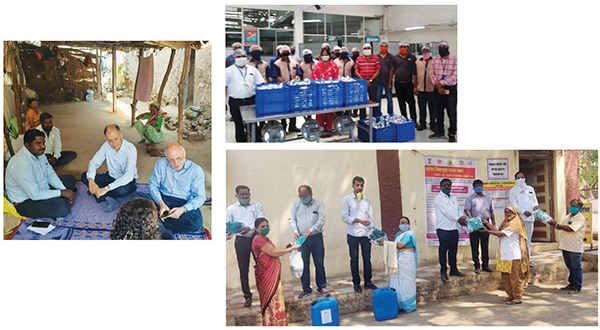
Clockwise from above: Forbes Marshall Group’s Naushad (center)
and Farhad Forbes (r) with villagers from around their plant; meals for migrants;
distribution of protective equipment and sanitizers to health centers
"We have also supported causes outside Poona... We provided food grains and cooking essentials to hundreds of families, income generation support for underprivileged women, distributed disinfectant made by us to several hospitals, and donated PPE (personal protective equipment) kits to hospitals and health care centers,” said the note from Forbes’ office. Their canteen cooked "several thousand meals” for migrant workers and the needy which were distributed through the Poona Municipal Corporation. "We are also working with non-governmental organizations (NGOs) to prioritize and re-structure their initiatives in these difficult times,” the communiqué noted.
Forbes closed his message with a quote from Stanford professor of psychology, Jamil Zaki: "While we are made to practice physical distancing, we can still use the wonderful technology we have all learnt to use to practice ‘distant socialization.’”

Innovative initiatives
The Godrej Group made a commitment in the early days of the pandemic to "support health personnel, government workers, and everyone working to curb the spread of this pandemic.” A fund of Rs 50 crores was earmarked for community relief and support initiatives. "This is an initial outlay and we hope to supplement it over time,” noted a press release dated March 23, 2020. The initiatives under their program included a donation of five crore rupees to the Bombay Municipal Corporation (BMC); supply of medical equipment and protective gear; funding for 115 hospital beds; assistance in setting up a 75-bed quarantine center; free distribution of hand wash powder. The Group tied up with communities under their corporate social responsibility program to support 1.12 lakh beneficiaries across eight states with hand wash, sanitizers and soap.
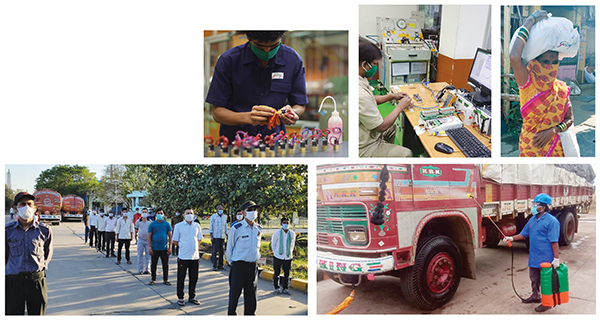
Activities at Godrej Group, (top): alcohol gel, gloves and mask in use;
clockwise from above: manufacture of ventilator valves;
food relief around plants; following hygiene standards;
observing social distancing and safety protocol
"Our furniture brand (Interio) is doing a lot of innovation in health care and hospital furniture, to create ergonomically designed healing environments,” stated an update dated October 7. "We are also exploring how we can leverage our medical refrigerators business... to build quarantine rooms, and expertise in mechanical, electrical and plumbing systems for hospitals.” As a player in the real estate business, the Group is "particularly concerned about the acute problems being faced by migrant laborers,” with isolation facilities set up at labor accommodation and their project sites in eight cities they operate in are frequently sanitized.
The Group supported over 30,000 families in communities around their facilities operated by Godrej Consumer Products with safety kits provided even to their transporters’ staff. Their aerospace business developed and delivered their first batch of 1,000 solenoid valves (a critical component for making ventilators) to the Defence Research and Development Organization (DRDO), stated a press note of June 25. The valve "regulates the flow of oxygen based on the requirement of the patient in each breathing cycle, and is a critical component for the manufacture of ventilators and other medical devices.” The business, which teamed with DRDO, Aeronautical Development Agency and Bharat Electronics for this production, "and took just 10 days to start production under supply side and logistics constraints,” is drawing up plans for the international market.
Godrej & Boyce (G&B) teamed with the BMC, RPG Foundation and NGO FromU2Them to support an online platform — Milkar for Mumbai. The platform enables concerned citizens to aid in relief efforts. Individual donations will be matched fivefold by Milkar’s corporate partners. "We hope that this platform can evolve into a sustainable crowd-funded initiative, with engaged (citizens), to tackle urgent civic issues like access to healthcare, sanitation, education, upskilling and reskilling in a focused manner,” stated G&B executive director Nyrika Holkar in a press statement.
"Over 4,400 Godrejites voluntarily contributed a part of their payroll to the PM CARES,” stated the update from the Group, which made a matching contribution to the fund. Employees in Kenya, Nigeria, Ghana, South Africa, Dubai, Nepal and Indonesia too contributed towards local relief work in their areas.
Ramping up for the vaccine
It will take till the end of 2024 for everyone in the world to be inoculated, according to SII’s chief executive officer (CEO) Adar Poonawalla. He told The Financial Express (FE) on September 16, 2020 that "pharmaceutical firms the world over (are) not ramping up capacity fast enough to deliver the vaccine (quicker) than that.” Fifteen billion shots of the preventive vaccine will be required as the medication is a "two-shot” one (to be administered twice to an individual). The CEO was skeptical of the union government’s plans to ensure all Indians are vaccinated at the earliest. "I don’t see a plan on paper to do that beyond 400 doses.”
The Poona based company is in partnership with British drug maker AstraZeneca (AZ) to supply one billion doses of University of Oxford’s preventive potential coronavirus vaccine candidate (see "Serum’s vaccine production,” Events and Personalities, Parsiana, April 7-July 6, 2020). A total of 100 volunteers in India have received the trial dose of the vaccine to be manufactured by SII. Nationwide, the trial involves 1,600 volunteers at various sites including four Poona hospitals, according to reports.
Microsoft co-founder Bill Gates has stated that the world is looking to India for large scale production of vaccine once it is rolled out, reported FE on September 16. The world’s largest vaccine manufacturer by volume, SII has entered into a partnership with Gavi, The Vaccine Alliance, and the Bill and Melinda Gates Foundation to accelerate manufacture and delivery of the vaccine. "The collaboration will provide upfront capital to SII to help them increase manufacturing capacity now so that, once a vaccine, or vaccines, gains regulatory approval and WHO (World Health Organisation) prequalification, doses can be produced… for distribution to India and low and middle income countries,” read an announcement dated August 7 on the website of SII. The company has set an affordable ceiling price of three US dollars (about Rs 240) per dose.
A press announcement from another collaborator of SII, Codagenix Inc dated September 22 hosted on SII’s website stated that the Indian company has started manufacture of their partner’s nasal Covid-19 vaccine. "Pre-clinical testing of a single, intranasal dose in animals has yielded encouraging safety and efficacy signals,” Codagenix said in the statement. "With Serum Institute’s financial and technical support, we expect to rapidly propel the vaccine into the clinic before the end of 2020,” Codagenix’s chief operating officer, Dr Robert Coleman added.
"Execution challenges”
After the partial relaxation announcements made post June 2020, "operations at the SP Group of Companies resumed but with reduced manpower to the tune of just 15-30% of its original strength.” The supply chain for bulk construction materials is getting restored. "The limited labor strength would continue to impact the construction operations for us,” stated their note to Parsiana. "Due to the mismatch of skills among the remaining workers, output and productivity is being impacted.” They have expedited release of payments towards certified bills and also considered additional advances to subcontractors. "These payments can then be channelized by the companies to their supply chain.”
SP foresees that "post lockdown, construction companies will need to offer higher rates and other incentives to attract the required number of workers to ensure business continuity.”
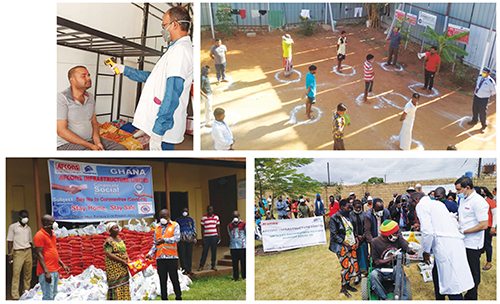
At Shapoorji Pallonji facilities, clockwise from above l: testing for symptoms;
social distancing in practice; distribution of rations in Ghana; food kits for the needy in Lusaka
They estimate that they have "provided over 10 lakh cooked meals and dry ration to over 20,000 workers across project sites within the first two months of the lockdown.” On-site practices include the use of steamers and oxymeters to monitor health, isolation of workers returning from their native villages and hometowns and training on sanitization practices. "Apart from supporting our employees, SP has supported the community by donating Rs 1.74 crores to the Prime Minister’s and state relief funds.”
SP’s welfare activities were not restricted to in-company employees and their subcontractors. Eureka Forbes (EF), a SP Group company, joined hands with the Federation of Hotel & Restaurant Associations of India (FHRAI) for temporary employment to those hospitality industry workers rendered jobless. EF manufactures water purifiers, vacuum cleaners, air purifiers and security solution products. Selected individuals are being reskilled to be able to service and repair EF’s branded appliances at customer homes. The employees of Afcons, also from the SP Group and another company involved in setting up a port in Gopalpur contributed a part of their monthly salaries while their finance company supported 330 underprivileged families in drought-hit Marathwada (Maharashtra). Afcons has helped wherever possible "to alleviate the food and sanitation issues of local communities around its project sites across Bhutan, Bangladesh and Africa.” Assistance was provided to the Royal Bhutan Army to help build temporary homes to prevent the spread of the virus, stated the write-up.
Technologies that reduce cycle times and the requirement of construction labor, reduce project duration and wastage, and improve quality and safety will be the norm in the future, they expect. "Shapoorji Pallonji is at the forefront of using these construction technologies in India,” stated the note.
EF has "almost returned to its pre-pandemic sales figures,” reporting July 2020 sales at 85% of July 2019 sales, stated a comprehensive note from their communications team to Parsiana. They are witnessing a "renewed focus on health and hygiene categories,” stated the note.
SP comprises 18 major companies that work in six business segments: engineering and construction, infrastructure, real estate, water, energy and financial services. They employ 70,000 people in over 70 countries. "However, the challenge has been in terms of execution, due to the disruption in the supply chain…. With the resumption and supply of critical equipment, and the coronavirus situation stabilizing in some countries, work has started to pick up pace,” stated the communication.
Sterling and Wilson, SP’s engineering procurement and construction company has been selected to execute projects of one gigawatt (GW) capacity "of the four GW projects for which tenders have been called.” Their real estate companies are continuing development of mid-income-housing projects in Howrah-Calcutta, Bombay, Poona and Gurgaon. "Despite the pandemic,” SP is "confident of investing in mid-segment projects and to launch at least two new projects in Maharashtra and new phases in existing projects elsewhere.” During the lockdown Afcons Infrastructure commissioned the Makeni Flyover, the longest in Lusaka, Zambia. Their Tema-Mpakadan railway project in Ghana is progressing satisfactorily, stated the communication. A portion of the Mahatma Gandhi Setu (bridge), in Bihar, was inaugurated. In Maharashtra where Afcons is constructing the state’s longest and widest road tunnel, "the team completed 214.5m excavation in May 2020 alone... More than 850 employees were engaged in managing the labor camps for about 52,000 construction workers.” SP sees the Rs 5.6 crores spent on this as "an investment.”
Augmenting facilities
The Tata Group’s "accurate and low-cost paper-based test strip to detect Covid-19 in less than 30 minutes” called Feluda developed jointly with the Council of Scientific and Industrial Research has been approved by the Drugs Controller General of India, according to reports. This will drastically lessen time required for determining whether a person has the dreaded Covid-19 virus.
As part of its multi-pronged approach to combat the coronavirus announced in the early stages of the pandemic, the Tata Trusts have upgraded four government hospital buildings, two each in Uttar Pradesh and Maharashtra into Covid-19 treatment centers. This initiative augments Maharashtra’s bed strength by 154 and Uttar Pradesh’s by 292. The facilities have been handed over to respective administrations, stated a press release of August 31 on the website of the Trusts. Each hospital is armed with critical care capabilities, minor operation theaters, basic pathology and radiology, facilities for dialysis and blood storage, and telemedicine units. "Both in-patient and out-patient wings are permanent and supplement existing health care infrastructure in these locations... The decision to upgrade existing infrastructure was to bring speed and make use, wherever possible, of existing capabilities and services,” stated the note.
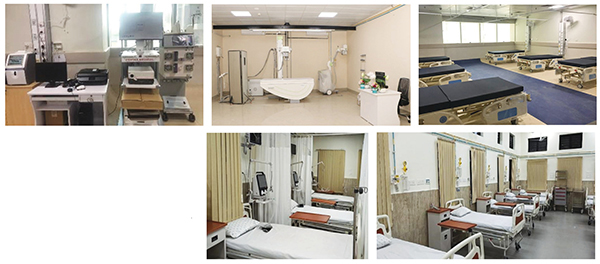
Clockwise from top: ventilators with monitors; X-ray machine; beds equipped with gas and
other facilities in the intensive care unit at hospitals augmented by the Tata Group
Critical care management skills of health care professionals from "over 356 hospitals in 26 states,” including the four recently upgraded hospitals, have been augmented as a result of the Trusts’ tie-up with Christian Medical College, Vellore and Care Institute of Health Sciences in Hyderabad. Their 22-hour on-line training programs are meant for staff chosen by identified hospitals and are provided free of cost.
The Trusts have donated PPEs to state governments and individual hospitals in about 32 states and union territories, stated the press release. Their community outreach programs encourage adoption of health practices in rural areas to prevent the spread of Covid-19. "The exercise is expected to have covered about 21 million people in 21 states.” For wider deployment by any interested organization, the Trusts have made about 300 video and audio messages available through social media in different languages and dialects. A list is available on their website.
While announcing a pledge of Rs 500 crores on behalf of the Trusts on March 28, Trusts chairman Ratan Tata had outlined key areas: PPE kits for frontline medical professionals; respiratory systems for treating increasing cases; testing kits to increase per capita testing; setting up modular treatment facilities for infected patients; knowledge management and training of health workers and the general public.
The April-June issue of the Tata Review commented in the editorial that "The Tata Group has committed (a total of) Rs 1,500 crore to fight the invisible enemy (Covid-19).”
Besides the procurement and supply of PPE and other hospital equipment, the efforts include free cargo flights to transport PPE (by Vistara and Air Asia); manufacture and distribution of sanitizers (by Rallis); construction of a hospital "in weeks” in Kerala, one of the earliest Indian states to be affected.
Staying connected
For Thermax Limited’s chairperson Meher Pudumjee, the pandemic has been a phase of introspection. "It made me realize how little we really need and yet we spend most of our lives chasing materialistic ambitions,” she communicated with Parsiana, commiserating with "thousands of migrant workers and daily wage earners who lost their source of livelihood overnight.” The "less cars and people on the roads, no emissions, being able to hear the chirping of birds and see many more varieties, should be an eye-opener for governments and corporates,” she believed, making a case for sustainable policies and practices going forward. "At home, I realized the amount of work our house help do and was grateful to them.” The company provides solutions and products for heating, cooling, water and waste management, and specialty chemicals.
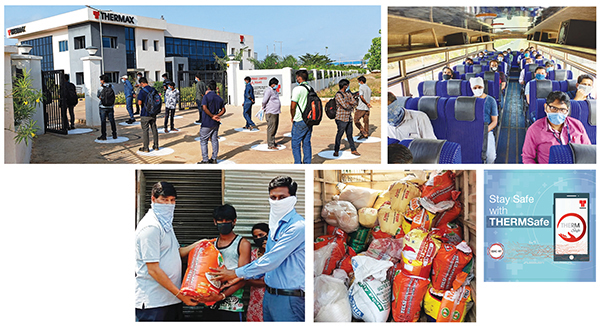
At Thermax, clockwise from top: adhering to safety norms at the plant and during travel;
mobile application to monitor health; supporting migrant workers with basics
The impact of the pandemic on their operations was "substantial,” Pudumjee wrote. In a capital goods company, where a significant amount of invoicing takes place in the January to March quarter, "We ended the year with a subdued performance on all financial parameters of revenue, order booking and profits.” The chairperson stated that their management ensured that employee safety and wellbeing "took precedence over revenues.” All their manufacturing facilities were shut down initially. In order to connect people working at home and remotely at sites, they organized virtual fun activities: quizzes, yoga, Zumba and cooking. The company tied up with two health counselors to address staff’s concerns. "We have launched a mobile application called Thermsafe to regularly track the health of our employees and take quick decisions as and when needed,” she wrote. Virtual trainings "ensured that employees utilize this time for enhancing their skills.” Contract workers were not forgotten. "Thermax supported its labor workforce, directly or through contractors and customers, by providing them with daily essentials and handling medical emergencies in some cases.” Thermax Foundation "has been working collaboratively with NGOs and volunteers to support the worst affected people in Poona and around their manufacturing facilities.”
Realizing the need for more communications, Pudumjee had "many more interactions with our board (of directors), beyond the statutory requirement and with our own people through blogs, emails, fireside chats and open forums.” They stayed connected with customers through remote support and webinars, sending communications on best practices to maintain their critical utilities, and even "managed to remotely commission a large boiler in Egypt.”
As the chairperson of a manufacturing company, Pudumjee was "apprehensive of the idea of working from home.” However, she sees an opportunity to "redefine the new normal for Thermax where processes will be more digitized, and customers will be assured of continuous, uninterrupted support through remote applications.”