At well attended election meetings in Parsi colonies, trusteeship candidates speak about their plans for the community
With 15 candidates in the fray for the seven Bombay Parsi Punchayet (BPP) trusteeship seats, election campaigning is proceeding at a hectic pace. The main contestants are holding meetings at various Parsi colonies on almost a daily basis. With two candidates, Yasmin Mistry and Adil Irani dropping out and the third Maharukh Noble’s eligibility in question, of the remaining 14, each has a 50% chance of winning.
"My mother was not in favor of my contesting the elections and my Mother’s Day gift to her was my withdrawal,” stated Mistry in a message released on May 8, 2022. "I always believed and still continue to believe that I will be able to do a huge amount of good work for my community through the BPP.
"I have promised myself, that in future, if I have the time and if I feel so inclined, I will offer my candidature once again, in the service of my community,” she noted.
Irani dropped out of the race on grounds of ill health.
Whether Noble is eligible to contest the May 29 elections was to be decided by the Election Commission (EC) at a hearing on May 19, at 3 p.m.
A complaint has been lodged with the EC alleging that Noble "does not satisfy the eligibility criteria” in Clause 6.1 (i) of the BPP election scheme. The Clause states, "Any Parsi desirous of contesting elections… (should not have) been convicted by a court of law anywhere in the world and sentenced to imprisonment of not less than six months (suspended or otherwise).”
BPP trusteeship candidate Kaikhushroo Irani who filed the complaint alleged that "Noble has been convicted for physically assaulting a senior citizen (her sister-in-law), Dr Nelie Noble, a former trustee of the BPP, causing grievous hurt including injuring the retina of the victim’s eye, who had to be hospitalized… This episode led to a complaint dated November 25, 1990 being registered by the Bombay Police,” he noted. Kaikhushroo asked that Maharukh "be directed to file an affidavit disclosing all the facts and circumstances leading to her conviction and sentencing, substantiated by supporting documents.”
Maharukh responded stating, "I deny that I do not satisfy the eligibility criteria… Relevant information has been deliberately suppressed by the complainant.” Noting that "the records for the period are not easily available,” she added, "I am not able to produce the relevant orders with this reply. I also do not admit the veracity of the documents relied upon by the complainant.”
Thereafter Kaikhushroo retaliated, "It is crystal clear that Mrs Noble does not deny that an order of conviction and sentencing her to one year rigorous imprisonment has been passed against her.” Kaikhushroo called upon the EC to immediately ask Maharukh "to categorically confirm or deny in a single sentence whether such an order of conviction and sentencing has been passed against her or not.”
Covering ground
Parsiana covered three election meetings held on April 29 and May 6 at the Zoroastrian Colony (Chikalwadi) and on May 9 at Captain Colony (near Haji Ali). The first was of BPP trustee Kersi Randeria along with candidates Hoshang Jal, Dr Adil Malia, Daara Patel and Farhad Hozdar. The first four term themselves as "Team Committed to Community (TCC).” Hozdar is an independent, like-minded candidate who shares their platform.
The second meeting was of social worker Anahita Desai and the third of BPP trustees Armaity Tirandaz, Viraf Mehta, Xerxes Dastur and social worker Rumy Zarir. (Team member Maharukh was not present, being in Udvada, Mehta explained.) The group’s slogan is "Kom-ni-unity” and "Trustees You Have Trusted.” Their loyalties lie with former BPP chairman and Viraf’s father, Dinshaw Mehta. All three parties have a social media presence, with the Randeria and Mehta camps having printed publications, Parsi Times (Randeria) and Parsi Junction (PJ) (Mehtas).
At all three venues the chairs were occupied and some attendees were standing. The dates and venues of the meetings were circulated largely on WhatsApp but people not fortunate enough to receive the forwards were unable to access the information. One irate Dadar resident telephoned the Parsiana office to inquire about the dates of the meets, voicing her frustration at not being able to access the schedules. The schedules of the independent candidates Tehmtan Dumasia, Dr Zuleika Homavazir and Kaikhushroo were not sufficiently publicized, if at all.
The common subjects at all three venues included the finances of the bankrupt trust, the stalled ownership building projects, the housing policy, conversion of leave and license to tenancy, auctioning of flats, the scrapping of the Rs 750 monthly service charge, the need for better communication between the trust and the beneficiaries…
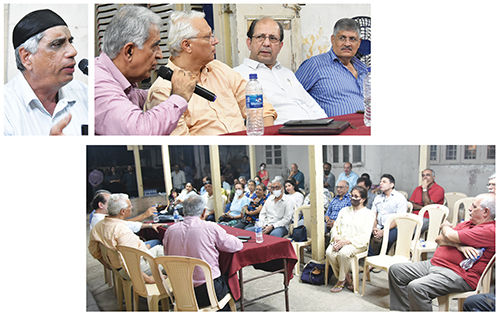
Top (from l): Farhad Hozdar with Team Committed to Community’s Kersi Randeria, Dr Adil Malia,
Daara Patel and Hoshang Jal at Zoroastrian Colony
The forceful four
At the Zoroastrian Colony meet on April 29 at 7.30 pm, Randeria, an industrialist, likened the auctioning of BPP flats to a lady selling her necklace to make ends meet. When that money runs out, she is left with no financial recourse. He said the refundable security deposit earned by auctioning flats on a leave and license basis is shown as a liability on the BPP’s balance sheet as the amount would have to be returned at some point. Of the Rs 70 crore (USD 9,045,564) received as deposits, Rs 63 crore (USD 8,141,007) "pura karya (finished),” have been spent! "Only seven crores (USD 904,556) is left.” He referred to the auction of a flat in Rustom Baug to a party who already owned two flats there. As Randeria had opposed the selling of flats after assuming office in 2015, the trustees who opposed his policy later overruled him alleging, "I am responsible for the financial mess” the bankrupt trust is in. But "even before 2015 the BPP finances were in the doldrums,” he pointed out. "Donations have dried up.”
He noted The B. D. Petit Parsee General Hospital (PGH) received five to six crore rupee (USD 644,792 to 773,750) donations annually, because "it is well run.” He alluded to the stalled ownership building project at Godrej Baug and property development at Shapurji Bharucha Baug that if rented out for commercial use would earn the trust Rs 40 lakhs (USD 51,353) rent per month. The trustees have been engaging in a blame game as to why the 15-or-so-year-old ownership Godrej Baug housing project is stalled. How to handle government regulations and requirements remain points of contention between the trustees. "This is why we need a team” to constitute a majority, explained Randeria. "I request you cast your vote for all four of us.”
Jal, a retired assistant commissioner of customs and honorary secretary of the Cusrow Baug United Sports and Welfare League, referring to the "financial mess” the BPP is in, said in his 35 years of administrative experience he had "been dealing with financial matters.” He said the policies of the BPP "should be made public so that not only friends of the trustees take advantage” of the schemes, etc. He believed the trust deed gave the institution "direction.” Noting the "next five years will be crucial” for the BPP, he advised the gathering to "make an informed decision” when casting their ballot.
Patel appealed to the gathering to "change the face of the BPP.” Referring to the infighting between the trustees in recent times, he noted his colleagues on the team were "all professionals…We know how to raise money…We are all on the same page.” Even if they differ amongst themselves, "We will agree to disagree.” Citing his years of experience in the corporate world and pharmaceutical industry, he said he could "manage people…manage human resources…I have been doing this for the Lions Club. Why can’t I do this for my people?… We want to be community-centric.” He drew attention to the plight of the elderly in the community. When people retire at 65 and live to 85 and beyond, how can they manage economically on just the interest earned on their investments? he queried.
Using his knowledge and contacts in the pharmaceutical industry, he said he could arrange for generic drugs to be made available to the community at low rates. "There are a lot of facilities available... Every Parsi should have mediclaim.”
Malia said that in the 370 years of the BPP (349, according to Sapur Desai in the History of the Bombay Parsi Punchayet 1860-1960) the trust was doing "beautiful work.” It is only in the "last 20 to 25 years the image of the trust has suffered.” He asked the audience how they perceived the performance of the BPP. The answers ranged from, "Not good…not trustworthy” to "Not doing any work…nor letting others” do work. People "complain that good people are not coming forward.” When Malia complained to his wife about the community’s shortcomings she shot back, "Either do something or shut up.”
Born in a home where there was "lots of love but very little money (his father retired when Adil was 18),” he joined Godrej "sitting on the floor,” checking and matching numbers on keys and locks. He moved on, gained 44 years of corporate experience, was conferred a doctorate in philosophy and now aspires to "rebuild trust” in the BPP. He listed various objectives for the institution: create an enabling environment where people "mitigate not litigate,” develop the capabilities of the youth, utilize modern techniques to tackle problems ("You can’t win the wars of today with yesterday’s weapons”), initiate concrete programs and provide "clean governance.”
A practicing chartered accountant running his own firm and president of the Godrej Baug Residents Welfare Association, Hozdar stressed, "Things need to change…There is a mess…We need to clean it up…We need to be there to do it.” During his 30 years of practice he has audited the accounts of several trusts. Dealing with trust finances "is not alien to me,” he noted.
"Housing is not the main object of the BPP. The trustees should "do what the trust deed says. The trust deed does not say auction flats.” He observed that some people in Godrej Baug "have five flats, some have one.” He did not favor litigation, but to "find solutions out of court.” He believed the BPP "should concentrate on education, not housing.”
A question and answer session followed and the meeting which began at 7.30 p.m. ended at 10 p.m.
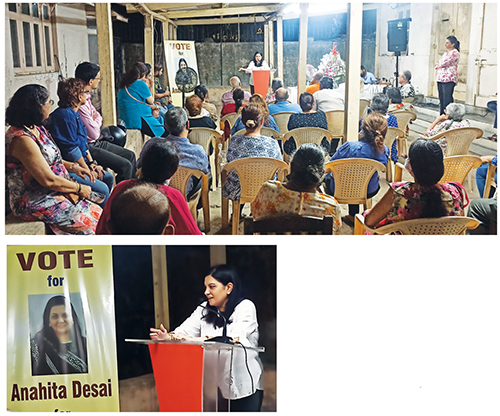
Independent candidate Anahita Desai (top and above) addressing residents of Zoroastrian Colony
Anahita’s agenda
When well-wishers asked candidate and wife of the late BPP chairman Yazdi Desai, Anahita why she was standing for election after all the criticism and insults she and her husband had endured, she replied, "More than 20 years of our lives were devoted to the community. This is our life. This is my life. I can’t think of not having anything to do with the community.” She is the chief executive officer of the traditional World Alliance of Parsi Irani Zarthoshtis. She had stood twice earlier for trusteeship and lost, narrowly the second time. The voters did not favor a husband-wife duo on the seven-member board. She noted that unlike Yazdi who had to balance a professional career along with his community involvement, "I do not have any career… and not too many family responsibilities.”
Stating that the management of Doongerwadi was of prime importance to the trust, she enumerated the various projects she had undertaken to refurbish the bunglis, "though I am not a trustee.” The donors had given her authorization to act on their behalf. She recalled the time when Yazdi was on the board, some of the majority trustees had written to the BPP personnel that she could not "contact any of the staff…That was very hurtful.” Attempts were made to keep her out of the restoration and inauguration of the BPP’s Godavara Agiary "but as Yazdi and I were the biggest donors…I pushed my way” through. The couple had donated Rs 10 lakh (USD 12,920). She stated at least one of the other trustees did not even know where the fire temple was located and asked her for directions. The trustees were not even present at the annual anniversary function, salgirah of the Agiary, she stated.
Though Chikalwadi is not a BPP colony, Anahita told the gathering many issues pertaining to the BPP "are relevant to you.” She referred to housing, noting as per the present policy only those with a monthly income of less than one lakh rupees (USD 1,292) qualified for housing. If the income is more than one lakh, the applicants have to bid in an auction which favors the "richie rich…You are penalized if you are doing well…The middle class is neglected. I will definitely cater to that segment,” she stated. Applicants who lie on their application form or withhold facts, however, "should be disqualified.”
She bemoaned the lack of a proper dharamshala in Bombay and said the existing one near Charni Road was not well maintained. (When Parsiana had carried a complaint from some reader/elected official about the place some years back, the administrator/trustee wrote back to state the place was well looked after.) "Even small anjumans have dharamshalas and they are well maintained… It’s sad the BPP is not looking into this.” If not a building, even a floor could be allotted for this purpose, she suggested.
Terming the BPP’s financial position "pathetic,” she noted that the promised financial subsidies to parents having two or three children have been held back for one and two years due to lack of funds. Though she is connected with the F. S. Parukh Dharamshalla for the elderly located in Khareghat Colony, Parsis refused to donate funds because it is a BPP managed institution. "This is the sad state” of the trust, she lamented. Even the BPP’s employment bureau was moribund. "Let’s be honest. We don’t have an employment bureau.” If it were activated, the bureau could serve as "a bridge between Parsi businesses and the people.”
She condemned the populist policies made recently by the three majority BPP trustees to garner votes. She referred to the scrapping of the Rs 750 service charge levied on all flat holders that eventually resulted in the inability of the trust to pay salaries on time. "Don’t do things to become popular…just to get a few votes…Let’s have honesty and integrity in the community.”
Referring to the conversion of leave and license agreements into tenancies, Anahita said, "I’m not against it…but see what are the ramifications. You are changing the whole system of housing. Why? To get votes.” Though the three trustees had been in a majority for two years, they passed the proposal "in 15 minutes…One week before the court sanctioned election code of conduct” came into force. "You have every right to question them.” She advised the trustees "to respond to people who write to you…treat people with respect.” At the end of her presentation she received thunderous applause. A question-answer session followed and the meeting which started at 7 p.m. ended a few minutes past 8 p.m.
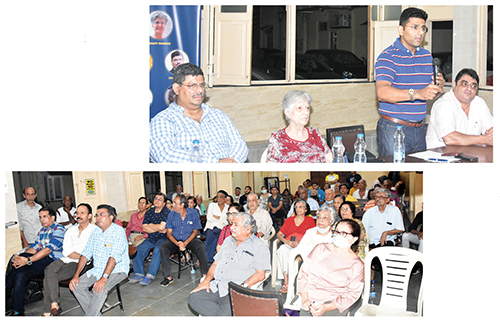
Top: Team Kom-ni-unity (from l) Xerxes Dastur, Armaity Tirandaz, Viraf Mehta and
Rumy Zarir addressing voters at Captain Colony (above)
The majority’s manifesto
BPP chairwoman Tirandaz noted she spent "13 years in the BPP and survived it!” When she was first elected in 2009 people said she received "sympathy” votes as she was seeking the seat made vacant by the untimely death of her husband Rustom. But seven years later when she was reelected, she doubted there was any "sympathy wave…I didn’t hold a single public meeting.” She visited "every baug.” No entourage accompanied her. At one flat a young boy whose parents were not home was so impressed she came all by herself that when she told the youngster to inform his parents to vote for her, he replied, "Madam I’ll make sure my parents vote for you.”
She noted she had sacrificed one year of her seven-year term so that elections could be held for all seven seats at one go. Dastur had given up around three years of his seven-year term. Each election reportedly costs the BPP close to Rs 40 lakhs (USD 51,689).
Keeping in mind the criticism leveled against her, Dastur and Viraf that they do Dinshaw’s bidding unquestioningly, Tirandaz stated, "We are all independent minded. None of us” are rubber stamps. Zarir "is a new entrant” to the group but "he is like-minded and we work together.” Referring to the "back and forth” between her and the Randeria camp she said she "never insulted or mocked” the opposition. When dealing with beneficiaries, "at no time have I ever spoken rudely to them…I always answer phone calls, emails, WhatsApp messages.” Even when she disagrees with her co-trustees, "I never do it in front of the beneficiaries.” People allege, "I am silent and I don’t make decisions. I make decisions. I never ask anybody whether I should say yes or no. If I lasted 13 years, I should have some intelligence.” As to her being too old to hold public office, she responded, "I don’t feel I’m 77. I feel 37.”
Viraf spoke of his "undying love for the BPP and the community.” He felt the Parsi media was "biased in its approach as to what the BPP board has done…They allege we are selling houses to the rich.” He countered the allegation by stating 225 flats had been given for free (of which 48 were allotted to the homeless and 86 to newly married couples). (PJ of May 15 put the figure at 232 since 2015.) "We can only give what we get,” he noted. Only 28 flats had been auctioned. From these 28, the trust realized Rs 55 crore (USD 7,107,229) over the 15 months, when Tirandaz, he and Dastur were and are in the majority, he noted. When they became the majority in 2020, "we got a bankrupt BPP.” Auctions of flats were drawing fewer bidders, he stated, alleging that Randeria’s dissent note opposing the sales featuring below the auction notices deterred buyers. Viraf said the fixed, annual cost of the trust was Rs 24 crores (USD 2,954,441) of which salaries constituted 14.4 crores (USD 1,849,367), of which 70% went to the Class IV employees. Other costs included four crore rupees for Doongerwadi, security of colonies Rs 1.5 crores (USD 192,642), second and third child subsidies Rs 1.24 crores (USD 159,251), education and medical assistance, property tax, etc. On the income side the trust received Rs 6.5 crores (USD 8,34,764) as rent and seven crore rupees (USD 898,998) as interest on investments. "We have a 10-crore deficit every year… We have outstanding of 13 crore (USD 1,669,567) rupees… How is the trust supposed to survive? We are in a majority only for the past 15 months (actually closer to 22 months as the service charge waiver was in July 2020 when the trio were in a majority). You need a group…a majority.”
Every meeting of the trustees is video and audio recorded, Viraf noted, so nobody could backtrack on what they said.
A resident of Rustom Baug, Dastur referred to a flat that he said had remained locked for 45 years. The party was residing abroad. A legal notice was sent, a case filed and finally a compensation of Rs 50 lakhs was offered to vacate the flat. The home was handed over to a family with four children, stated Dastur. "We don’t want the flat to serve as a holiday home for overseas Parsis.” Only a handful "have voluntarily given up their flats.” Litigation can go on for decades. A project to develop the Dhunbai Wadi colony hit a roadblock when some trustees alleged the builder was a friend of a particular trustee. He referred to two or three dissenters blocking the creation of a cosmopolitan hospital whose income would have subsidized the workings of the PGH. "We need to evolve, we need to change” our mindset, he averred. He noted The Federation of the Parsi Zoroastrian Anjumans of India had not been able to monetize a single asset of a defunct anjuman in over 40 years.
Noting that only lawyers "make money from litigation,” Zarir stated that as the recently appointed chief executive officer of the Zoroastrian Building Trust he had been able to settle "quite a few cases” involving the multiple baugs and buildings the trust owns.
Named as one among the top 100 Covid warriors in Bombay, according to Viraf, Zarir mentioned how he had halted encroachment on the Thoothi Agiary property and was instrumental in stopping the construction of a public toilet block near Indawalla Agiary. Noting that "we will never be able to do for the (community) what our ancestors have done, at least we should look after” what they left behind. Stating that he was "a common man who came up the hard way,” he asked the audience to "give me that one chance…to be your voice.”
In the question answer session that followed Viraf, defended the 14-month delay by the three majority trustees in holding the election, saying they were concerned about Covid and subsequently the Bombay Municipal Corporation guidelines that restricted campaigning. When one lady complained about waiting for hours to meet the trustees, Viraf and Dastur replied they were working on a plan whereby requests could be made by email and the BPP senior staff could convey the responses by email. Caterer Jimmy Gadiwalla narrated the incident of how the BPP trustees, Tirandaz in particular, bypassed bureaucratic niceties and financially assisted a Captain Colony resident who took ill and required urgent dialysis.
The meeting that started at 6 p.m. ended at 8.40 p.m.