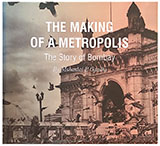
The Making of a Metropolis: The Story of Bombay by Mohanlal Popatlal Gandhi (1904-1996). Published in 2024 by Spenta Multimedia Pvt Ltd, 5th Floor, Industry House, 159, Churchgate Reclamation, Bombay 400020. Pp: 300. Price: Rs 2,950.
In the 1960s there weren’t as many books on the history and development of Bombay accessible to the public as we have today. This might have inspired Mohanlal Popatlal Gandhi, dedicated to reading and writing, to research and write a comprehensive volume about his city. This book is the full reproduction of his manuscript which his daughter Minaxi Kamath discovered and published after his death. The 300-page volume is divided into five parts, and is now illustrated with pertinent color and black-and-white photographs.
Mohanlal Popatlal Gandhi: extensive research
Though not much is known of Bombay’s oldest inhabitants, coins dating back to the third and fourth centuries were discovered in the Kalbadevi area which was, even then, part of the largest and most significant of the seven islands that comprised Bombay. The recorded period of the arrival of Hindus begins with Raja Bimb, who marched southwards from Deogiri’s hill fortress in 1296, when the fort was captured by the Sultan of Delhi Alauddin Khilji. Hindu rule ended in 1348 when Muslim rulers who were invited by one Hindu clan to fight another got the better of both and established their own rule. Raja Bimb retains his significance for having brought with him the Pathare Prabhus who immortalized him in Bimbakhyan, a commemorative volume of great historical significance.
When Vasco da Gama found a sea route to India around 1498, the Portuguese travelled northward from Calicut and settled in Goa. They had their eyes on Diu, and used Bombay harbor as a convenient stopover en route. They were not keen on staying in Bombay but in 1534 Sultan Bahadur Shah of Gujarat, who ruled over Bombay, "gave and bequeathed to the King of Portugal from that day and forever (Bombay’s) territories, islands and seas and all its revenues” in an agreement to prevent the Portuguese from capturing Diu. Wherever they went, the main pursuit of the Portuguese was proselytization, and so they built the church of St Michael in Mahim as the first church in Bombay. Converting Bombay’s seven islands into four by reclamation from the sea is the only other significant achievement of the Portuguese.
From the hands of the Portuguese, Bombay fell into the lap of the British as a wedding present for King Charles II, from the King of Portugal, whose sister the British monarch married. Bombay then began to assume significance geographically. In spite of setbacks like disease, floods, cyclones and earthquakes, its real development began, with docks, railways, electrification, road systems and services like the post, telephonic communication, banking, stock exchange, mills and trade organizations. A boost was given to education in 1813, when the East India Company included in their budget for the first time a sum of one lakh rupees for education, though it was Governor Mountstuart Elphinstone who, in 1822, helped found the Native Education Society. Later, women’s education was encouraged by Dadabhai Naoroji, and the SNDT (Shreemati Nathibai Damodar Thackersey) University was established in 1916.
In sport, Parsis were the first to take to cricket and founded the Oriental Cricket Club in 1848. The Parsi Gymkhana, too, was the first to be established in 1888, when Parsi cricket teams went to play in England. Eleven Parsis feature among the 30 shortlisted and briefly described in The Men who Built Bombay over 300 years.
Bombay inspires the author to end his book with the words: "There cannot be a better prospect for a city than to widen the horizon of its hope. And a city can be maintained or destroyed more easily by throttling hope than by gunfire.” P. B. J.