An annual lecture and a street intersection
commemorate Nani A. Palkhivala
Arnavaz S. Mama
"Nani Palkhivala’s life was marked by total commitment to our country, to the public weal...Each of us could add a number of instances to... the list of debts we owe Mr Palkhivala. I would recall just two or three — to illustrate the deep commitment that Mr Palkhivala had to first principles, to fundamentals, a commitment we must imbibe.”
In the second Nani Palkhivala Memorial Lecture titled "Prerequisites of Freedom,” Arun Shourie, former editor-in-chief of The Indian Express and former minister of disinvestment and telecommunications in the erstwhile National Democratic Alliance (NDA) government, noted, "When challenge comes, there is no substitute for character. Too many of us professionals calculate, weigh the pros and cons, try to rationalize.” When the Allahabad High Court held then Prime Minister Indira Gandhi’s election to the Lok Sabha invalid in 1975, Palkhivala had agreed to defend her by an appeal in the Supreme Court. Virtually overnight she had a subservient Lok Sabha enact the 39th amendment to the Constitution which insulated her against any legal challenge to her election. Palkhivala returned the brief. He did not pause to consider the repercussions of doing so, noted Shourie.
Shourie recalled other iniquitous constitutional changes under the Emergency which sought to abrogate the powers of the judiciary and the civil rights of the people. Palkhivala’s sturdy reasoning and courage aided by upright lawyers and judges had eventually turned back the tide of dictatorship that had threatened to engulf the country. "There are times when a word is a deed. Those were such times,” said Shourie. He maintained that the first requisite of freedom is that professionals should not be available to draft such sycophantic statutes.
Godrej Dotivala, Gandhi, Shroff, Annie Shekhar, Behram and Dhun Palkhivala and Deora at the chowk
"The victory against the Emergency was one of the most exhilarating moments since Independence. A determined assault against freedom had been pushed back... But since that fateful encounter in 1975, the state of India has become progressively weaker. Today governments are riddled coalitions. Therefore, they just cannot mount an out-and-out assault on freedom. And so we feel our freedoms are secure. But having muscle to withstand an open assault does not shield one against slow rot from within,” said Shourie. He referred to the appalling conditions in Bihar where the state is weak in comparison to the local toughs. Referring to the debates of the Constituent Assembly of 1946 Shourie quoted Dr Rajendra Prasad’s reservations: "It is anomalous that we should insist upon high qualifications for those who administer or help in administering the law but none for those who make it, except that they are elected.” "The consequences of that omission pile one on the other...Thus, irrespective of how sagacious the Prime Minister is, irrespective of the fact that six or seven of his colleagues are world class, the character, comprehension and capabilities of the average legislator have decisive, and all too often deadly consequences for programs and policy,” stated Shourie.
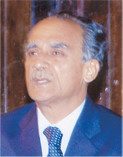
Shourie: "qualifications for legislators?”
The increasingly casteist, tribal and divisive elements in political parties are throwing up legislators who are unable to see the needs of the country as a whole, noted Shourie. "Second rate persons choose third rate persons...My heart is full of foreboding. India had lost her freedom because of internal divisions. She can lose her freedom again...” And yet there is hope. For when concerned citizens take up a cause and fight for it, success in the classical democratic mode is possible, noted the speaker, as he congratulated Shirin Bharucha, Palkhivala’s legal assistant at Bombay House, on her long but eminently successful fight to save the Oval maidan.
Though Shourie’s talk riveted the audience at the Tata Theatre on January 12, 2005, the presentation was but a synopsis of an effort that was later carried by The Indian Express over four instalments beginning January 20, 2005. In his welcome address Yezdi Malegam, chairman of the Nani A. Palkhivala Memorial Trust spoke of Palkhivala’s "romance with the concept of personal freedom” and of his disappointment with the apathy of citizens and quoted Palkhivala’s prophetic words, "Freedom cannot be inherited.”
Palkhivala Chowk
After the unveiling of the plaque designating the intersection between Homi Modi Street and Mudanna Shetty Marg as Padma Vibhushan Nani Palkhivala Ardeshir Chowk by Member of Parliament Murli Deora on January 14, 2005 the speakers and audience repaired to Bombay House to recount the redoubtable lawyer’s many qualities of head and heart.
Recalling Palkhivala’s moral courage, unmatched eloquence and command of language, his versatility and wide ranging interests, study and scholarship, Bombay Parsi Punchayet (BPP) chairman Minoo Shroff, who has succeeded Palkhivala as president of the Leslie Sawhney Programme of Training for Democracy, remembered how at a State Bank of India function Palkhivala said not a word about banking but spoke for 90 minutes on the contribution of Sri Aurobindo. His concern and care for the underprivileged led Nani Palkhivala to distribute his personal wealth to various charities, noted Shroff, upholding the lawyer as the "ideal role model for those who aspire to active public life.”
(From L) Shekhar, Gandhi, Bharucha, Shroff, Deora, Dada, Engineer and (Right) Ranina
Pravinchandra Gandhi, president of The Bharatiya Vidya Bhavan spoke of the "creative radiance that emanated... from my friend and colleague .” He spoke of how Palkhivala had sought the economic reconstruction of India. And of the lawyer’s "brilliant advocacy. To listen to his arguments in the Supreme Court was to fall under the spell of his magic persuasion. Yet he spoke nothing but the truth.”
"When Palkhivala addressed the Bar in 1975 and spoke about the supersession of judges, the Bar stood up in unanimous support,” recalled senior counsel and the president of the Bombay Bar Association Rafiq Dada. An appeal by this "gentle colossus” meant the surest chance for the litigant to succeed, declared Dada as he referred to cases fought by Palkhivala on behalf of the poor and for the rights of minorities.
"Bombay House was his second home. It was also the premises whence the Indian Constitution was defended,” offered Supreme Court counsel and Nani’s nephew Homi Ranina. He described his uncle as a "man of great humility (who) despised security and special protection. Respect as an Indian citizen was enough for him.” Noting that the "standard of life was more important to Nani than the standard of living,” Ranina spoke of Palkhivala’s concern for the judges, that they be provided with enough to enable them to live and work in dignity. "Our best tribute is to follow in his footsteps.”
A former student and later friend of the great man, noted solicitor and BPP trustee Dadi Engineer spoke of Palkhivala’s stammer as a child, of his not being selected for a lectureship at Wilson College, of how he missed a flight to Delhi because of viral fever in 1953. The plane crashed without a single survivor. But Palkhivala was spared to be a living legend of the law.” Engineer recalled how Palkhivala was often late for his lectures at the Government Law College but his explanations were so lucid, no one missed his lectures which he gave without notes or text books. In those days Palkhivala’s shock of hair added two inches to his height and walked so fast, Engineer couldn’t keep pace with him!
"As law students we lived and breathed the Keshavananda Bharati Case,” reminisced municipal councilor Vinod Shekhar. "Palkhivala’s life we would all like to emulate but few can...By naming the chowk we have immortalized him in the geography of this metropolis.”
Listening to the eulogies at Bombay House auditorium
Acknowledging that by naming the chowk after Palkhivala we are commemorating the place where he spent 40 years of his life in the service of the nation, Malegam suggested that the unnamed road where the Government Law College stands, where Palkhivala studied and was a part-time lecturer, was a more appropriate memorial for the man whose own life work was memorial enough. But we need to remind ourselves of Nani’s contribution and the values he stood for. "We remember him as a most virulent critic of the government and the bureaucracy but he was also most respected by them. He was a staunch follower of his own religion but catholic in his approach. He had a vast private practice but he never hesitated to give his time to the nation,” Malegam enumerated some of Palkhivala’s traits, most specifically the latter’s "regard and concern for his fellow citizens.”
"One of Nani’s great attributes was his brevity which I will emulate,” began former Chief Justice of India Sam Bharucha, going on to recall their times in the chamber of the redoubtable Sir Jamshedji Kanga which produced such legal stalwarts as Hormusji Seervai, Murzban Mistry, Cursetji Bhabha, Fali Nariman and Soli Sorabji; where the premises were so cramped, "Nani used to hold conferences in his car...By the time I joined, Nani was into Income Tax practice which was alien to me...My interface with Nani began after the Monopolies Act came into force.” Bharucha spoke of "Nani’s immense ability to explain nuances of the statute, to think on his feet; his grasp of language that enabled him to put forth his response in the simplest language possible.” Bharucha remembered the Air India case when J.R.D. Tata was at the helm. "The case was going badly. The only answer was to get Nani. There was a brief conference. The points involved pure fact, no law. In an hour’s time Nani began arguing.” The second time for Air India there was a conference for only 10 minutes in the court corridor before the matter was called, said Bharucha, marveling at Nani’s ability to not only grasp law but facts in such brief periods. "It is fit that some memorial should be named after someone who has given such enormous contribution to the public weal. But 50-75 years on people walking this street will ask who was Nani Palkhivala? We should prepare a biography of Palkhivala not only recalling his contribution to the law but also to business and his many charities.”
Congratulating the city’s Municipal Corporation for agreeing to pay tribute to Palkhivala, Deora recalled his personal experiences of the man: "He was a great participant in things happening around us.” As leader of the Corporation Deora recalled his own humble — and unsuccessful — attempt to get the Bombay Municipal Corporation (BMC) basic training in democracy. Palkhivala was then chairman of the Leslie Sawhney Programme of Training for Democracy, and hence privy to Deora’s effort. On another occasion Deora had Palkhivala inaugurate the North Bombay Chapter of Jaycees. "Nani’s speech began with a quote from Plato: ‘The punishment of wise men is to live under the government of unwise men.’ Active citizenship was his goal. He was against the licence-permit raj (and) used to be called an American agent (by some members of the then government). The height of a tree is best measured when it has fallen. Today when Nani Palkhivala is no more, we realize what a great man he was.”