The heritage buildings in Bombay’s downtown area
resulted from a need to expand beyond the erstwhile Fort
Farrokh Jijina
The demolition of the overcrowded Fort in Bombay resulted in the creation of "one of the most prestigious areas” in the city, according to Rashna Poncha, assistant professor, department of history, Sophia College for Women. The academician was delivering the Gulestan and Rustom Billimoria Memorial Lecture on "Native Precinct, Colonial Realities: The Genesis of the Esplanade Estate” at The K. R. Cama Oriental Institute on March 23, 2017. Poncha, who has recently submitted her doctoral thesis in November 2016 to Bombay University on "A study of Frere Town, Bombay, 1862-1947,” explained that the British-built Fort "that was constructed for security purposes,” had outlived its purpose by 1850. The British were firmly in control of the growing city and there was "no threat of attacks.” The buildings within were susceptible to fire, and the inhabitants were at risk of disease on account of cramped living conditions. Sir Bartle Frere, the then governor decided that it was time to expand the area available for its growing population. The demolition was commenced in 1862 by the Army engineers and the newly set up Public Works Department, she said.

Rashna Poncha Photo: Farrokh Jijina
The semi circular area outside the western flank of the Fort facing the Arabian Sea where no buildings were allowed, and which was used as a parade ground, was the site chosen for the proposed expansion, which came to be called Frere Town. The development extended from the current day Capitol Cinema opposite the Victoria Terminus (VT) to Cooperage, she explained, with neatly marked maps from that period. The Esplanade Estate was that part of Frere Town that was "to house majestic offices, grand residences and educational institutes.” It is an area bound by the Hornby Road, [current Dadabhai Naoroji (D. N.) Road], Esplanade Road [current Mahatma Gandhi (M. G.) Road] and Waudby Road (current Hazarimal Somani Road), the historian told the audience.
The Rampart Removal Committee set up by the colonial administration to oversee the new development had stipulated "strict conditions” for the proposed buildings. All construction plans had to be approved by the Committee, which had laid down guidelines for styles (neo-Gothic or neo-Classical) and completion time frames. The guidelines even suggested what kind of trees were to be planted in the Estate and who would maintain them. Arcaded pavements along the main road were a must. "They took their open spaces seriously, back then,” said Poncha. As a bonus, the government even gave out some extra space, if the purchaser bought larger plots or more than one plot!
The right to build on the land was leased to the highest bidder, explained Poncha. The first plots were taken up in 1864 at prices that averaged Rs 95 / sq yard and fell to Rs 30 / sq yard around 1881. The plot where the Bharda New High School stands today was sold at Rs 25 / sq yard, she informed the audience. Prices were reduced as there were fewer interested parties at the northern end of the Estate, closer to VT.
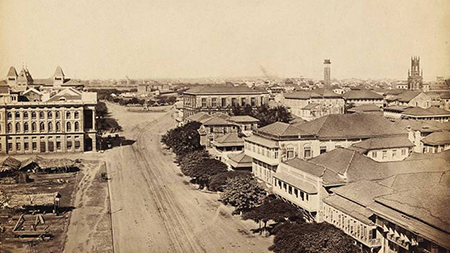
Looking northward towards Esplanade Estate
Hornby Road, currently Dadabhai Naoroji Road
Parsi Lying-in Hospital
Oriental Insurance Building at far left
The historian provided interesting snippets about certain buildings in the Estate: the site where the J. N. Petit Library stands currently, was leased by the Tatas and transferred to the Petits as "they had a greater need” for the corner plot; the iconic Oriental Insurance Buildings that occupy a triangular shaped plot at the corner of M. G. and D. N. Roads earlier housed the Cathedral School; the authorities were reluctant to lease two large plots to a single individual (Jamsetji Tata) for what was to later become Esplanade House, but subsequently acceded to the request. Tata offered Rs 25/sq yard, and the deal was finally struck at Rs 30/sq yard, Poncha quoted. The construction of a mews for stabling horses and carriages of the proposed residents drew much flak from the new occupants of the Estate. The Esplanade was "the only open area left to enjoy the sea breezes for the modest classes,” was the common refrain, until the government had to step in and assure that cleanliness would be maintained.
By 1907, all 65 plots that were put up for sale had been leased and by 1910, all had been built upon. Poncha rued the disappearance of the York Building on the eastern edge of the Estate (facing the D. N. Road) in October 2015 after it was re-designated a Grade III structure and therefore allowed to be demolished. "These buildings were the precursor to the megapolis that the city became, and we are now seeing the last vestiges of our past that must be preserved,” commented the historian.
Chairing the session, Dr Sr Anila Verghese, director of the Sophia Shree B. K. Somani Polytechnic and principal of the Sophia -Smt Manorama Devi Somani College called Poncha a "thorough and meticulous professor” and reminded the audience that the historian had been her student in her undergraduate years. Dr Nawaz Mody, honorary secretary of the Institute welcomed the audience and also proposed a vote of thanks.