The Ruttonjees: Industry, Foresight, Charities by Carl Shu-Wai Lau. Published in 2024 by Plus Group International Limited, A3, 11/F, Winner Building, 36, Man Yue Street, Hung Hom, Hong Kong. Pp: 141. Price: Not mentioned.
While there is some literature dedicated to the history of the Parsis of Hong Kong (HK), it hardly does sufficient justice to the community’s immense contribution to the place. The Ruttonjees: Industry, Foresight, Charities, a coffee table book commissioned by Rusy and Purviz Shroff, therefore fills an important gap by narrating in some detail the contributions of two exceptional families. It brings to the reader a vivid account of the personal successes and the major contributions to HK of two distinguished inter-related families, the Ruttonjees and the Shroffs.
Ruttonjee and Mody are household names in HK, the former principally due to the Ruttonjee Hospital and the latter due to a busy street in Tsim Sha Tsui. But few people know the names of the persons this civic memorialization honors: Jehangir Hormusjee Ruttonjee and Sir Hormusjee Mody, important members of the Parsi community of yesteryears. And if millions of people travel between HK and Kowloon on an iconic ferry service they have Dorabjee Naorojee Mithaiwala who founded the Kowloon Ferry Company to thank for it.
Above l: Zarir Rusy Shroff Annex at Freni Care and Attention Home;
above r: headquarters of Hong Kong Tuberculosis, Chest and Heart Diseases Association
Front row: graves of Jehangir, Banoo and Dhun Ruttonjee
at the Hong Kong Parsee Cemetery;
behind: grave of Sir Hormusjee Mody
The story starts with Hormusjee Ruttonjee from Bombay disembarking at the Fragrant Harbour on August 21, 1884 to join a centuries-old Zoroastrian diaspora. As author Carl Shu-Wai Lau tells us, "He brought with him not only a keen acumen for business but the fundamental Zoroastrian belief in charity and philanthropy. The HK dynasty that he founded was destined to become synonymous with both.” This book charts the history of that family from its humble origins as purveyors of stationery, groceries and liquor to the "modern force of community-minded charity” that it has become. The family who made its money largely from the brewery poured back much of that wealth into philanthropic projects, the most famous of which is the hospital that bears its name.
Hormusjee Ruttonjee, who was from Valsad, started his career as a clerk at P. F. Davar & Co, wine and provision merchants, on a salary of 13 HK dollars (Rs 145) a month. Eighteen months later he was invited by B. P. Karanjia & Co, who had an opium business, to run their office from Canton. He established a reputation for consistent and transparent honesty in his dealings and this helped him set up his own business three years later. Beginning in 1887 as B. M. Ruttonjee & Co, it appears that he had taken over the business of his erstwhile employer P. F. Davar. Ruttonjee traded in groceries, wines and spirits, and other general provisions. As the European population grew so did the demand for European foodstuff, and more importantly liquor. By the time the store’s name changed to H. Ruttonjee & Co. in 1890 the inventory had expanded to include fresh produce and even stationery.
Like Mody who was swift to realize the potential of real estate in Kowloon on the Chinese mainland and played a key role in in the foundation of the Hong Kong Jockey Club, the Kowloon Cricket Club and the University of Hong Kong, Ruttonjee saw great potential in Kowloon. It was here that his business expanded and diversified into the hospitality industry with the opening of several hotels. The foresight to invest in the area paid rich dividends and laid the foundations of the family’s wealth that was built upon by the next generation. Hormusjee retired in 1913 and the business passed into the capable hands of his son, Jehangir, who was born in 1880 in Valsad and arrived in HK with his mother Dinbai in 1892. After completing his graduation, Jehangir joined his father’s business. However, it was only in 1907 that H. Ruttonjee & Co. became H. Ruttonjee & Son, Ltd.
But there was another partnership in store for Jehangir before the business changed its name. In 1902 he married Banoo Master in India. They would go on to have a son and three daughters. Dhun was born in 1903, Tehmi and Freni followed in 1907 and 1909. Their fourth child Khorshev died at a very young age. In time they effectively adopted three others, Rusy, Beji and Minnie Shroff, the children of Banoo’s niece Tehmina Shroff.
There appears to have been a cooling in relations between Hormusjee and Jehangir when the father took a Chinese wife by the name of Alice Tung. Jehangir took over the business completely but only through the act of buying out his father through formal channels. The rift continued for decades and it took the trauma of the Japanese occupation in 1941 for the ice to melt. By that time Jehangir had become the face of the family business and the principal steward of its prosperity. It was he who steered the family towards its most famous achievements in business and philanthropy.
Jehangir had won contracts to supply the British armed forces in HK and he invested the profits into further real estate acquisitions. The land he bought on Duddell Street in 1923 is the site of the headquarters of the family’s business operations, manifested today as the Ruttonjee Centre in steel and concrete with the 31-storey Ruttonjee House and 25-storey Dina House. But Jehangir was not one to rest on his laurels. He realized that the large and growing demand for beer made local production a sound business proposition and decided to start a brewery. The journey was a long one and there were many roadblocks on the way but suffice it to say that in 1930 Jehangir became the managing director and the largest shareholder of the Hong Kong Brewers and Distillers Ltd that sold HB brand pilsner and dark beer. Brewing operations commenced in early May 1933 with a grand ceremony in August to mark its opening. But by the mid-30s the HK dollar had appreciated so much that British-made beer provided serious competition to Jehangir. By 1935 there were severe losses and in December that year a resolution was passed to voluntarily wind up the company.
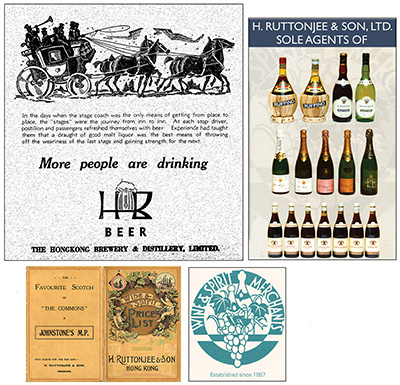
Advertisements for the family’s liquor business
Author Carl Shu-Wai Lau
But Jehangir was not one to admit defeat so easily. In April 1936 the business and goodwill of the erstwhile company was transferred to Ruttonjee Estates Ltd. A new company, Hong Kong Brewery and Distillery Ltd was floated and the beer started flowing once again. Slowly, the financial viability of the company improved with the government agreeing, rather belatedly, to lower the duty on locally brewed beer. By 1941 annual production had touched a quarter of a million gallons of high quality beer. But dark days were ahead. The Japanese occupied HK in December 1941 and the brewery was taken over by them. Jehangir was at the forefront of relief work and placed the two flagship properties which had basements at the disposal of the Parsi community as war time shelters. Jehangir and his son Dhun were even arrested by the Japanese but set free after a brief detention. In the following years not only did the family business suffer but in 1944 Jehangir lost his daughter Tehmi (to tuberculosis) and his father. The brewery was sold in 1948, for the then record sum of six million HK dollars (Rs 6.70 crores).
Even though the brewery was sold Jehangir did not forget the villagers of Sham Tseng where it was located. He built dispensaries and donated land to a Protestant missionary to build a primary school. In fact, the Ruttonjee name is indelibly linked with the Ruttonjee Hospital which prior to its development as a hospital was known as the Ruttonjee Sanatorium and managed by the family. When Jehangir sold his brewery, he also pledged half a million HK dollars (Rs 55 lakhs) towards a sanatorium specifically for tuberculosis patients. The donation too set a record and the next year Jehangir followed it up with a donation of another HK $ 300,000 (Rs 33 lakhs). Equally munificent donations followed later. All of HK mourned Jehangir’s passing away in February 1960.
It was through the Ruttonjee Sanatorium that Dhun rose to prominence. There had been a falling out of sorts with Jehangir when Dhun married a Chinese, Annie Yip. Later, there was a rapprochement. In time Dhun would become one of the most prominent political figures in post-war HK, honored with an OBE (Officer of the Order of the British Empire) and then a CBE (Commander of the Most Excellent Order of the British Empire). In 1968 Queen Elizabeth II granted him the honorific of "Honourable.” When Dhun died in 1974 his many roles were taken up by Rusy and Beji. Rusy, who had married Freni, was also Jehangir’s son-in-law. After Beji’s death in 1997 Rusy’s second wife Purviz (née Moogat) took a more active role in the business. Rusy too received many honors including an MBE (Member of the Most Excellent Order of the British Empire).
The germ for this well-researched and engagingly written book arose from the author’s anthropological field work at the site of the Ruttonjee Brewery. The fond reminiscences of the locals piqued his interest and he began researching the Ruttonjee family’s considerable contribution to HK. Rusy and Purviz not only agreed but also assisted financially with a sizable donation to fund the research. This well-produced book that throws light on the contributions of two eminent families of the Parsi diaspora deserves to be read.
BAKHTIAR DADABHOY
Dadabhoy is a Secunderabad based author.