Perseverance and generous donations saw
The New Bombay Zoroastrian Association commence work on their fire temple
Parinaz Gandhi
The metallic bangle was slipped off the infant’s wrist and tossed into the cupped palms of the architect standing in the pit. A young mother removed her silver ring and placed it in the same receptacle. Other trinkets, coins, medallions, seals brought by the members of The New Bombay Zoroastrian Association Charitable Trust (TNBZACT) were offered at the time of the foundation stone laying of the new agiary and hall building at Plot No. 14/2, Sector 9, Koparkhairne on June 15, 2014. Under the instructions of Dastur Khurshed Dastoor who had earlier officiated at the jashan on that Sunday morning, the paanch dhaatu (five metal) objects were laid on an engraved copper sheet, nearly a foot in length.
Artist’s impression of proposed agiary (right) and hall building at New Bombay
Cover: Architect Jamshed Bhiwandiwalla (in pit) at the foundation stone laying of
the New Bombay Zoroastrian Association fire temple Inset: Sharukh Doctor
Photos: Jasmine D. Driver
On both the copper plates readied by the High Priest was inscribed in Pahlavi script, a nirang (traditionally distributed on mah Spandarmad, roj Spandarmad to be hung outside the door of one’s residence) to ward off evil and wicked forces. Besides recording the date of the event, mah Bahman, roj Bahman, the two sheets earmarked for the two pits, one for the foundation stone of the agiary and the other for the hall building, also bore the names of the principal donors.
"The complete expenditure for building this Atash Adaran is being borne by the executors and trustees of the estate of Shirinbai K. Doongaji,” noted the contents of the time capsule buried alongside the metallic objects, coconut, betel leaf and betel nut in the agiary pit. As per Parsi custom, the architect of the project Jamshed Bhiwandiwalla was meant to break the coconut on the cement slab and sprinkle its waters on the ground. But his repeated thuds yielded only a couple of drops from the near dry coconut. Fortunately a light drizzle that continued for barely two minutes made the congregation feel divinely blessed.
The action then shifted to the second pit, a few feet away, for the community hall where similar preliminary rituals were conducted. As per the contents of the time capsule buried in this pit, "The complete expenditure for building this community hall is being borne by Dara Hormusji Hansotia in loving memory of his dear departed wife Dr Mehroo Hansotia.” The coconut breaking ceremony with one swift movement was performed by the benefactor’s nephew Viraf Hansotia.
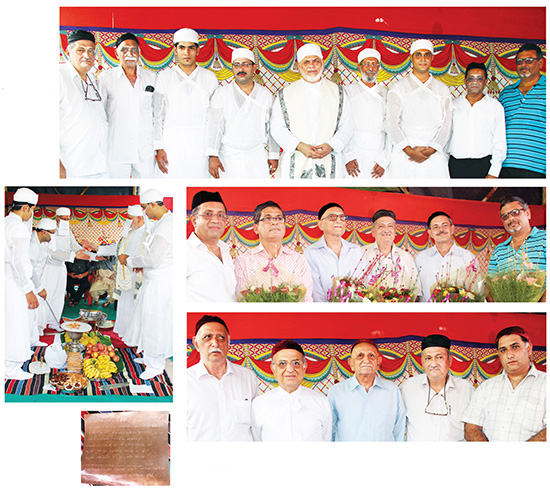
(Top) Sharukh Doctor (far left) with his co-trustees and priests who performed jashan;
(2nd row) with representatives of the Doongaji family;
(3rd row) with Dara Hansotia (center) and other guests; (left) Dastur Khurshed Dastoor leads
jashan and metallic sheet bearing Pahlavi nirang
The jashan that morning performed by five priests stretched longer than normal because "we prayed seven kardas,” explained Dastoor. Such a momentous occasion deserved to earn the blessings of Spandarmad, the giver of prosperity and protector of land, Ardibehest, that promotes righteousness and piety, Srosh, the fire, Bahman, the good mind that increases wisdom and knowledge and protects the animals... Whilst the whirring of the pedestal fans in the shamiana may have drowned the intonation of the priests on that sultry Sunday morning, for the devotees from New Bombay who had gathered there, the day was of considerable import for they were nearing their dream to have their own fire temple instead of commuting to Dadar or Bandra or Thane. By the time the assembly partook of the consecrated chasni, the foundation stones had already been sealed.
It was only a month earlier they had been granted a commencement certificate by the Navi Mumbai Municipal Corporation to start construction work on the 1,000 sq m of land sold to them by
CIDCO (City and Industrial Development Corporation) "for Rs 65 lakhs, which is 1/10th of the market price. The time limit for completion of our project is June 2016, else CIDCO will levy a penalty premium which may be 100% or more,” stated Sharukh Doctor, managing trustee of TNBZACT who has been primarily responsible for pursuing this dream since 1995. A retired chemical engineer with extensive experience in project and operations management in India and abroad, Doctor’s skills are matched by his current co-trustees: treasurer Noshir Parlewalla, a retired chartered accountant, secretary Nozer Mirza, a retired engineer with considerable experience in project and maintenance management, and Dr Dorab Daruwalla, a long-standing pediatrician.
The TNBZACT core team has been bringing together Zoroastrians in the New Bombay area at their bi-annual dinner meets organized at different hotels in the vicinity. Their Trust, registered in 1993, accepts membership from Zoroastrian families who pay annual dues of Rs 1,000. Currently they have 65 families comprising nearly 250 individuals as members, and they accept into their fold the families of men and women who are married out of the community who constitute 15-20% of their total strength. As per their estimates, they have 12% who are under 20 years of age, and 32% aged above 60, with the majority 56% falling in the 21-59 age group.
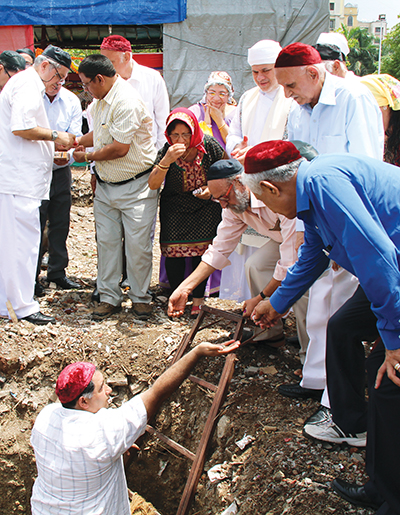
Viraf Hansotia given metallic objects to place in pit for the hall building
The sacred saga
Sharing "the saga of the New Bombay Agiary,” Doctor recalled how TNBZACT members "were always desirous of having a meeting place of our own like the other communities who were given concessional plots to have their places of worship and social facilities.” However, their membership comprising "all middle class or lower middle class people with not a single businessman amongst us, we simply could not afford to contribute the sum required even to buy a concessional plot.”
In 1995 they had sent circulars to several Parsi Zoroastrian trusts in India and overseas and even a decade later were merely inching towards their goal until Rustom Vakil, managing trustee of The F. H. B. Sethna Legacy Trust approached TNBZACT senior founder member Aspi Dadachanji and offered to pay for the concessional plot in 2006. Since 50% of the Sethna Trust’s trustees were not from New Bombay, they could not be allotted the plot whereupon they requested CIDCO to assign the plot to TNBZACT and contributed Rs 10 lakhs towards the purchase. The cost of the plot then being Rs 36 lakhs, and the Trust falling short of Rs 16 lakhs, the members managed to raise nearly Rs 15 lakhs in a few months and made a fresh application to CIDCO.
In 2008 they accepted CIDCO’s offer of a 1,000 sq m plot, with member Hoshang Ambapardiwalla who was working as a project specialist with CIDCO rendering considerable assistance in helping the files move to The Urban Development Department at Mantralaya. After continuous follow-up the Home Department gave a clearance and CIDCO issued an allotment letter more than three years later, not for the earlier plot but for a smaller plot of 850 sq m costing Rs 63 lakhs. Faced with this new challenge, Doctor and another member Farhad Elavia met the chief minister of Maharashtra Prithviraj Chavan at his residence who gave the necessary instructions to his assistants that helped TNBZACT get a fresh offer from CIDCO. Fortunately they were even able to convince Tanaji Satre, then vice chairman and managing director and currently chairman and managing director of CIDCO, to restore the plot to its original size and on receiving a confirmation paid up the full amount to get possession in January 2013. Within four months they had built their compound wall. In addition to Doctor who contributed over Rs 20 lakhs towards the purchase of the land, yet another major donor was Dr Cyrus Poonawalla, chairman and managing director of Serum Institute of India Limited who gave Rs 20 lakhs.
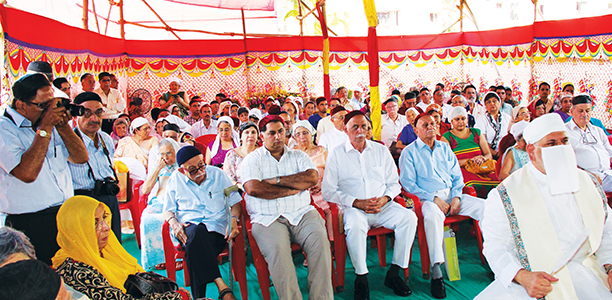
Gathering at the foundation laying ceremony in New Bombay
At that time they had also approached the Bombay Parsi Punchayet (BPP) for assistance but chairman Dinshaw Mehta insisted that it did not make sense to build a new agiary when the Parsi population is declining everywhere. "We argued that should not the religious needs of the New Bombay Parsis be met? We argued that none of our Parsis in New Bombay have asked for charity housing from the BPP and that we all had paid and are still paying back loans for our houses. But to no avail… It seems the BPP has crores of rupees to fritter away on meaningless litigation but does not have funds for the betterment and progress of a growing Parsi community in their backyard,” regretted Doctor who is still hopeful that the BPP will support them as will other charitably inclined Zoroastrians who could send funds in the name of "New Bombay Zoroastrian Association Charitable Trust” to Doctor at Plot 179, Lane F, Sector 8, Vashi, Navi Mumbai 400703, mob: 9869016730, email:
smdoctor47@yahoo.co.inSupport for the structures
Towards the construction of the agiary, a sum of one crore rupees has been promised by the executors and trustees of the estate of Shirinbai K. Doongaji. Whilst trustees Khurshed Doongaji and Aspi Darukhanawala were present for the foundation stone laying ceremony, senior trustee Behram Bharucha could not attend. "The noble lady who died 40 days short of her 100th birthday in 1997 did not have any children,” revealed Darukhanawala. She and her husband who were cousins with their roots in Bharuch had made an irrevocable will in 1973. From the sale of her property in Bombay, the price of which had considerably appreciated in the last few years, the trustees were able to make a donation to TNBZACT and have made a similar offer of nearly a crore to the B. D. Petit Parsee General Hospital (PGH) to initiate an enduring facility in her memory.
The four-storeyed building on the same plot in New Bombay will accommodate two airconditioned halls of 2,800 sq ft each on the two lower floors which will be hired out to Parsis and non-Parsis to generate income for the agiary, and a home for the aged on the top two floors. The cost of one of the halls is being borne by philanthropist Dara Hansotia who made a contribution of Rs 80 lakhs on the understanding that it will be named after his gynecologist wife Dr Mehroo who passed away five years ago. Former president of the Federation of Obstetric and Gynaecological Societies of India, she had established a Fertility Clinic in 1969 with her associate Dr Sadhana Desai and together they reported the first invitro fertilization baby in the private sector. Mehroo being an honorary consultant at several hospitals including the PGH, Dara donated one crore rupees to the Corpus Fund of the Hospital, the interest from which will be used through the Poor Patients’ Subsidy Fund to finance the cost of hospitalization facilities such as medicine, surgical stores and/or diagnostics for poor and needy Zoroastrians.
The decision to earmark two floors as a home for the aged was "solely my idea,” reports Doctor. For a community that enjoys a long life span and being a witness to his father Mahiar crossing 95 years and his grandfather Manchershah 92, he felt it necessary. "In this day and age when most of our youngsters are migrating abroad, such a facility will be a boon to the older generation who still prefer living in India. And what better place than to live so close to an agiary?” he asks rhetorically.
Bhiwandiwalla was appointed architect for the project as "he was highly recommended” by Dastoor since he had done the interiors of the Zoroastrian Information Centre in Udvada, had also restored the two buildings in Navsari where Jamsetjee Jejeebhoy and Jamsetji Tata were born as also several agiaries and colonies in Bombay. "I am more into conservation/heritage restoration work,” Bhiwandiwalla told Parsiana but he sees this upcoming project as a "once in a lifetime opportunity,” because this may well be the last fire temple built in Bombay. He was considerably involved in assisting Bomi Sachinwalla erect his fire temple in Vasai in 1999 too.
Whilst planning to do "the maximum possible with minimal funds” at New Bombay, Tehran born Bhiwandiwalla stresses on the need to be "very judicious in the use of space since it does not make sense to make it lavish.” To retain the Persian dignity and essence, he will have winged ghodas and other traditional motifs embellish the agiary façade, he specifies. Behind the agiary will be residential quarters for the priest and the ground floor of the building will be used as a storage facility for kathi and other material. All the municipal clearances having been received, he expects construction work to start in a month’s time after inviting tenders and finalizing the contractors.
Whether the fire temple will permit entry to children of interfaith marriages or prayers for those cremated "will be decided later by the trustees” of TNBZACT and the Doongaji representatives, declared Doctor. Since such children are given "a backdoor entry” at most fire temples, "how long will we deny?” wonders Dastoor under whose religious instructions the new fire temple will be consecrated and an adaran fire brought from one of the fire temples in south Gujarat.
At the vegetarian luncheon organized for the congregation at the Navi Mumbai Merchants Gymkana, Doctor introduced the principal donors and hoped the congregation of over 130 would gather again to celebrate the inauguration next year. Added Dara Hansotia, "And the venue will be the Hansotia Hall!”