The over 150-year-old Lalkaka Family
Fund has maintained unity and is
upholding the ideals of its ancestors
Aban Mukherji
The over 90 members of the Lalkaka family who attended the 100th general body meeting of the Lalkaka Family Fund (LFF) at the Wodehouse Gymkhana on February 2, 2019 ranged in age from five-year-old Tarini Raina of Bombay and six-year-old Hunter Pundole who had come with his parents Jon and Jessica and grandfather Kershasp from Cleveland, USA, to nonagenarian Jal Lilaoonwala. They had congregated to celebrate this milestone and to honor their ancestors whose benevolence and dedication had kept this charitable trust in existence for over a century.
The trees of the Gymkhana were bedecked with fairy lights, its hall decorated with exquisite flower arrangements when at 6.30 p.m. young and old began to assemble in the hall, some of them meeting after many years. Others, vague about their Lalkaka roots were warmly welcomed into the fold and enlightened about their family links. "Oh! I never knew until today that it was through my great-grandmother that I am related to the Lalkakas,” exclaimed a member, delighted finally to be able to join the dots. Members had come from as far as Malaysia to mingle with family from the US and Australia. They came from Porbunder and Bangalore, the Nilgiris, Ahmedabad, Delhi and Poona to participate in this joyous occasion.
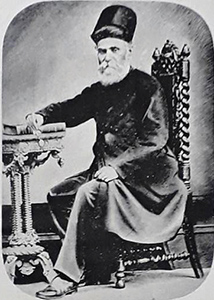
Framji Shapurji Movdawala
L-r: Dinbai Lalkaka, Behramji Lalkaka, Dr Cawas Lalcaca, Edulji Pallonji Lalkaka
The first AGM in 1909
AGM of the Lalkaka Family Fund circa 1928
Not many families can boast of a charitable trust that is over 100 years old, originally created to financially assist its own needy members. Over the decades that followed, the members have prospered and the trust has been helping people of all communities. The last known case of a family member availing of assistance from the trust is that of Najamai Kaikhushroo Lilaoonwala, whose son Pervez Lilaoonwala, now an alert 102, though unable to attend the meeting, recalled in an audiovisual sponsored by him and created for this occasion, how his family was able to hold its head above water because of the LFF. A member of the Lalkaka family, Najamai lost her husband in 1931 when she was only 35 years old. She had four children to bring up. After staying for a year at the ancestral home of her mother Kuvarbai Lalkaka, she moved to Bombay to educate her children. Here, she appealed to the LFF for monetary assistance and was granted a monthly allowance.
‘Charity begins at home’ took on a more personal meaning when young children were induced to attend the annual meetings of the LFF at the homes of hospitable members with spacious residences that could accommodate 50 to 60 persons. There were some years when no meeting was held. There was no permanent venue for these meetings, but some of the residences where they were held were those of Framroze Lalkaka at Cuffe Parade and Jamshed Davar at Marine Lines. The centenary of the founding of the LFF was celebrated at Sheroo Wadia’s Malabar Hill mansion in 1967. Col Pesi Cama and his wife Aloo offered the grand Adenwalla Baug hall for the meetings, a courtesy that their children Phiroza Muncherjee and Jamshed Cama have continued to extend. After the meetings, which often seemed never to end, mouth-watering refreshments would be served and members would mingle to catch up on the latest family news.
As Navaz Patuck, now on the managing committee recalls, "I remember as children being forced to come to these meetings, but now I’m so grateful that our parents insisted on our attending as the Lalkaka family has come to mean a great deal to me. Feroza Seervai had put us on the managing committee.” Her statement was endorsed by Cyrene Banerjee with "Seervai always wanted young people to join the LFF managing committee.”
Banerjee shared her "wonderful memories of attending the Lalkaka meetings, but more than that was the excitement we had in our family every time a meeting was held. My father Cyrus was the president of the LFF for many years. My mum Shirin and he put in a lot of effort – Daddy into the proceedings of the meetings and Mummy into the food. That was a big highlight of the event, and I believe that it still is! It was lovely meeting so many people who we did not meet throughout the year; we got a chance to interact with so many people we did not know belonged to our family.”
Tosher Lalkaka stated: "I was hijacked by Jimmy Uncle and Phiroza Aunty (Taleyarkhan) and mandatorily put on the managing committee. There I have remained till now. It has been fun to be associated with the LFF.”
Patuck recounted some interesting anecdotes. "My masi (mother’s sister), Aloo Driver, was a passionate Lalkaka, as were her sisters Meher and Phiroza Taleyarkhan. We had a photo of one of the Lalkaka family weddings — I think it is of Jehangir and Minna Lalkaka (the famed artist and his wife Tehmina) — and every time Aloo would pass this photo she would point to it and say ‘What noble souls every single one of them were, except for this gentleman,’ and we would ask, ‘Who is he?’ and she would reply, ‘He’s not a Lalkaka — a son-in-law.’ But the pride with which she spoke about the nobility of the Lalkakas was something worth listening to.” Patuck’s mother would declare: "Mahatma Gandhi was the man of the century, and for me Shanoor (Forbes, a spunky tetraplegic relative) is the woman of the century!”
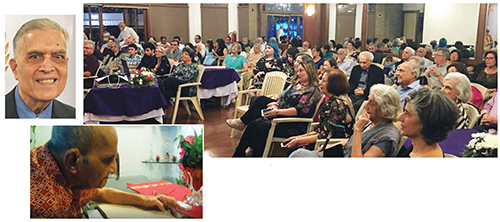
Clockwise, from above: LFF president Cawas Lalkaka; family members at
100th general body meeting; centenarian Pervez Lilaoonwala
Above: Feroza Seervai; left: Mehera Lalkaka (in sari),
India’s first provincial commissioned governor of Girl Guides with Lady Colville
Tosher spoke of his cousin Rasheid Taleyarkhan’s love of flying and the Aksa property in a northern seaside suburb of Bombay that he, his father Jimmy and grandfather Rustam had nurtured as a convalescent center for nurses and others. Lots of Lalkakas loved visiting Aksa, like Neville and Sherene Vakil who went there often.
A volume on the family written in Gujarati records that Faramjee Shapoorji Movdawala was the inspiration behind the founding of the Fund in 1867. "He has helped the Lalkaka family in countless ways but his greatest contribution was the setting up of the Fund and for that alone will his name be uttered with undying love and respect by the members of the Lalkaka family for many generations to come” (Biographical Sketch and Genealogical Tree of the Lalkaka Family). The Lalkakas were bound by strong ties to the Movdawalas — Faramjee’s mother Hamabai was a Lalkaka; his sister Dinbai was married to Dadabhai Lalkaka; his two daughters too married into the same family; and his daughter-in-law Pirojbai Nusserwanji Movdawala also happened to be a Lalkaka.
For many years Faramjee singlehandedly kept the LFF going and through his contacts and influence inspired many Lalkakas to donate generously towards it. He personally contributed handsomely and overcame many difficulties in order to place the Fund on a firm and viable footing. Nusserwanji followed in his father’s footsteps and took it upon himself to manage the affairs of the LFF. In 1883 it was decided to have a lottery amongst the family members to collect funds, and between 1885 and 1886 a considerable amount was thus raised. Philanthropic members like Avabai Khurshedji Palonji Lalkaka contributed generously; she also bequeathed a designated amount for the LFF in her will.
The LFF was formally constituted in 1909 and in 1925 it was registered as a trust, at which time its corpus was Rs 55,000. The original trustees were Nusserwanji, Goolbai Pestonji Lalkaka, Kaikhoshru Cursetji Lalkaka, Behramji Sohrabji Lalkaka and Minocher Dorabji Lalkaka. After Independence, the Fund was registered under the Bombay Public Trust Act in 1952.
Its first annual general meeting was held in 1909 in Bombay. This was a very significant year for the LFF. In February 1909, Dr Cawas Lalcaca, who had made a name for himself in Shanghai for his selfless service to the poor as a medical practitioner, paid a visit to India to meet his family. He tirelessly canvassed for the Fund, personally meeting family members in Bombay as well as other cities in India to request them to contribute generously. His efforts were crowned with success and the first General Sabha was convened in the same year on March 20 and 21 during which over Rs 6,000 was collected for the Fund. Soon after this meeting, Cawas set sail for London where he lost his life at the hands of the revolutionary freedom fighter Madanlal Dhingra while trying to shield Sir Curzon Wyllie, the intended victim. His tragic death was mourned by all. Many Lalkaka lads have been named Cawas after him.
Cawas’s brother Eruch and uncle Edulji were great supporters of the LFF and worked tirelessly to bring out the second edition of the Biographical Sketch and Genealogical Tree of the Lalkaka Family (1690-1910) in 1910. The first edition dates back to 1897.
Edulji became the first president of the newly constituted LFF. He spoke so movingly about the trials and tribulations faced by the poorer relatives that funds started pouring in, his contribution being the largest. For his tremendous help and support he was appointed trustee and president of the LFF for life.
Others who served the LFF include Cyrus Lalkaka of Ahmedabad and later Bombay who was president for many years and Ratan Lalkaka, who took upon himself the triple role of vice president, honorary secretary and treasurer. Earlier, the Taleyarkhans, Jimmy and Phiroza were joint secretaries and rendered yeoman service by extending the use of their office and staff for carrying out LFF’s work. Their daughter, Gitanjali Khanna, continued in their footsteps as a managing committee member until her death on December 15, 2018.
Currently it is flourishing under the presidentship of Cawas Nariman Lalkaka who is also a trustee and has ably guided it into the 21st century. The other trustees are Aban Mukherji, Soonu Davar and Limji Nanabhoy and the active managing committee comprises vice president Sherene Vakil, honorary secretary Mukherji, honorary treasurer Nanabhoy, assistant secretary Davar, assistant treasurer Hilla Lalkaka and members Patuck, Ava Lalkaka, Tosher, Adil Wadia and Kerman Lalkaka.
The 100th general body meeting was called to order by the president at 7.30 p.m. and a minute’s silence observed in memory of Neville Vakil who had passed away on June 4, 2018 and Gitanjali Khanna. Davar spoke movingly about their sterling qualities and love for and commitment in serving the family.
Researcher Arnavaz Kharas showed a short audiovisual tracing the history of the LFF, highlighting the admirable role played in its creation and preservation by many of the family members of yore. The gathering was reminded of the origin of our "unique” surname. It was the ruddy complexioned Kuver (son of Baman who was the son of Shapur of the Homiyar or Palon Patel family of Suvali) who was responsible for this moniker. His complexion would turn "beetroot red” in the sun, and so he began to be addressed as "Lal Kaka” (Red Uncle) by one and all.
Through her slides Kharas traced the trajectory of the LFF from its inception, with glimpses of its main objectives and various activities highlighted through interesting facts and anecdotes. The funds were demarcated as A, B and C, with A being the corpus. The monies in the B category were to be used solely to help family members in need of financial support. The C category was open to all communities, irrespective of caste or creed. In the latter half of the 20th century the B and C funds were merged since for some decades no family member had sought assistance.
The monies disbursed by LFF go towards the relief of poverty, education and medical expenses. Generous yearly donations from family members have helped the Fund to expand its scope. The Balwadi (play school) in the Women Graduates Union, patronized by sisters Feroza Seervai and Freny Mehta in memory of their father Behramji Lalkaka, was financed by the Behramji Lalkaka Education Trust which was later merged with the LFF. Around 20 to 25 children from the neighboring shanty towns are enrolled in this school. The Fund also pays for a counsellor at the Alexandra Girls’ English Institution and will soon extend this service to the Bai B. S. Bengalee Girls High School as well. In the past, educational institutions like Vanasthali in Poona have received funds from the LFF and the children of many single mothers have been helped to complete their education.
Funds are disbursed for medical aid to individual applicants as well as organizations like the Lions Club for their affordable cataract operations and other projects. The Red Cross too has been helped to buy equipment to enhance their medical facilities.
The audiovisual presentation concluded with a recorded greeting to the LFF from Avameher, Rashna and Rishad Vaghaiwala, the three young Los Angeles based grandchildren of Mahrukh Batliwala of Sydney, Australia, illustrating how the future generation has grasped the significance of true philanthropy. In its remarkable way, the LFF binds the Lalkakas together by opening its arms to welcome all who marry into the family.
After the meeting came to a close Kerissa Lalkaka’s melodious voice floated across the room, followed by her father Kerman and singer Willy whose crooning enlivened the evening with their rendition of old favorites. Members partook of cocktails and dinner, as animated conversations and peals of laughter rippled through the gathering. A glow of warmth and fellowship enveloped all, holding out a promise of many more such gatherings in the future.