Puppeteer Dadi Pudumjee’s production Rumiyana, on the
Sufi poet Rumi, tackles a serious theme
Firdaus Gandavia
"Everybody has read English translations of (Jalal al-Din Muhammad) Rumi’s work at some point of time or the other,” says Dadi Pudumjee who, along with the Ishara Puppet Theatre Trust, has just produced a spellbinding performance of Rumiyana: A Journey Within which was part of the National Centre for the Performing Arts’ festival of Sufi music and poetry.
"I used some lines of Rumi’s verse in one of my earlier productions Transposition and when our group Ishara was at GEMS Modern Academy in Dubai to create a performance of Who is at my door? Some of these verses have remained with me for a long time and probably resulted in Rumiyana.”
Ishara Puppet Theatre Trusts’ Rumiyana
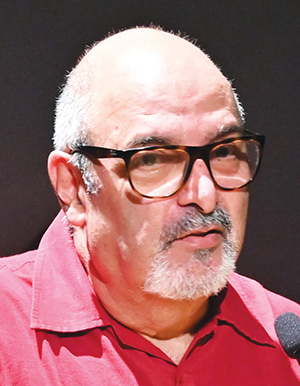
He and his team worked on Rumiyana throughout the pandemic with gaps, as was to be expected. It was a collective work; his script writer and animator, Shaaz Ahmed, who had worked with Pudumjee in When Land Becomes Water, was greatly motivated as he is a staunch supporter of Sufism. Experiments in the studio began in September-October 2022 with puppeteers and dancers and, finally, the two actors Mohit Mukharjee and T. Joshua Chin.
As Pudumjee, Ahmed and Sandeep Pillai who composed the music were all students at the prestigious National Institute of Design (NID) they speak the same language. Rumi is always connected with Afghanistan and Iran and when, initially, Pudumjee had to choose the music, he chose an Iranian group chanting in Farsi almost like a Gregorian chant. "But I realized that Rumi’s message as well as his philosophy are universal and middle eastern sounds were not really necessary. Pillai’s music was most conducive for the performance. He was at Bangalore and I am in New Delhi. Every night he would send me something and we would discuss if it worked or did not work. But it is only when he came to Delhi and timed each sequence did the music fall into place.”
Pillai gave him the idea of mixing all religions together in the chants in the middle of the performance which enforces the idea of the universality of all religions and their oneness. When the organizers of the Mahindra Kabir festival in Varanasi (Banaras) requested them to do something, Pudumjee agreed that they would put some puppets together as they were in the midst of Rumi but they started reading Kabir’s couplets and found a resonance with Rumi’s poems as both said very similar things about love and peace.
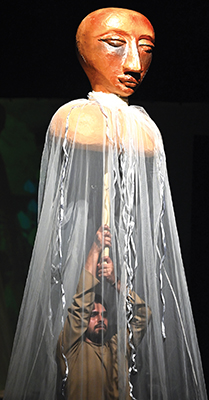
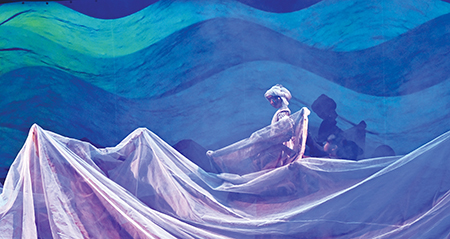
This is not the first time Pudumjee has produced a serious puppet show dispelling the widely held belief that puppetry is only for children. In fact, Ahmed much prefers working with animation for adults. Pudumjee has directed, amongst others, performances on HIV awareness and substance abuse. Images of Truth was based on the ideology of Mahatma Gandhi which deals with satyagraha, apartheid and non-violence. However, he is equally comfortable with lighter themes for youngsters like Apples and Oranges, a clown show, and Where Has my Nani (maternal grandmother) Gone? "Movement and music are most important to me. My puppets are simple, not very technical but I like to see the actor or the puppeteer emote through the puppets.”
When a boy of eight, Pudumjee received a gift of two string Pelham puppets (simple, wooden puppets worked by strings made by Englishman Bob Pelham) from the UK. What was interesting for the young lad was that puppetry involved craft and making things, which he enjoyed. It aroused his interest and he was encouraged to perform by The Bishop’s School, Poona where he was a student. This was a defining moment in his life. After studying political science, history and economics at the Nowrosjee Wadia College in Poona, he went to NID at Ahmedabad in 1971 and later taught creative drama and puppetry at the G. D. Somani School in Bombay, where he was introduced by the late thespian Pearl Padamsee.
Pudumjee’s first serious brush with puppetry came between 1980-86 when he studied the art under the late Meher Contractor. "Manneys Bookshop had a shelf of theater books and some of them pertained to puppetry, which was a bonus.” Though he started with string puppets (marionettes), handheld puppets have always fascinated him. He was exposed to them in Sweden. He reminisces about the time he came to Delhi in 1980 and worked at the Sri Ram Centre for Art and Culture. He set up a puppet repertory company for them which performed every Saturday evening and Sunday morning.
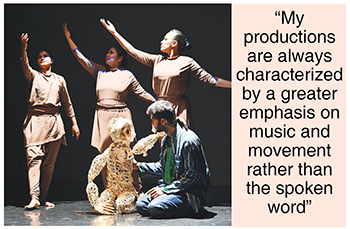
His recent production of Rumiyana depends more on Pillai’s melodious music than on the spoken word. "My productions are always characterized by a greater emphasis on music and movement rather than the spoken word,” he says. "One has to be very careful with the text as once it is spoken the audience cannot go back to it as a reader can while reading a book. Hence, music has always been the star of my shows.”
Pudumjee strongly believes that puppetry is not the end but the means to an end and should be used more for education and addressing social causes. "Our puppeteers have a very strong technique but they do not get an opportunity to create new things and that comes through exposure and workshops. Our government should do more to tap into more festivals to provide this opportunity. All through the pandemic many traditional puppeteers used their own puppets creatively and made fantastic little videos about awareness.”