With an exhibition in Delhi earlier in the year and
another in Bombay next month, Michelle Poonawalla
is impacting the international art scene
Delshad Karanjia
I’m an organizer and a perfectionist and I work very hard,” says Michelle Poonawalla who is currently making her mark on the Indian and international art scene. Soft-spoken, elegant and attractive, behind her gentle demeanor one detects the steely resolve, passion and ambition of a creative and committed artist. Married to well-known industrialist Yohan Poonawalla, Michelle is determined to avoid being dismissed as a "society lady who dabbles in art” and is striving to ensure that she should be recognized in the art world for her talent rather than her impressive family connections.
"I know that initially some people didn’t take me seriously,” Michelle admits. "What does it matter what my surname is? The focus should be on my art (which) is not very Indian but has more international appeal.” With growing recognition of her artwork in recent years, in 2018 she decided that the time was right to do a solo show to establish herself as an artist. A chance meeting with Suhel Seth (author and a managing partner of consultancy firm Counselage India) led to an introduction to his brother Swapan, who collects art and curates art shows. "I sent Swapan photographs of my work, and started working on my collection. I wanted to do something different — it had to be more than people walking around a gallery and staring at static, two-dimensional paintings. It had to be ‘wow,’” she adds.
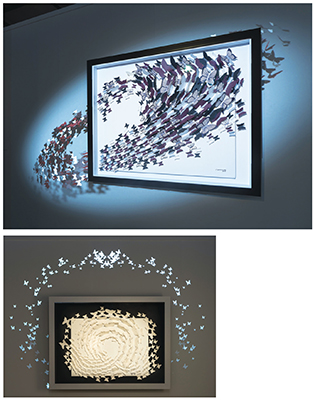
Michelle’s show, "What If You Fly?” at the Vis A Vis Gallery in Delhi earlier this year featured a collection of her butterfly art. Using projectors, motion sensors and video mapping involving detailed programing of her art, she created a unique three-dimensional experience for viewers as butterflies fluttered out of, around and behind the picture frames symbolizing the circle of life. Her innovative approach — using technology to give her canvases life and depth — created quite a sensation. "I’ve always been more dramatic than others,” Michelle states. "No one had seen this technique used with art anywhere.” Her show also featured mixed-media artwork, paintings inspired by the graffiti she saw in London, and large sculptures made of brass with gold-plating.
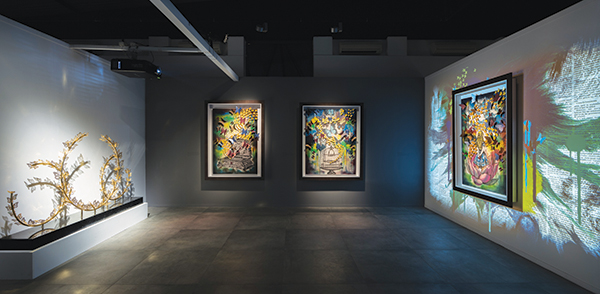
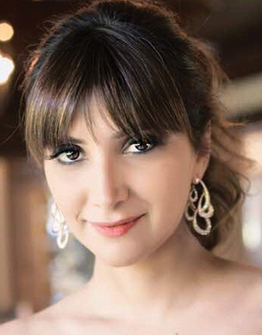
Michelle Poonawalla (top) and her artworks displayed at the Vis A Vis Gallery in Delhi (above)
Her signature motif, butterflies, the embodiment of ephemeral beauty and grace, had surfaced two years earlier when she created an artwork with children with learning disabilities from Bombay’s Gateway School for their spring-summer art show. The response to her work was heartening: "After that I started to do butterfly paintings, placing white butterflies on white backgrounds, then white butterflies on black backgrounds.” Michelle again made time to work with the special needs children of the Gateway School for their summer 2018 art show, where she taught the children to paint with oils using a palette knife.
The next breakthrough came when Michelle was approached to participate in a charity art show organized by Khushii, a nongovernmental organization headed by former cricketer Kapil Dev, which runs education, health care, rural development, and art and culture projects for the underprivileged. Following the auction conducted by Sotheby’s to sell the artwork to raise funds for Khushii, Michelle was approached by art consultant Farah Siddiqui Khan who asked her if she would be interested in participating in an art event for which the Prince of Wales was the patron.
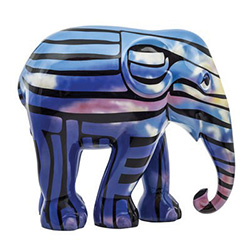
This was the Elephant Parade, a charity event to save the Asian elephant and protect 101 elephant corridors across Asia, in which artists and celebrities paint or decorate an elephant statue which is then sold to raise funds for protecting endangered elephants. The life-size baby elephant statues are exhibited in cities across the globe to raise awareness of the need for elephant conservation. To Michelle’s delight, her elephant — "Monsoon Magic” — was shortlisted to showcase at the British High Commissioner’s residence in Delhi during a visit by the Prince of Wales and the Duchess of Cornwall. Michelle’s elephant statue was also chosen to be displayed in London. "Years ago, living in London, I was fascinated by the vividly colored elephant statues that I saw on the streets,” Michelle recalls. "I never thought even in my wildest dreams that one day an elephant painted by me would be displayed in Grosvenor Square.”
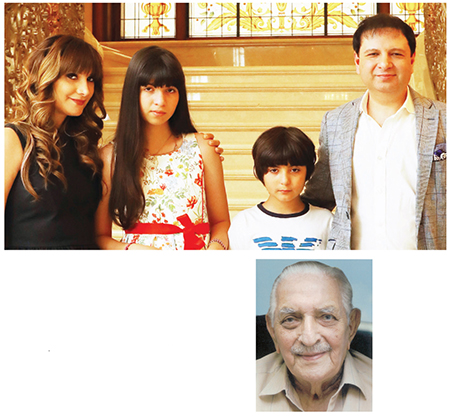
Top (l to r): Michelle, Tania, Zayan and Yohan Poonawalla; above: Jehangir Vazifdar
She was also signed on by Arushi Arts gallery in Delhi and recently sent three works to Italy, one of which will be displayed at the Parma art fair through an Italian gallery. In addition, art enthusiasts have been commissioning her to create artworks for their private collections. In September this year she participated in the Harvest Exhibition in Delhi, sharing wall space with old masters like M. F. Hussain, S. H. Raza, Francis Newton Souza as well as contemporary artists like Krishen Khanna, Akbar Padamsee, Atul Dodiya and Paresh Maity. In December she will be showcasing an installation at the Kochi Biennale. The highlight of the year for Michelle, however, is sure to be her solo exhibition scheduled from November 6 to 12, 2018 at the Jehangir Art Gallery in Bombay as a tribute to her late grandfather Jehangir Vazifdar.
In more ways than one, Michelle is to the manner born. Vazifdar was an architect by profession and an artist by passion. Credited with designing and building some of South Bombay’s most iconic buildings — the Bharatiya Vidya Bhavan, the new Tata Memorial Hospital, Breach Candy Apartments, Eden Hall, Washington House, Palacimo, Amalfi and Sorrento among others — in the 1950s and 1960s, Vazifdar derived his greatest pleasure from his art. As an artist he was remarkable in that he never sold a painting and always refused commissions because he didn’t want his creativity to be governed by money, declaring, "In my painting I am a free man.” Some of Vazifdar’s distinctive artworks have been gifted to art galleries the world over, including New York’s famous Grey Art Gallery which houses more than 700 works of art from Asia and the Middle East, where Vazifdar’s work is displayed alongside paintings by Hussain, Anjolie Ela Menon, Souza and Satish Gujral among others.
Vazifdar is credited with having compiled an alphabet of color, in which each shade represented different events or emotions such as white for death, black for peace, yellow for life, red for sorrow and blue for joy. Another of his inventions was a technique for producing "fake-proof” art.
Michelle has fond memories of watching her grandfather painting in his studio. "My grandfather had developed a method of making his paintings fake-proof,” she recalls. "First, he would complete the painting, then he would cover the entire canvas with paint, using horizontal and vertical strokes forming a uniform layer over the painting. Then, while the paint was still wet, he would use a ruler to remove the recently applied layer of paint in thick strokes to reveal the portrait underneath. My grandfather knew I was very good at art, so he showed me… I was the only one who knew his secret.” Michelle’s art studio in her palatial home in Poona displays several of her imposing paintings in which she has used this palimpsest-like method.
Talent clearly runs in the family. Michelle’s flair for art was evident as a student at Bombay’s Cathedral and John Connon School and subsequently at school in London (her family moved to the UK when she was 12) where she scored an A* — the highest grade — in art for her A levels. She continued to pursue her passion at the American International University in London, graduating with a bachelor’s degree in interior design. Soon after finishing college, she got married at the age of 23 and moved to Poona. Art took a backseat for a few years while Michelle focused on her two children — daughter Tania and son Zayan.
Her interest in art was rekindled a few years ago when her father, Phiroze Vazifdar, published a coffee-table book titled Jehangir Vazifdar — Artist and Visionary on his father. For Michelle, "Compiling that book stirred all kinds of emotions and memories. That was when I felt that I have to take my grandfather’s legacy forward.” So she began to pursue her passion more seriously. Yohan proudly declares: "Michelle has achieved in two and a half years what takes others more than 10 years to accomplish.”
Despite achieving so much so soon, Michelle is modest and unpretentious and draws great strength from her faith. "I am quite orthodox in my views,” she reveals. "I am a traditionalist in my beliefs and feel the religion must be followed as per its old rules and regulations. I do not believe that we today can change what always was. Priests must stick to the Parsi laws and regulations. We have one of the purest, most ancient religions and it must remain like that.”
At present, her main focus is on planning and developing the various works for her November exhibition, featuring not only her own signature creations but also displaying her grandfather’s unique fake-proof art. "My November exhibition will be my personal tribute to my grandfather,” says Michelle. "It is something that I just have to do for my grandfather and for myself. I won’t stop until I reach the top!”