Many a tale is told of scorpions and snakes and belts and brakes
Dr V. M. Meher-Homji
My father, Dr Minocher, was the medical officer at the Damanwala Dispensary and gynecologist at Sir Ratan Tata Maternity Hospital in Udvada (1928-1947) and so I grew up in the sylvan surroundings of the place in the 1930s when there was no electricity. I lived in close contact with nature and had frequent encounters with snakes and scorpions. Siberian cranes spending their winter vacation in the nearby lake would perform graceful dances for us and in summer the koels would entertain us with their melodious notes. After sunset, the jackals would come out of their burrows, howling their hearts out because they were hungry. But this was a good omen according to the villagers! Soon I was convinced that the serpents surfacing on our premises were harmless as also the scorpions despite having been subjected to a nasty sting by a baby scorpion. Much later I learnt that only a few species of snakes in India are equipped with deadly venom and there are no killer scorpions here, unlike in Africa. Against this background, I decided to pursue higher studies in the natural sciences, breaking away from the family tradition of joining the medical profession.
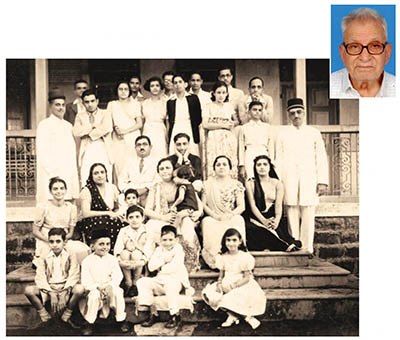
Dr Vispy Meher-Homji (inset and seated front row, third from l) with family at his navjote in 1940
Top: High tide in Udvada; above: ruins of a hospital caused by erosion
Marine misadventure
When I was 12, the sea at the beautiful beach of Udvada fascinated me. For hours together I would watch the tidal waters moving towards the shore and then retreating more than a kilometer twice every day.
At this juncture I would like to comment on the geography of the seabed. At Udvada, the seabed is shallow and covered with stones and pebbles, while in Pondicherry the seabed is deep and covered with sand, as a result of which seawater always remains near the shore. In Udvada, the seabed offers stiff resistance to tsunami waves, controlling their height, but in Pondicherry the seabed has no such facility, permitting tsunami waves to rise to a height of one or two stories of a house.
Returning to the Udvada beach, one day I decided to investigate that point of the seabed about one kilometer from the shore where the sea water remains static, moving neither forward nor retreating backward. I embarked on the mission with a friend while the sun was still high in the sky. Fast movement was not possible as the stones were covered with sea oysters (kalu in Gujarati) whose razor sharp shells can tear open the soles of shoes or feet, causing bleeding. While we were still quite some distance from our target area, to our horror, the sun began to set and the tide set in with water rushing much faster than we could run. We had also to contend with the sharp nail-like rock oyster shells and the gathering darkness, but with prayers on our lips we reached the sacred shore of Udvada before the water could rise above our waists.
Ghostly encounter
Let me narrate another scary event which occurred decades later when for my Masters of Science project I had to collect a particular plant growing in the marshy areas in the suburbs of Bombay. It was late evening on a no moon night (amavas) a day before Diwali (Kalichowdas) when, according to popular belief, ghosts haunt the domain of human beings. By the time I reached the last suburban destination, it was dark already. I silently entered the compound harboring the plant, taking care that nobody witnessed my trespassing on the territory. I tried to remove the plant, but it was deeply rooted in the soil. Using all my might I succeeded in pulling it out, but to my shock along with the plant a human skull also emerged! Realizing that it was the day of the ghosts, I dropped my paraphernalia and ran out at the speed of a bullet train. Seeing me run so fast, people enquired, "What were you doing in the graveyard?” In my haste, and because of the darkness, I had walked into a burial site for the poor where there were shallow graves.
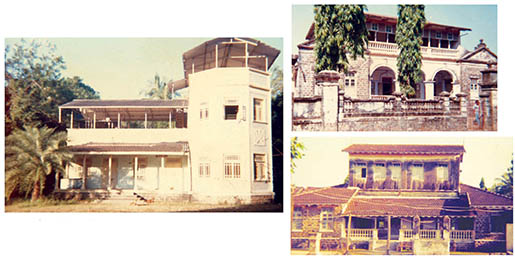
Clockwise, from top r: front and rear views of Udvada’s Damanwala Dispensary;
bungalow built in the 1930s by Dr Minocher Meher-Homji
Knife attack in a forest
My first assignment as a research assistant was to accompany my professor on a forest excursion, with a peon to carry the botanical specimens. To save time, a private taxi (without a meter) was hired at the station at the usual rate of Rs 100 to travel up to the maximum distance that a car could go on the forest road. The driver wanted his friend to come along to help in case of the car breaking down on the deserted road.
However, hardly half the distance was covered when the driver stopped the car at an isolated spot and demanded the full fare of Rs 100, claiming that petrol worth that amount had already been used up. My professor, a Parsi and a man of principles, refused to pay a pie, saying that an agreement was an agreement. What ensued was a war of words. But then one of the goons took out a knife and threatened us: Money or your life! However, the Parsi professor, a strict disciplinarian, refused to budge.
To counter the knife, our peon took out a shovel, but realizing that the frail professor, the peon (a tuberculosis patient) and myself were no match for the two goons, I envisaged a tragedy. I was also reminded of the words heard at a coroner’s court: from words to blows and from blows to the brandishing of a knife and wriggling of intercostal spaces (the space between two ribs); a prick and a shriek and a man forgets to breathe. I parted with a Rs 100 note (nearly half the amount of my monthly salary) and quietly slipped it into the hands of one of the hooligans to prevent a gory scenario.
As we had lost quite some time over the incident, we hurried towards the core area of the forest, with my professor advising me all the way never to bow down when you are in the right, whatever be the consequences.
Trouble at the ski resort
The next frightening moment occurred some years later. I was on my way to France to prepare my doctoral thesis. My mentor and research guide, who was then the United Nations expert ecologist in Damascus, invited me to spend a month in Syria. An outing to a ski resort in Lebanon was arranged. A ropeway carried the tourists from one hill to another. The view was wonderful, but while approaching the landing site I realized that the belt of my heavy overcoat had become entangled with the chair of the ropeway. No matter how much I struggled, the belt would not release. The attendants were shouting in Arabic, "Vacate the seat or be prepared for the consequences.” The chair was heading rapidly towards the driving mechanism and I thought of saying my final prayer before the bloody end. And just then a miracle occurred — barely a foot from the machinery, the belt gave way and I fell on the snow-covered ground. Such is the power of the Yatha Ahu Vairyo prayer, I realized.
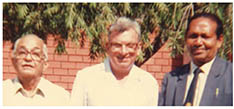
L-r: Homi Chothia, Dr Vispy Meher-Homji and Prof Sahu
The eye of the tiger
While on a tour of Rajasthan to map the forests, we visited the Sariska sanctuary, only to return to our lodgings disappointed at not having spotted any wildlife. It was the twilight hour and the jeep following ours had switched on the headlights. I was seated on the front seat, with my left foot on the mudguard. Suddenly, out of the blue, I found myself staring into the eyes of a tiger! The big cat was trying to cross the road and was as surprised as myself when our jeep crossed his path. Years later, I read with great sorrow that all the four tigers in Sariska had been eliminated by poachers.
Brake in time saves two
The last thrilling moment happened in the Eastern Ghats, while on a forest survey. Our Willys Jeep station wagon had only two doors; to reach the rear seat, one had to fold back the front bucket seat. The officers went out to inspect the site and the driver stepped out, leaving the two guards on the rear seat. I too decided to collect interesting plant specimens, but I soon heard desperate cries from the panicked guards. I could not believe my eyes when I looked up. The vehicle, parked on a steep meandering slope without applying the hand brake or engaging the gear, had started moving and was gathering momentum as it fast approached a 1,000 ft gorge. I jumped into the station wagon and while standing pushed the brake pedal to bring the vehicle to a halt inches away from the edge of the gorge.
Monkey in the metropolis
My last confrontation with wildlife took place in the least expected quarters, not in a jungle but in the very safety of my own apartment, about a year ago. Call it by any other name like monkey business or monkey menace, the simian deserting his natural arboreal habitat and trying to adapt to his successor homo sapiens’ lifestyle in a crowded locality of Bombay seemed surprising.
One afternoon while having a nap, I heard queer noises emanating from the dining room of our apartment on the 20th floor of a high-rise building. Expecting to see the usual intruder pigeon, I was taken aback to confront a large sized monkey enjoying the bananas kept on the table. Warned as I had been never to use a stick on a langur as the stick may be used on oneself, I banged a hammer on a steel plate to frighten and drive away the langur through the balcony. I congratulated myself on successfully getting rid of the invader without any mishaps and returned to my bedroom, only to see him playing with my medicine bottles. This time he had entered through the window. When I shooed him away, he walked off with my eye-drops.
As the avatar of Lord Hanuman, the monkey was fed delicacies by some devotees and became a frequent visitor, departing with one thing or another, whatever took his fancy. We lost a mobile phone and a thermos flask among other things before we learnt to keep the doors and windows shut whenever his presence was reported in the neighborhood. But I must appreciate his acrobatic skills, maneuvering himself over a few centimeter-wide ledges and balancing himself on narrow railings at the height of a 30-storied high-rise.
These are some of my recollections of my memorable career as a naturalist. Thus from the healthy environment of my childhood, when the calls of frogs on rainy nights assured us of no threats of pollution, global warming or droughts, I passed through several scary moments to reach the age of 90 with the grace of the Almighty.