"It is seen as a step forward for Africa,” stated senior counsel Pheroze Nowrojee referring to the landmark judgment by the six- member bench of the Supreme Court of Kenya that declared — with four in favor and two against — the election of the President of Kenya Uhuru Kenyatta as "invalid” and called for fresh elections by October 31. The judgment of September 1, 2017 was hailed for being the first in Africa when a presidential election result has been overturned. Kenyatta, 55, had been declared reelected three weeks prior on August 8 with 54 percent of the votes. His main opponent, former Prime Minister Raila Odinga, 72, who petitioned the Supreme Court to nullify the election, had received about 44 percent, a difference of nearly 1.4 million votes. Although the casting of ballots went smoothly, the electronic transmission of vote tallies was faulted, with the opposition alleging that as many as seven million votes had been stolen.
The Independent Electoral and Boundaries Commission (IEBC) which was in charge of the polling, "failed, neglected, or refused to conduct the presidential election in a manner consistent with the dictates of the Constitution,” the court verdict was reported on international media. The judges found that the Commission "committed irregularities and illegalities in the transmission of results.”
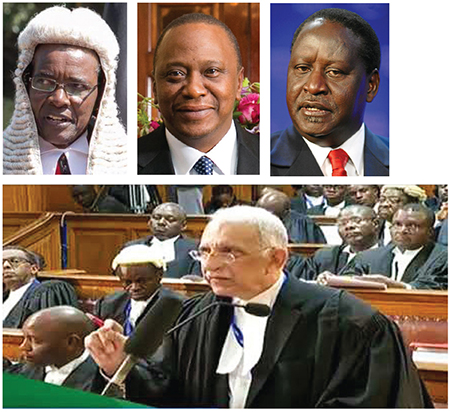
Clockwise from top left: Chief Justice of Kenya David Maraga; presidential contenders
Uhuru Kenyatta and Raila Odinga; senior counsel Pheroze Nowrojee
"The judgment has been greatly welcomed and is important,” summed up attorney Nowrojee, a human rights activist, in his email response to Parsiana. He was on the prestigious nine-member legal team appointed by Odinga and National Super Alliance (NASA), the opposition umbrella group, to challenge the outcome of the poll. In his nearly 41-minute deposition before the bench that had earned 27,574 views on Youtube by September 22, Nowrojee asserted that the Election Commission failed to conduct "free and fair elections… in an impartial, accountable, efficient, accurate manner.” Insisting that "something has gone wrong seriously with the entire process,” he and the others convinced the bench to declare the elections "null and void.”
As Nowrojee explained to Parsiana, the judgment "re-imposes the Constitution’s prescriptions and the Rule of Law on an executive driven historically by disregard of the Constitution and the law and with a show of entitlement to impunity. It impacts as a precedent on all public affairs, (not just elections), and on all public officials. It affirms that the processes and the means used in public affairs are as important as the lawful national ends. The means, too, have to be lawful. It was Jawaharlal Nehru who set the desirable democratic standard: ‘A just state by just means.’
"This judgment moves Kenya in that proper direction. It will have a long-term influence in the coming decades to apply the Rule of Law to all aspects of Kenyan public life, including business, investment, governance, equal opportunity, social justice and other constitutional protections and safeguards. It has begun to change a critical wrong in Kenya… and will be a slow process, which will continue for long to be resisted by those who currently benefit and want the status quo to continue.”
As expected, Kenyatta who was named third respondent in the suit lashed out at the judiciary as reprted by Agence France-Presse: "I think those robes they wear make them think that they are more clever than the rest of us Kenyans… (Chief Justice David) Maraga thinks he can overturn the will of the people. We shall show you…” He slammed the judges as "crooks.” The president of the Law Society of Kenya Isaac Okera condemned Kenyatta’s remark as "wholly inappropriate” and "ominous” while the Kenya Magistrates and Judges Association termed the criticism as "an assault on the judiciary.”
The Press and democratic organizations in Kenya hailed the ruling as a hard fought victory for the rule of law and the sign of a maturing democracy. The verdict "offered a potent display of judicial independence in a continent where courts often come under intense pressure from political leaders,” as per a report in The New York Times of September 1. "It’s a historic moment showing the fortitude and courage of the Kenyan judiciary,” Dickson Omondi, country director for the National Democratic Institute, was quoted in the report.
The election controversy hinged on two paper forms that legally validate the ballots — 34A from each of the country’s 40,883 polling stations and 34B from 290 constituencies. Representatives from rival parties were required to approve the forms before they were scanned and electronically transmitted to a national tallying center in Nairobi. Here they were to be put online immediately so they could be crosschecked. But the electronic system, which had been overseen by Christopher Chege Msando, the election official who was killed, broke down. Therefore, only the results, not the forms, were sent to the national tallying center, often by text message.
With 11,000 forms missing, "the scenario was similar to that of the Bermuda Triangle, where no one knows how ships disappear,” Nowrojee told the Supreme Court justices tongue in cheek. A third of the forms had allegedly lacked security features like watermarks or serial numbers and there were many other equally grave lacunae.
Referring to the "disturbing if not startling revelations” about IEBC, deputy chief justice Philomena Mwilu faulted the officials for ignoring a Supreme Court order to open up its computer servers after opposition allegations of hacking. While Odinga sought expulsion of the Commission stating he had no faith in the organization which is tasked with organizing fresh elections by end October, Kenyatta has refused to replace IEBC stating, "We don’t have time for any more reforms.”