The newly inaugurated museum at the Zoroastrian House in Singapore will familiarize the local populace with the ancient religion and culture
Parinaz Gandhi
Our heritage, through initiatives like this museum, really plays an important role in anchoring our identity and fostering a stronger ‘sense of us.’ It also allows us to connect with different communities… (and) reminds us of our historical and contemporary links to one another and instils a sense of belonging,” stated Singapore minister Edwin Tong when addressing leaders of the community and interfaith organizations at the inauguration of the Zoroastrian museum in Singapore on March 14, 2022.
"Despite the relatively small numbers, the Parsi community has always been an active participant in Singapore’s rich social fabric. It is a community of both deep roots and tall branches,” added Tong who is minister for culture, community and youth as also second minister for law in Singapore.
Due to social distancing requirements attendance from community members was restricted to a few women who came attired in garas and men in daglis. Tong was welcomed with a traditional achhu-michhu before he cut the ceremonial ribbon. He was then taken around the museum by Homiyar Vasania, president of the Parsi Zoroastrian Association of South East Asia, Singapore (PZAS) and Hormuz Avari, PZAS past president and Zoroastrian representative on the Inter-Religious Organization. They explained the exhibits to Tong, noted the press release that gave details on the "muted yet successful” museum inauguration on mah Avan, roz Hormazd, according to the Shahenshahi calendar.
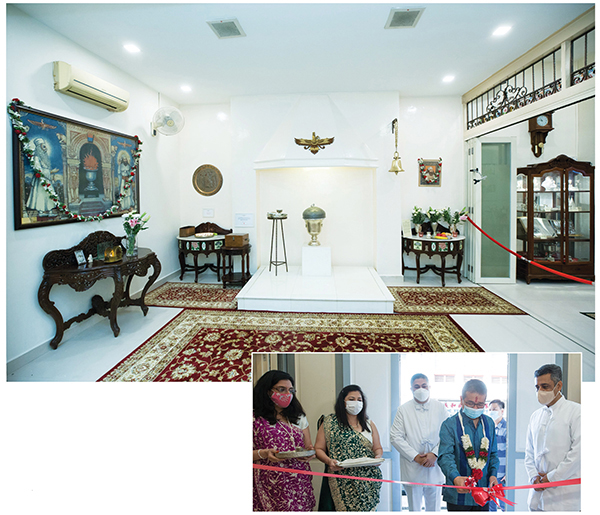
Top: exhibits on view at the museum; inset (from l): Monira Bhada,
Natasha Karanjia, Hormuz Avari, Edwin Tong, Homiyar Vasania
Navroz table and exhibit panels at the museum
The museum is spread across 1,200 sq ft on the ground and first floors of the Zoroastrian House. It offers a historical understanding of the Zoroastrian faith and the lifestyle of its adherents who contribute to the intangible cultural heritage, said Vasania. "Approximately 350 to 400 Parsi Zoroastrians call Singapore home but despite being such a minuscule community it boasts of a Parsi Road in the prime financial district,” reminded the press release.
Entitled "The Joyous Flame,” the museum is a joint effort between PZAS and the India based Parzor Foundation. "PZAS is very grateful for the service rendered by (Parzor founder) Dr Shernaz Cama and her team in helping create the content of this museum,” acknowledged the press release, adding, "The museum comprehensively covers many aspects of Zoroastrianism, specifically depicting our Prophet Zarathushtra, our religious and cultural symbols, our origins and political history in Persia, our subsequent move to India, the history of the Parsis in Singapore and the global diaspora, our clothing, festivals and cuisine.” Set up at a cost of SGD 50,000 (Rs 28,09,277), Kai Nargolwala and other philanthropists were the major contributors.
On view at the museum is a rich repository of Zoroastrian artifacts and historical records. Included in the 21 panels are displays of traditional objects, a replica of the Cyrus Cylinder, models of the Iranshah Atash Behram (created by architect Jamshid Bhiwandiwalla) and a dakhma, other religious implements and symbols like the ses. Reference books on Zoroastrianism like those authored by Prof Mary Boyce, a 1907 translation of the Shahnama and another 1917 edition of the 10-volume set of the Shahnama feature in their collection. Adding color to the exhibits are the sari kors, garas, pheta, pugrees worn by the laity and the priests on festive occasions and an introduction to the Parsi cuisine. An elaborately decorated Navroz table delighted representatives of the Buddhist, Taoist, Christian, Hindu, Muslim, Jewish, Sikh, Jain and Baha’i faiths at the inauguration.
The ground plus two-storeyed Zoroastrian House has been serving as a community center cum prayer hall since 2011 thanks to the largesse of Vasania who offered it on lease to the community against payment of one dollar a month. Witnessing "a great deal of curiosity and interest among our fellow Singaporeans about our religion, its history, culture, practices and food,” the managing committee of PZAS decided to create a permanent Zoroastrian museum at Zoroastrian House. "This is conceptualized as a vivid showcase of the history and traditions of Zoroastrianism, not just for members within the community but to be experienced by all its friends and well-wishers in Singapore.”
The creation of the museum was "a team effort by the full committee, whether it was research, finding furniture, panels, pictures, getting the display pieces, organizing the inauguration,” stressed Vasania when responding to queries from Parsiana. Besides Vasania and Avari the others on the PZAS committee are Monira Bhada, Natasha Karanjia, Benaifer Nilgiriwala, Khurshid Choksey,Tushna Antia, Neville Dotivala, Hoshi Deboo, Burzeen Driver, Rumy Kanga.
The local community too parted with their showpieces and books, temporarily or permanently, for the museum. It was in the second half of 2019 that PZAS started refurbishing Zoroastrian House. By early 2020, the furniture had been changed. The content creation for the museum was to commence in March 2020 but was substantially delayed due to Covid. Efforts were resumed in early 2021 and collaboration with Parzor helped accelerate the process and see the panels completed by August 2021.
The committee had not anticipated the museum to generate instant interest among the lay public. "Around 40 plus email inquiries to visit the museum were received on day one itself,” stated Vasania. To manage the flow of visitors in the absence of permanent staff, the PZAS is dependent on volunteers to take care of the premises and conduct guided tours. Currently, admission is free and the museum is kept open one day a week. The frequency will improve once they get more volunteers. For important guests the museum will be kept open on an ad hoc basis. Prospective visitors need to book their slots in advance. For the future, the committee would like to create a special mobile application that could help in booking the visit and guiding the visitors with an audio for each panel. They are hoping to find "a young Parsi app developer who can help on this front.”
Parsis have been known to reside in Singapore for over 200 years ever since an individual by the name of Muncherjee first landed on the island in 1819. Having made their mark in the fields of medicine, airlines, shipping, banking, finance and technology, the members set up the Parsi Association of Singapore in 1954. To mark the 50th anniversary of the Association, a commemorative volume entitled Flame of the Faith — An Insight into the Parsee Zoroastrian Tradition — was published conjointly with the Zoroastrian Charity Funds of Hongkong, Canton and Macao, recollected art historian Dr Pheroza Godrej, sharing an e-version of the volume with Parsiana. The publication and the concurrent exhibition "Flame of the Faith,” co-organized by the Asian Civilization Museum Singapore from May to August 2004, had resulted in the showcasing of "our rich heritage and an opportunity for learned scholars to share their views on our religion and culture with others,” noted a foreword by then Association president Rustom Ghadiali.