Adventures in art
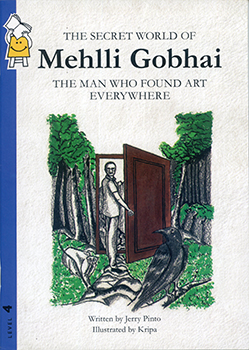
The Secret World of Mehlli Gobhai — The Man who found Art Everywhere by Jerry Pinto. Published in 2021 by Pratham Books, #621, 2nd Floor, 5th Main, OMBR Layout, Banaswadi, Bangalore 560043; email: info@prathambooks.org; website: www.prathambooks.org Pp: 28. Price: Rs 55.
If you have ever stopped to wonder why an artist like Pablo Picasso loved to look at life through the eyes of a child — seek no more.
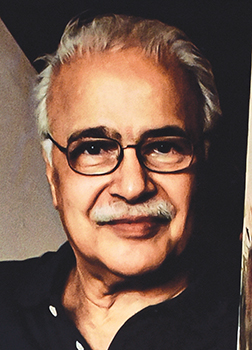
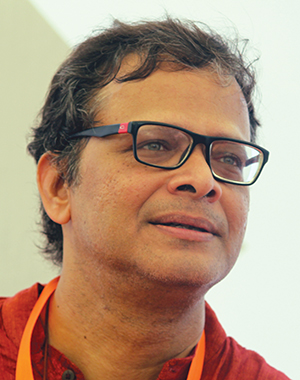 Jerry Pinto (pictured alongside) takes the reader for a walk with Mehlli Gobhai (1931-2018, pictured bottom right), artist and story-teller, that is enchantment itself.
In his company, Jerry, as he calls himself in the text, becomes a child again and through his questions to Gobhai, we too become that child.
When for instance they walk through Gobhai’s country estate near Gholvad after the rains and Jerry remarks on how green the countryside appears, he is surprised when his companion answers:
"Too much green,” said Mehlli.
"I thought everyone likes green,” said Jerry.
"I do too. But when the trees are bare, you can see their shapes. You see how it is all geometry. Life has a geometry underlying it” (paraphrased from the text).
Discovering the geometry of life appears in different forms as Pinto, an acclaimed writer and translator in real life, alternates between being a character in his book as well as the chronicler of Gobhai’s life story. The geometry could be a dazzle of colors, a harmony of shapes, a tickle of tastes, a whisper of sounds, depending on a particular time and place.
We hear for instance that at some point in his life Gobhai kept a slow loris (primate) as a pet hidden from his mother’s eyes at home. Pinto describes with a certain relish how he used to feed his slow loris with cockroaches.
Can one possibly believe such a story?
Surely cockroaches don’t laze around the bedroom waiting to be fed to slow lorises? Yet so vivid are the terse descriptions that Pinto provides, that are also accompanied by the lively soft charcoal drawings and watercolor sketches by Kripa, the illustrator, that you are more than willing to accept that cockroaches dead, or alive, are what slow lorises like to consume.
That is to say, Pinto is adept at changing the frame of his meetings with Gobhai to make the ordinary appear magical. Through these sleights of hand, Pinto also nudges the reader into an understanding of how it is that an artist like Gobhai discovers art in everyday occurrences.
Is that the secret world of the title?
 Obviously, there is no such formula, no fixed rules or formulations. What Pinto suggests, in his rambles through the life and stories that Gobhai tells him, is the art of the possible.
As in the fable of The Little Prince by Antoine de Saint Exupery the important part is to ask questions. To be a seeker without actually trying to find anything. Listening to Gobhai, Pinto seems to suggest that these questions might open windows to other worlds.
Though the book is meant for children, there is something of a mystical flavor about Gobhai’s life story as seen through the eyes of Pinto that makes it equally fascinating for adults.
In one of the brief memorable sentences that Pinto records, he describes Gobhai’s vision of a flowing river filled with mud: "The stream carries life.”
The book connects the reader to a rich and ever-changing stream of life enhancing stories.
A note on the back cover explains "Pratham Books is a not-for-profit organization that publishes books in multiple languages to promote reading among children.” Different colors have been given to different degrees of comprehension. This book comes with a blue cover. It’s meant for "Older children who can read with confidence.”
GEETA DOCTOR
Doctor, a longtime contributor to Parsiana, is a writer and critic.
The geometry of life
In his later period as an abstract artist Meherwan (Mehlli) Minocher Gobhai created a series of works composed of different grades of paper that he cut and placed in layers with a muted palette of paints. They appeared in monochromatic browns and ochres like the earth itself. Some of them had gritty surfaces created by powdered charcoal, or specks resembling mica that you might find on the beach sands that wash along the shores of Bombay during nighttime.
These later works were far different from the teeming color palette and vibrant forms jostling for attention on his canvas of the early years that made him one of the city’s leading abstractionist artists. There was also a black and white period, an architectural phase of vertical and slanted lines slicing through the canvas and others that had him design the storybooks that he wrote for children. He also worked at J. Walter Thompson and is credited for having created a booklet for Bobby Kooka, the maverick creator of the Maharaja myth for the early Air India advertisements.
 Peeling off the different layers of Gobhai’s artistic career is like peering through these different layers. The major credit for undertaking this task as a labor of discovery as much as love must go to Ranjit Hoskote and Nancy Adajania. Their first major attempt at retracing the peripatetic career of Gobhai’s life as an artist that spans 70 years was at the National Gallery of Modern Art (NGMA), Bombay in 2020. Equally arresting is an edited version of the same collection of works at the Chemould Gallery entitled "Mehlli Gobhai: Epiphanies — a series of breakthrough moments.” It is from these sources that the current tribute to Gobhai has been written.
Having finished his earlier stints at St Xavier’s College and at the Government Law College in Bombay, Gobhai decided that what he really wanted to do was to be an artist. This took him first to the Royal College of Art in London and thereafter to New York where he found a place for himself at The Pratt Graphics Center and at The Art Student League. From the early 1960s to the early 1980s he was living in New York, perhaps at the headiest time for young people exploring other ways of expression in the arts. This is perhaps why there is such a vivid explosion of color and clashing forms in his works done in the 1970s. They are like jazz come alive.
Yet as reported by Hoskote and Adajania, when he tired of color and began dabbling in white and black symphonies of forms with aluminum paint for effect he was to say: "I like colors to be somewhat submerged, I like forms to be somewhat submerged, and come up for air.”
There are Gobhai’s early life drawings that display his classic European style training in the arts, followed by compositions where he was apparently influenced by the many depictions of the Indian narrative style as found in Rajasthani paintings where we find abstract leaning compositions of Nandi the bull, Ganesha, Radha and Krishna and other inspirations from the time he spent at Mandi in Himachal Pradesh. He was also very much a part of the lively theater, music and literary world that characterized Bombay when he returned during his time in New York.
One reason why Gobhai’s work did not resonate as much as it should have amongst art collectors and critics of the period was perhaps that his inclinations were towards a more aggressive American mode of expression, rather than the evolved European ones that were in vogue at the time. Even his later works, where he appears to say as the NGMA show was entitled, "Don’t talk to me about color,” and creates his textured canvases in singularly somber tones are reminiscent of the large canvases of a Mark Rothko (American abstract painter). Equally, they could be a result of his interest in textiles and the process of dyeing the fabric and leaving the natural colors to leach into the canvas and be submerged within it, as he might have explained.
Finally, however, what he seems to be seeking is to create a geometry of lines, to discover the hidden bursts of energy that pulses through creation as it did through the life of an artist who refused to be defined. G. D.