Who is the mysterious female deity whom Ahura Mazda himself invoked to grant him a boon? The one who strikes for gender equality in the male dominated Zoroastrian pantheon. Petitioned for intervention successfully by the mightiest of Persian warriors and emperors; why, even Prophet Zarathushtra himself. The grantor of fertility, prosperity, womb and sperm purification. Devotees, over the centuries, swear to her great efficacy. Honored by one of the longest prayers in the Avesta. Worshipped in dedicated temples and appearing on countless images and coins, not only in Persia, but in several ancient civilizations. The one spoken of in the same breath as the supreme lord, Ahura Mazda, and even before the all-powerful Mithra. The goddess presiding over the waters and the environment. Aredvi Sura Anahita (ASA), she with the only title having more adjectives than even the Amesha Spentas, Mazda’s exalted ministers in the Avesta. But was she Zoroastrian?
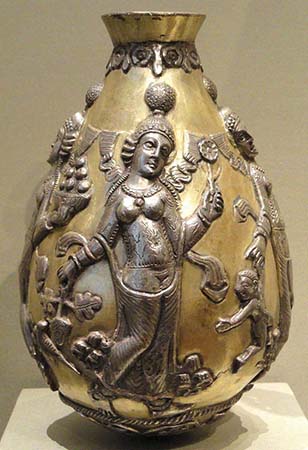
4th-6th century silver and gilt Sassanian vessel, assumed to be
depicting Anahita (Cleveland Museum of Art) Photos: Wikipedia
The lotus flower is the symbol of goddess Anahita
Anahita (meaning innocent) was a pre-Christian, possibly pagan, Armenian goddess who was imported by the Achemenian kings into Zoroastrianism, with the words "Aredvi Sura” added to "Persianify” her. Aredvu or Aredvi means raise, increase, grow. Sura means strong, innocent, rainy. Aredvi Sura Anahita means pure, powerful river. Scholars unanimously agree that the son of Darius II, the Achemenian king Artaxerxes II (404-370 CE), was the first to formally establish the cult of Anahita. He had her name inscribed on the columns at Susa and Hamadan next only to Ahura Mazda’s. His objective was to portray a fully Iranian goddess to establish a bond between the masses and the Persian aristocracy, perhaps in an attempt to whitewash the fact that she was already a goddess of fertility and the waters of a different civilization, with her statues made of gold worshipped in golden temples. This Achemenid introduced worship continued under the following two Persian empires, the Parthian and the Sasanian.
Four eminent Muslim scholars from Tehran, in a superb essay titled, "An overview of Goddess Anahita and her iconography in Ancient Iran,” state that the archeological and epigraphic evidence of Anahita worship is particularly overwhelming in the last Persian empire, the Sasanian. She lost prominence once the Sasanian dynasty collapsed, through the last emperor of Persia, Yazdegird III (popularly Yazdegird Sheriar) was himself crowned in a temple dedicated to Anahita.
Herman Lommel, a renowned German scholar states that in Vedic Sanskrit, which has great similarities with Avesta, there is a near identical goddess of the waters and learning called Saraswati. Before it embraced Christianity, Iran’s neighbor Armenia had worshipped this goddess under different names and many temples were dedicated to her.
In present day Iran, remnants of temples exclusively dedicated to ASA are evidence of a cult which, on the face of it, was antithetical to Zoroastrianism which prohibits image worship. There is some evidence to suggest that the orthodox Zoroastrian priests tried in vain to resist this image worshipping cult.
According to Dr Mary Boyce, an eminent Zoroastrian scholar, the Ava Yasht (actually, Avan) is a mixture of old Avestan as expanded greatly by the priest of priests Adarbad Marespand (of the "unscathed even after molten lava voluntarily being poured on his chest” fame), is recited by devout Zoroastrians, particularly on mah Avan, roz Avan. Never to be recited before a fire and only until sunset.
Present day popular consciousness regards the deity as a benign wish fulfilling Yazata (one of the deputy ministers in Mazda’s cabinet) propitiated by offering of dar ni pori (sweetened lentil cakes) tossed over the parapet at Gateway of India (after a boring annual speech making function at the Radio Club). The truth is that ASA, in the Zoroastrian hierarchy, is next only to the supreme lord himself, before the Amesha Spentas who are full-fledged cabinet ministers, and much ahead of the exalted Yazatas Srosha and Varham. She is a martial, no nonsense goddess who summarily rejects the petitions of the non-righteous, even if they be kings and, according to Avan Yasht itself, was propitiated by offerings of a hundred stallions, a thousand oxen and a million goats (wonder how she feels about the Radio Club gang offering dar ni pori).
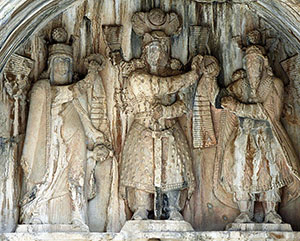
Taq-e Bostan high relief of the investiture of Khushro II. The king (center) receives the
ring of kingship from Mithra (r). On the left, presumably Anahita Photo: Wikipedia
A huge inscription at the ruins of Taq-e Bostan, erected by the last great Persian emperor Khushro II (590-628CE), show him sandwiched between the smaller figures of Ahura Mazda and Anahita. Khushro’s beloved wife, Shirin, was a voluptuous Armenian Christian, to please whom the emperor, after subjugating Jerusalem in 614 CE, brought home the "true cross.” This had to be returned by Khushro’s son Sheroe (born of another Christian wife, Maryam) to the Byzantine emperor Heraclius in 628 CE. This was done after agreeing to a humiliating truce (before which Sheroe, for good measure had killed Khushro and his 17 sons in a bloodless coup). Khushro’s last act was to pray before ASA in a temple erected in the palace complex at Ctesiphon (35 km from present day Baghdad), not to save his throne but to punish his traitorous son who perished from the bubonic plague after just eight months of his rule.
According to Boyce, the idolatry started by Ardasir I, founder of the Sasanid empire, slowly faded away in Sasanian times when fire temples and inscriptions were dedicated to the goddess but without her statues, as Zoroastrian priests grew in power. Several fire temples subsequently built in her name replaced her statue with the holy fire. In light of this, the present practice of not reciting prayers to her in a fire temple is based on the orthodox reasoning that she, the lady of the waters, may be deemed to extinguish the fire.
Thus this extremely popular deity invoked by Parsi believers for fulfilling legitimate wishes was, to begin with, a non-Zoroastrian goddess whose statues and images were worshipped in temples all over Persia. Did someone say something about extra-religious worship?
Berjis Desai, lawyer and author of Oh! Those Parsis and Towers of Silence, is a chronicler of the community.