Col Sehra Karaka (Retd) was a pioneering army nurse
Nawaz Merchant
Many Zoroastrians pride themselves on being part of a culture where there is no gender discrimination. Sadly, this perceived equality is not historically accurate. Although both boys and girls are initiated into the religion with the navjote ceremony, there was gross discrimination against women in the 1800s and during much of the 1900s. Despite this, some Parsi women were able to achieve noteworthy feats in many aspects of life. Some, like Madame Bhikaiji Cama, an Indian nationalist, sacrificed her marriage (to an industrialist and British loyalist) for her ideology. Others, like my grand aunt, a colonel in the army, never married, but saw action in war, and served as a nurse and nursing administrator for over five decades.
Sehra Karaka was born on January 22, 1910 to Ratamai and Kavasji Karaka. Sadly, her mother expired in childbirth, leaving Kavasji with three children: son Faramroz, daughter Banoo and newborn baby Sehra. Finding himself unable to care for his children perhaps, he left them in the care of his wife’s sister in Surat and migrated to Iran. He did not return, and we have no record of him after this point, so his story stops here.
In the early 1900s, women usually did not work outside the home. However, Banoo and Sehra needed to earn an income. Since the teaching and nursing careers were open to women, the sisters chose to become nurses and trained at The B. D. Petit Parsee General Hospital in Bombay. With the advent of World War II (WWII), the medical corps of the Indian Army sought trained nurses. Along with other intrepid young women, both sisters joined the Nursing Corps. Sehra was aged 30 in 1940, and Banoo was a few years older. During WWII, Sehra was part of the British Eighth Army which recaptured Italy. What terrible scenes of war she must have witnessed!
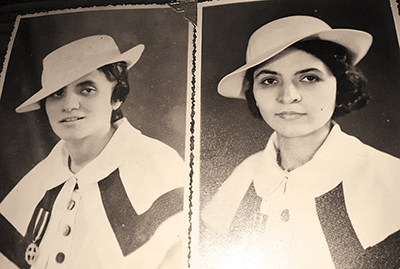
Sehra and Banoo Karaka
Sehra on camel Photos: Phiroze Karaka
History.com mentions: "Among the British and American Allied troops fighting in the Italian campaign were Algerians, Indians, French, Moroccans, Poles, Canadians, New Zealanders, African Americans and Japanese Americans.” Wikipedia notes: At the height of WWII, more than 2.5 million Indian troops were fighting Axis forces around the globe. The WWII museum estimates that India lost 1.5 to 2.5 million army and civilian lives. A recent article in The Indian Express notes that three infantry divisions of the Indian Army, the Fourth, Eighth and 10th Indian Divisions, took part in the Italian campaign. "The first one to land in the country was the Eighth Indian Infantry Division that saw action in Iraq and Iran when the British invaded these countries in 1941. The second one to arrive was the Fourth Indian Division that came to Italy from North Africa in December 1943. In 1944, it was deployed in Cassino. The third, which is the 10th Indian Division, was formed in 1941 in Ahmednagar and moved to Italy in 1944.”
Field Marshal Lord Richard Carver’s history of the Italian campaign points out that in October 1943 the Eighth Indian Infantry Division fighting on the Adriatic front reached the Barbara Line which was breached in early November. The Eighth Division led the assault on the German defensive Bernhardt Line, crossed the Sangro River and advanced to just short of Pescara where the Eighth Division halted to wait for better weather in the spring…In the 1945 spring offensive, the critical role of getting across the Senio, honeycombed with defensive tunnels and bunkers front and rear, was given to the Eighth Indian Infantry Division, reprising the role they played crossing the Rapido in the final Battle of Monte Cassino. On April 29, 1945, the Germans signed an instrument of surrender; hostilities in Italy formally ceased on May 2.
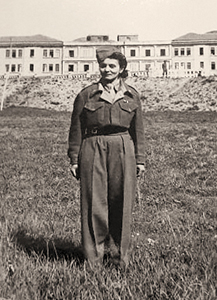
Sehra (above) and her retirement plaque (below) Photos: Phiroze Karaka
The website British Military History details the difficult terrain. "The men from the Punjab and Indian plains coped with the extremely hostile conditions experienced in Italy. Even the Gurkhas from Nepal struggled with the heavy and persistent rain, and freezing nights in the Italian mountains. All three Divisions performed well in the Italian campaign and were highly respected by the Allied and Axis commanders alike.”
Sehra slogged through the rain and sleet with this army. However, she rarely spoke of this time. Her most joyful moments may have come at the end of the War, when she attended the Victory Parade in London as part of the Indian contingent.
In 1945, after the War ended, she was posted to a Bangalore army hospital. Still in Indian military service, she received a number of promotions during her nursing career and worked in army hospitals for the rest of her life. It is unclear why Sehra did not marry, and neither did Banoo.
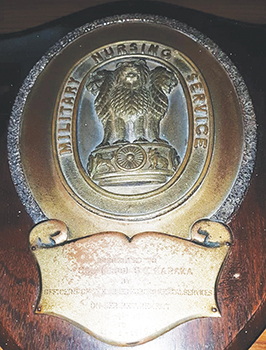
In 1969, Sehra retired as principal matron in charge of military hospitals, possibly in Delhi. On January 21, 1969, she retired as a full colonel of the Indian Army.
As a child, in the 1970s, I remember her as a short, slightly plump but energetic lady who lived with Faramroz’s family. Banoo predeceased her by a few years. Throughout, she was an extremely loving, calm and competent woman with a fondness for children, evident each time I visited with my siblings. Over the years Sehra had amassed a collection of small, exquisite glass curios from her travels around the world. We were entranced by this collection, and she often took out artifacts for us to admire.
A plaque acknowledging her retirement is a family heirloom and stands testament to her lifelong commitment to nursing the soldiers and officers of the Indian Army.