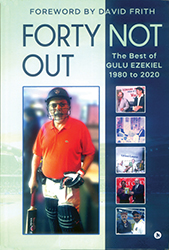
Forty Not Out: The Best of Gulu Ezekiel 1980 to 2020 by Gulu Ezekiel. Published in 2021 by Notion Press Media Pvt Ltd, No. 50, Chettiyar Agaram Main Road, Vanagaram, Madras, 600095; website: www.notionpress.com. Pp: 206. Price: Rs 699.
He is here, there and everywhere. Where there is cricket, there is Gulu Ezekiel (pictured) with his laptop, camera and an open mind. His semi-autobiographical Forty Not Out covers his journey in cricket writing; his encounters and interviews with famous cricketers, cricket writers, administrators, you name it. I would describe the book as "artico-graphical” as it is a collection of articles he has written in various newspapers/magazines/websites in the last 40 years.
This is Ezekiel’s 15th book (13 on cricket, one on table tennis and one on the Olympics). He dedicates his latest book to the memory of his beloved parents Prof Joe Ezekiel, an accomplished badminton and tennis player and Khorshed Wadia Ezekiel, a well-known writer and poet.
Appropriately, there are 40 chapters in Forty Not Out as the author takes us to different countries where he meets and interviews cricketing greats: England’s tour opener Sir Geoffrey Boycott, South Africa’s peacemaker Dr Ali Bacher and Norman Gordon who was the first male Test cricketer to turn 100, Australia’s speed menace Dennis Lillee.… The most interesting chapters are on Indian greats: the legendary Sachin Tendulkar, M. S. "Cyclone” Dhoni, Mansur "Tiger” Pataudi, Sourav Ganguly — the prince of Calcutta, friendly Bishan Bedi, "survivor” Anil Kumble, among others. 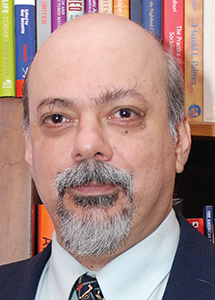
There is an engrossing chapter on the exclusion of South Africa from international cricket in 1971 because of their government’s apartheid (whites only) policy. The ban was lifted in 1991-92 when black players were included to represent South Africa. Ezekiel reveals the second birth of South African cricket in three dimensional detail; especially his meeting with South Africa’s former captain Bacher who had earlier fought against the hateful apartheid policy.
To quote the author, "It was Sudhir Dar’s delightful caricature of Bacher, magnifying glass in hand, peering at a ball Sherlock Holmes-style that got me on the team bus to the airport. As Bacher was entering the vehicle, I thrust the sketch forward with a request for his autograph. Bacher and his compatriots enjoyed the joke and my request to accompany the team to the airport was acceded to.”
Ezekiel thought very highly of Tiger Pataudi both as batsman and as captain. He quotes England’s reputed writer E. W. Swanton, "I believe that but for his handicap (losing sight in one eye) Tiger would rank by now as the greatest of modern Indian batsmen.” Ezekiel chooses Pataudi over Ganguly and Dhoni as India’s greatest captain.
The author quotes Abbas Ali Baig, Pataudi’s teammate for India and Oxford, who told him, "Tiger’s recovery from a position wherein he could not identify the location of a ball tossed to him to being able to plunder world class attacks was nothing less than miraculous. What further heights he would have reached will remain in the realms of speculation.”
And there is an exciting chapter on Baig being kissed on the field by a young girl during the Bombay Test of January 1960 at Brabourne Stadium. After scoring his second 50 in the match he was returning to the pavilion at tea time when this eye-catching and lip-warming incident took place. Was she a Parsi? No one is sure. It inspired a novel and a TV ad as juicily summed up byEzekiel. Then there was a sequel. Another on-field kissing sensation took place when a woman in a black sari kissed Brijesh Patel during the first Test to be played at Wankhede Stadium in Bombay in 1975.
 The chapters on Sir Donald Bradman are both sentimental and realistic. On the death of India’s captain Lala Amarnath in 2000, Bradman wrote to Ezekiel, "I was very sad to hear the news that my old cricketing foe, Lala Amarnath, died over the weekend… I found him absolutely charming and a wonderful ambassador for the game. It was a special time for me as it was during this series (1947-48) that I made my 100th century. Lala was among the first to congratulate me… There was a wonderful spirit of camaraderie amongst the players of both sides.”
Adds Ezekiel: "To cricket worshipping Indians, Bradman was a God,” quoting Sunil Gavaskar. Don received the most fan letters from Australia and India. Shane Warne and Tendulkar were guests of honor at Bradman’s 90th birthday in 1998. "The two stars were like schoolboys when they were interviewed on TV about their thoughts, giggling as they recalled how nervous they were on their way to Bradman’s Adelaide home.”
"We were wondering what to say,” confessed Tendulkar with Warne by his side. "I am one of the luckiest guys on this earth because I had a chance to meet him. It will always remain a special moment in my life.” Ezekiel writes, "When in the same interview Sir Donald mentioned that Tendulkar reminded him of his own batting, the Indian media went gaga.”
On Bradman’s passing in 2001, Bedi was choking back tears when he met Ezekiel, saying, "Such towering achievements, such humility. I feel very deprived at not bowling to Sir Don. I am told he would have murdered my bowling. I think I would have loved that.” The author cherishes the time he spent at the Bradman Museum in Bowral, New South Wales in 2000.
There are other chapters titled: "The Tied Test that ‘Never Was,’” "Like a Spider to a Fly,” "The Forgotten Double Hat-Trick Hero,” "When Procter Polished Sobers’ Boots,” "More than Just a Game” and the autobiographical "A Joyous Journey of a Cricket Fan.” I assure readers that they will enjoy dipping into these episodes.
Ezekiel selects India’s Best "kar” XII, including Gavaskar, Tendulkar, (Vijay and Sanjay) Manjrekar, (Ajit) Wadekar, (Dattu) Phadkar, (Eknath) Solkar…
But I have a bone to pick with the author in his selection of an All-time India XI in England. Why is Vijay Hazare left out? In the second innings of the Headingly, Leeds Test of June 1952, India was four wickets down for no runs on the board when Hazare (56 runs) and Phadkar (64) added 105 runs for the fifth wicket against the frightening pace of Fred Trueman and swing of Alec Bedser. Two months later at the Oval Test in London India made another disastrous start, losing five wickets for six runs to Trueman and Bedser but the man of crisis and majestic cover drives, Hazare, stood firm and scored 40% of India’s poor total of 98. Parsiana readers will be pleased that Farokh Engineer is included in the above XI as wicketkeeper.
The chapter on the Calcutta connection of Norman Pritchard’s kin has become very topical now since India’s Neeraj Chopra won a gold medal at the Tokyo Olympics this August. It was India’s first gold medal in an Olympic track and field event, its first in any individual sport since a shooting title in 2008. India’s only previous medals in Olympic track and field were two silvers won by Pritchard in the 200 m and the 200 m hurdles at Paris in 1900. Historians have debated whether the results for Pritchard should be recorded for India or for Britain. Pritchard was born in India to a British colonial family, moved to London before qualifying for the Paris Olympics and later moved to the US and embarked on an acting career. Ezekiel obtains accurate information from Pritchard’s grandnephew Gilbert Pritchard Cann who lives in Middlesex.
Ezekiel throws further light on Pritchard’s achievements 121 years ago without realizing at the time of writing that the multinational Olympian would become a topical person a few months after his book was published.
I enjoyed Ezekiel’s poems on Gundappa Viswanath "the pocket dynamo, the wristy maestro,” on Pataudi "Tiger, Tiger, burning bright,” on E. A. S. Prasanna "the portly sweaty hangman”…
Describing Ezekiel as his industrious friend, England’s eminent cricket author David Frith wrote in the Foreword, "… it’s usually more rewarding to enjoy quietly, privately — even by sitting in an armchair with a good book — just like this one.”
I agree. Forty Not Out is a book to read in an armchair and cherish, to go down memory lane and look ahead with anticipation. KERSI MEHER-HOMJI
A retired virologist, Meher-Homji is an author of cricket books.