Despite advancing age
and a hearing impairment, the Mistry sisters are immersed in the traditional art of making torans
Parinaz Gandhi
MISTRY” read the lettering in red against the white bead background of the name plate. Above the unpretentious portal hung a beads toran (door decor) that appeared to be an assemblage of several scenes: a house and tree with birds, children seated at a bench, a woman taking shelter under her umbrella, a palanquin being carried by two bearers.
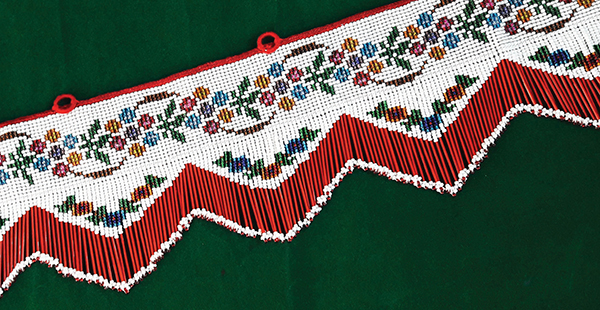
Each of the doorways at their ancestral home in Byculla was decorated with a toran. Even the entrance to the washrooms bore a toran. The array of beads skillfully strung together bore images of roosters and chicks, flowers and geometric patterns, the popular swastika sign… The handiwork of sisters Roda, Zarine and Maharukh Mistry, the torans reflect the painstaking effort and attention to detail and neatness that is the distinctive feature of RZM Torans. Formed 12 years ago, the collective enterprise that bears the starting letter of the first names of the siblings was the brainchild of Maharukh, the youngest of the three, now aged 73.
Whilst all three of them suffer from varying degrees of hearing impairment, Maharukh can manage a conversation with a stranger with the help of hearing aids. Eighty-three-year-old Roda is unable to vocalize but flashes a winning smile frequently. Seventy-seven-year-old Zarine seemed more comfortable with sign language. When Parsiana sought to interview them in October, they twice deferred their appointment to ensure their elder sister Goolu Lala, 84, a teacher, was in attendance.
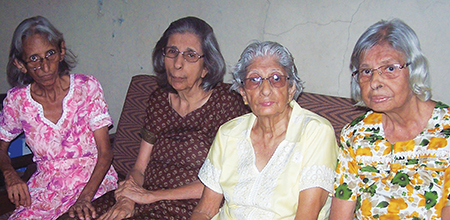
(From l): Mistry siblings Maharukh, Zarine, Goolu and Roda
Giving full credit to her sisters for working the entire day, Goolu elaborated on their "good division of labor.” Whilst all three of them showed us the torans they were independently working on, each of them also has her area of specialization. Thus cording work, that gives torans a neat finishing along its 36 or 38-inch length and variable width is invariably entrusted to Roda. Zarine does beadwork only on a saar or frame, one is metallic, and the other is wooden. Cooking for the family is her responsibility too. Their work starts in the morning before breakfast and ends at sundown. Maharukh has taken up part-time employment at Nekoo Insurance in the mornings and after lunch is engrossed in her beads assignments. Whilst proficient in all aspects, she is the only one amongst the three who does the complex, "three-bead work” that requires greater dexterity. With advancing age, they find it is a strain on their eyes, "especially with nalla dana (finer beads).”
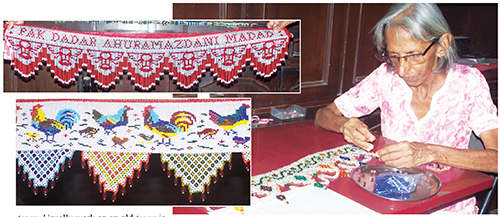
Maharukh Mistry at work; some of the handiwork of RZM Torans
Entrance to the Mistry residence
Since one of them may have a "tight haath” and the other "dheelo haath” (a tight or loose pull on the string that determines the tautness of the toran), it is important that the person who starts an assignment duly completes it to give it a uniform texture, stresses Maharukh. RZM manages to produce around five or six new torans a month and they additionally make coasters, wall hangings, curtain holdbacks, to add to the variety. They also receive a regular supply of old torans sent to them for repairs or extension. The sisters thus alternate work on one new and one old toran. Usually work on an old toran is more laborious because they first have to wash and clean the old toran, remove the beads from the broken strings and then thread them anew. The distinguishing feature of the old torans was kaach na dana (glass beads). Most of their orders now are executed using glass, acrylic and crystal beads. Plastic beads are also available but the sisters prefer not to work with those.
Their customers are mainly Parsis although some Gujaratis too have now started buying from them. The Mistrys are willing to oblige customers who have specifications in terms of color or design. Maharukh referred to one current customer who wanted bells incorporated in the toran with the lettering "Happy New Year.” When Maharukh agreed to the request, the customer wanted bows added to the bells. She is not sure how she can incorporate both. Also before her was a specimen of one motif in a particular color scheme as requested by the client. Not happy with the outcome, she asked us, "How does it look?”
Before proceeding with the execution of a design, they usually visualize the pattern on craft paper. Of the RZM trio, Maharukh is particularly dynamic and is constantly experimenting to introduce new concepts and designs. Although the sisters had learnt the basics of toran making from their mother Khorshed, since they did not know how to make scallops, Maharukh says she honed the art from her cousin Sheroo Captain, now deceased, before launching their business.
"Knowing of their physical impairment, members of the community tend to encourage them,” observes Goolu who helps them deal with customers and maintain an account of sales at the RZM stall at exhibitions. Whether they participate in the biannual Cama Baug sales or the ones at Sohrab Palamkote Hall or Allbless Baug, the RZM practice is always to keep their torans and products on display with the price tags visible unlike others who choose to conceal their rates. Their torans are priced between Rs 1,200 and Rs 4,000.
There are five or six others in the toran making business but the sisters choose to keep away from competition. They have not forgotten an incident before they launched their own business. On learning that one lady sold torans, Maharukh went to her residence thinking she would offer the services of the sisters. But she was almost shooed away by the lady’s husband, Maharukh recalls his brusque demeanor. In hindsight, she is happy that he did, for it convinced them to launch RZM. Goolu refers to one toran maker who advised them to increase their rates. But so long as they make some profits after paying for the high cost of the beads and allowing for their intensive labor, the sisters are content. While some beads are purchased on weight, others are bought as skeins of 100 beads, Maharukh brings out some from their collection.
The sisters appreciate the support and guidance they received from Dinaz Mojia and her husband Farokh "who is an old horse at sales and knows the pulse of the people.” They feel that the WAPIZ (World Alliance of Parsi Irani Zarthoshtis) sales held at Cama Baug under the stewardship of its chief executive officer Anahita Desai are well organized for they even provide bottled drinking water to those who sell their wares. Whilst fraternization continues during the year by way of an outstation trip for entrepreneurs who participate in the sales, the Mistry sisters prefer to remain immersed in their work that they accept is "a dying art.”
Socialization has not been a priority for the three unmarried sisters. Whilst Zarine was earlier employed with Sir Ratan Tata Industrial Institute for 23 years, Roda managed to work there for only two or three years. Their father Jehangir who was a weaving master in Ujjain had brought the family to his parental home in Bombay in 1956. After studying at the Sitaram Podar School in Bombay, Maharukh graduated in Arts from Ruia College, and subsequently earned a diploma in accounts and business management from Sir J. J. College. Having started work in 1967 as a stenographer in Timber Industries, she continued there for 12 years until she joined Lumex Lighting. When Lumex shifted to Poona she decided to try her hand at toran making and involved her sisters too, both of whom she considers her responsibility as they were unable to complete their schooling. Her only regret is that their parents are not alive "to see their daughters succeed at RZM.”
The consanguineous marriage of cousins Jehangir and Khorshed had no adverse repercussions on the two older children. Their first born, Rumy, earned his PhD and worked as a professor in textile engineering. He currently resides in Vadodara. Goolu now gives tuitions to students from Std VIII to XII and teaches English to street children twice a week at Bal Jeevan, managed by a Parsi trust. She was formerly a teacher at the Dadar Parsi Youths Assembly School and later at the Wee Tots nursery. She married Kunversha Lala who was her colleague at The Bombay Samachar. Whilst he worked in the editorial department, Goolu was a secretary there. Maharukh recalled that when he had earlier come as a suitor for an arranged marriage, Goolu had rejected him. Knowing him to be a khadi wearing follower of Gandhiji and a vegetarian, Goolu admitted that she was initially wary of him but as she got to know him better she admired his traits and appreciated that he did not try to force his views on her until his death by which time she had become a vegetarian of her own volition.
An eye-catching toran in white and red bearing the blessing "PAK DADAR AHURAMAZDANI MADAD” is brought out for our viewing. Below the lettering were symbols of the farohar and at the lowest end, the cylindrical red beads. Are the sisters religiously inclined? "We go to the fire temple two or three times a year, on New Year and our birthday,” states Maharukh. They are content to pray at home. "Zarine used to pray from the Avesta but has now stopped.” When we asked her the reason, she indicated that she would feel drowsy when reciting prayers from a book. Does she not feel sleepy when working on torans? Promptly responded Maharukh, "This is not work. It is enjoyment.”
For further enquiries contact Maharukh Mistry, mobile: 9867417925, email:
rzmtorans@gmail.com