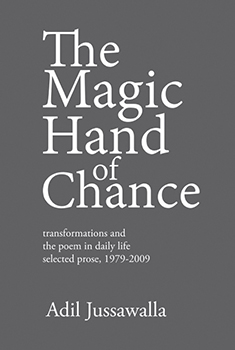
The Magic Hand of Chance: transformations and the poem in daily life, selected prose, 1979-2009 by Adil Jussawalla. Published in 2021 by Paperwall, An imprint of Paperwall Publishing, A/103 - Krishna Residences, 379, Cardinal Gracious Road, Chakala, Andheri (East), Bombay 400099. Pp: ix + 215. Price: Rs 499.
One has always thought of Adil Jussawalla as a poet. This impression has been further bolstered by the fact that he has recently been conferred the title of Poet Laureate at the Tata Literature Live! The Mumbai LitFest 2021. This has somehow obscured the fact that he has published two books of prose — Maps for a Mortal Moon and I Dreamt a Horse Fell from the Sky (prose cum poetry) and recently The Magic Hand of Chance, a collection of articles that had appeared in various newspapers and magazines between 1979 and 2009. Many of the journals are now extant. The reason for publishing these, as with the previous collections, was to keep them accessible to the present day reader. "Much of our journalism has gone with the journals and papers they appeared in. They can only be found in the archives kept by some libraries in the UK and the US. So getting them republished in a book, as many journalists abroad do from time to time, was a good idea. I wish it had happened to other journalists here more often.”
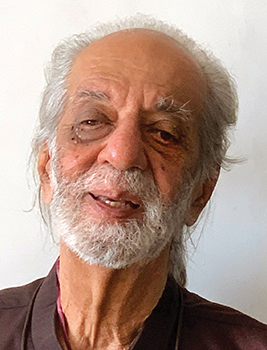
Adil Jussawalla Photo: Noshir Gobhai
The book is divided into three sections and a "Coda.” In each of the sections — "Transformations,” "Seven Poets” and "The Poem in Daily Life” — Jussawalla has grouped his poems to give some structure to the articles. His analysis of his favorite poets in "Seven Poets” and the influence of poems in his daily routine life are illuminating and offer an extremely original point of view.
In "Transformations,” the first of the three sections, the reader is immediately struck by the trajectory of the essays; in Jussawalla’s hands each article becomes a leap into the unknown. Starting on a simple and apparently deceptive note, they develop into something quite different. "Death of a Scholar” begins with the straightforward reporting of the fact that on July 17, 1992, 15 people were crushed to death in a stampede during a pilgrimage undertaken by thousands of devotees on their way to Pandharpur in Maharashtra. One of the sacred stops during this pilgrimage was at Jejuri where a man’s ashes were immersed in the nearby river Karha. We are then told about this "man” who had spent a lot of time in the area studying the customs and the lives of the Varkaris (pilgrims), a man whose identity is as yet unknown to us. His last wish was that his ashes be immersed in the Karha river. It is only when we are well into the article that we come to learn that the person is a German, Gunther Sontheimer, who died of a heart attack in his flat in Dossenheim. Jussawalla paints a sensitive picture of this professor and his love for India and its people. It is here that he spent the six months of the year when he was not teaching in his homeland. He encouraged a healthy exchange of visitors between Germany and India and would often generously pay for an Indian scholar to visit Heidelberg when funds were not forthcoming.
The essay "Fame,” starts with the controversial comment made by late writer Khushwant Singh that many Indians may have heard of Rabindranath Tagore and Satyajit Ray but very few "know” them; a non-Bengali would probably be able to mention just Gitanjali and Pather Panchali. It is possible that these names may mean nothing to people outside India. This bare fact makes Jussawalla reminisce about the nature of "fame” and the desperation with which it is sought even though it is so short lived and "its range is shorter than that of a short-range ballistic missile.”
Similarly, looking at a long line of ships waiting to dock at Bombay Harbor in "The Ship in the World,” Jussawalla imagines the captains receiving messages [as the official service provider MTNL (Mahanagar Telephone Nigam Limited) often subjected us to in the past] from the port: "You are in queue, please wait,” and of course, the more lethal one: "This number does not exist.” He feels that this has come true and the port of Bombay has ceased to exist as the sailors’ yarns, the maritime history, songs, poems and paintings have long since disappeared.
Jussawalla makes a sensitive analysis and provides an appreciation of several poets in the section "Seven Poets.” In "Vikram Seth: Telling a Beastly Tale,” he comments about man’s eagerness to "give his voice to everything he has touched and sometimes not touched.” He asks pertinently: Would animals like us to speak to them in their own voice? Would a dog long to hear his master bark?
In "Shelley Goes Down Again,” Jussawalla regrets the unfair treatment meted out to poet Percy Bysshe Shelley both at being "sent down” from University College when he was a student as well as the fact that the bicentennial of his birth was not celebrated in the UK. Though Jussawalla accepts that anger according to Buddhist and Hindu scriptures "is seen as a base emotion, one that distracts the mind, clouds judgment and causes great spiritual harm,” he feels that anger has a part to play in poetry and much of Shelley’s poetry could never have been written without that spur; the poet’s anger was not the sort contemplated by the Indian scriptures but stemmed from an overwhelming desire to get things done.
In the final section, "The Poem in Daily Life,” as the title suggests, Jussawalla blends poetry with the often humdrum and routine aspects of our daily chores. In Tongue to Tongue, he concentrates on poems written on the subject of food. He strongly feels that Raj Rao’s poem entitled Food as Shit is revolting. He also criticizes the many vapid articles on food, recipes and restaurants. He quotes marvelous and evocative lines from Andrew Marvell’s Bermudas as well as from the contemporary poem Settling down by Ira Sadoff with its witty image of the tea bag and finally refers to a translation of a Bengali poet, Benoy Mazumdar, where he speaks of:
"The dry mouth
conjures memories of sharp sauces
succulent meat wallowing in gravy.”
Parents teach their children not to waste or throw away food; Jussawalla advises the latter to throw away all senseless and uninteresting matter in newspapers including his prose pieces but never such sensitive and suggestive poems as the ones he has quoted from.
Jussawalla describes a journey he makes to see a natural phenomenon in "The Day According to the Eclipse.” During this period he is often reminded of lines from Andrew Marvell’s To His Coy Mistress. He is a vegetarian that day which makes him recall:
"My vegetable love will grow
Vaster than Empires and more slow.”
When he has an article to write, it brings to mind:
"But at my back, I always hear
(Time’s winged chariot hurrying near)”
Though Marvell says that "we cannot make our Sun /Stand still!…”Jussawalla feels he can do this by capturing the moment in a photograph.
In the introduction to The Magic Hand of Chance Jussawalla writes that on going through these essays readers will wonder what is happening; but "wonder’s a good state to get lost in” and only by losing ourselves in this wondrous state will we be able to appreciate the wisdom and the perceptiveness of this collection.
FIRDAUS GANDAVIA
Gandavia holds a doctorate in English literature and is a retired chartered accountant. He is a compulsive reader of fiction.