Ratan Tata’s marriage to Suzanne Briere and
her subsequent navjote created a storm but the marriage was a happy one
Exracts from ‘Jeh’: A life of JRD Tata by Bakhtiar K. Dadabhoy. Reprinted with permission of the publishers Rupa and Company.
Jamsetji established Tata and Sons in 1887 with his first-born Dorab and young Ratanji (RD) as partners. He had been impressed with Ratanji’s handling of the textile business in Nagpur and decided to make him a partner when he set up Tata and Sons 13 years later. RD was born in Navsari in 1856 and according to an interview his son Jehangir (JRD) gave many years later, was, in all probability, adopted from a poor family. After completing his graduation from Elphinstone College in Mumbai, (then Bombay) RD did a course in agriculture in Madras before joining the family business with the Far East. He spent time in Hong Kong importing silks from China to India and exporting rice from Burma to the Far East. He also opened branches in Kobe and faraway New York.
RD had been married at an early age to a girl from the Banaji family who died childless soon after the union. He remained a widower till his mid-forties when fate intervened in the form of the lovely Frenchwoman Suzanne Briere, the 20-year-old daughter of his French teacher in Paris. RD had gone to Paris hoping to trade in pearls and silks. The 46-year-old Ratanji confessed that he had been struck by Cupid’s arrow. He asked for permission to marry from the patriarch Jamsetji, with what must have been much trepidation and little hope, since marriage outside the Parsi community was taboo in those days. A visionary in industry, Jamsetji proved that he was progressive in the social sphere as well. His enlightened consent led to the union of Ratanji and Suzanne in Paris in 1902. Soon after the marriage, RD gave his bride a Parsi name, Sooni. Sooni was a good cook and made excellent pastry. Witty and alert, she had golden hair and blue eyes and was also an accomplished seamstress. Within six months of coming to India she learnt Gujarati. It was obvious that RD had chosen well.
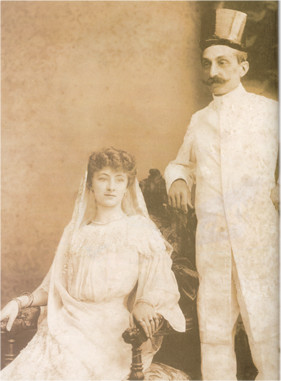
The happily married couple, Sooni with Ratan
The marriage created a sensation in Bombay because, not only had RD married outside the community, he had also taken the revolutionary step of converting his wife to the Zoroastrian faith. The uproar raised at the time still echoed 90 years later when JRD died. When R. M. Lala his biographer asked JRD if this incident had colored his attitude to the Parsis he replied, ‘I don’t think so.’ All his life JRD was against organized religion, including Zoroastrianism. He opposed what he called the ‘outward priest-created manifestations of religion,’ which he believed to be the cause of disunity and backwardness. JRD was against the insistence of the orthodox Parsis in not accepting into the Zoroastrian faith children of Parsi girls who had married outside the community. This still remains a highly controversial subject and one which never fails to excite many passions among the Parsis. JRD’s secular and national outlook was obvious, when at a felicitation by the Parsi Punchayet in Bombay, he remarked: ‘As an Indian, I am proud to be a Parsi.’
Jamsetji not only delivered the nuptial oration, but also lavishly entertained the newly weds at Kingston-on-Thames, hosting ‘the largest gathering of Parsis which had hitherto been held West of the Suez Canal.’ This was the last gathering Jamsetji attended. He fell seriously ill in May 1904, and passed away on 19, May 1904 at Bad Nauheim in Germany. Both Dorab and RD were at his bedside when the end came. Though they shared a slightly strained relationship, the two decided to work together to achieve Jamsetji’s vision. Under their able stewardship Jamsetji’s three dreams would become reality within the next eight years.
Childhood
JRD was born on 29 July, 1904 (70 days after Jamsetji’s death), in the second house on Rue de Halevy, a spacious road to the left of the Opera in Paris. This year also saw the birth of Pablo Neruda, Graham Greene, Bing Crosby, Marlene Dietrich, Alexei Kosygin, Lal Bahadur Shastri, (and his colleague in Tatas for nearly half a century, Naval Tata). It was the year in which King Camp Gillette introduced the safety razor and work on the Panama Canal began.
He was named Jehangir or ‘Conqueror of the World.’ JRD’s earliest childhood memory is of being thrashed by his father when he was four for kicking the maid and using her poverty to justify his misdeed. (‘I can hit you, kick you because you are poor.’) As Lala puts it, he was ‘an interesting product of two continents’ and schooled in Paris, Bombay and Yokohama. His education was disrupted regularly and he schooled in Paris with French as the medium of instruction for a few years, then in Bombay in English, then Paris again, before returning to Bombay once more. In between he spent about two years in Japan. Most of his education was in France and one of the problems Jehangir faced was of language — a result of his mixed heritage.
JRD later recalled: ‘When I attended one of the government schools in Paris, the Janson De Sailly, I was a much better student in French than I was in English at the Cathedral School in Bombay.’ Maths and Physics interested him but he was indignant about learning British history. JRD hardly had any recollection of the time he spent in Cathedral High School. Unimpressed with the pedagogy, he claimed that he was bored stiff with the way he was taught. Cars and aeroplanes fascinated him from the start; the latter interest put India on the aviation map of the world. The one single strand, which connected his childhood reminiscences, was his family’s peripatetic existence. ‘What I remember most vividly is that we always seemed to be on the move, and that my lovely and cultured mother had to uproot herself every two years or so to find a new home — alternatively in France and in India.’
There was no denying that it was an unusual childhood — nomadic and unsettling with the father mostly absent and no permanent home to speak of. Except for a holiday home in Hardelot, a summer resort on the Channel coast of France, they moved from house to house every few months. Some stability came in the form of a house on Ridge Road, Malabar Hill in Bombay, which he named ‘Sunita’ after Sooni. Unfortunately, Sooni did not live long enough to enjoy it to the full, passing away aged only 43 in Paris.
Sooni with her children: (from left) Rodabeh, JRD, Sylla, Darab with Jimmy in her lap
RD felt that his family was more comfortable in France and kept them there. Sooni wrote to him regularly in a unique form of personal cipher: French written in Gujarati script. Soon there were additions to the family. After Sylla and Jehangir a daughter, Rodabeh was born in 1909, and a son, Darab, in 1912. All the children were born in Paris, with the exception of Jimmy (Jamshed) the youngest, who was born prematurely in 1916 in Bombay, after Sooni suffered a fall from the steps in the Taj Mahal Hotel. She would have died of hemorrhage had timely medical attention not been provided round the clock.
When the First World War broke out in August 1914, RD was in Bombay and Sooni in Paris. The children were away on holiday in Switzerland with their granny. His grandmother was according to JRD a very formidable lady. As JRD was to tell Lala many years later, ‘Her husband was a humorist and after some time with her the gentleman ran away as anyone would have, had he been married to my grandmother.’ Perhaps JRD inherited his sense of humor from his French grandfather. When they returned from holiday, they found that their mother had volunteered to work as a nurse at the American Hospital in Paris. The strain of looking after a family and nursing took its toll, and Sooni contracted tuberculosis. RD summoned the family to Bombay and must have kept his fingers crossed as his family sailed from wartime France to India. The journey was, however, without incident.
Sooni’s tubercular lungs found Bombay’s humidity unsuitable. RD had good business links with Japan, and since the temperate climate was also suitable, he decided to send the family to Yokohama, where they stayed for all of 1917 and a fair part of 1918. Most of JRD’s early education was divided between Paris at the well-known Lycee (high school) of Janson De Sailly and Bombay’s Cathedral School. The Janson De Sailly was very close to where they lived and JRD called it ‘a very fine school, a great public school of Paris, but not in the British sense.’ JRD recalled how he was the fastest down the stairs and how for some strange reason his teacher called him L’Egyptien. He showed some talent for writing and even won a story writing competition.
JRD was by his own account a naughty boy and played practical jokes on people. He was also fussy about food, and Rodabeh, his sister, recalled an incident when RD got up from his chair at the dinner table to teach him a lesson and how JRD ran round the table saying, ‘No Papa, No Papa?’ It can only be assumed that the connection between JRD’s hand and mouth acquired a regularity and urgency not seen before. This trend continued throughout his life. JRD did not enjoy his food. For him food was just something one ate and he usually couldn’t remember what he had eaten. His only weakness was for prawns, which were sometimes the cause for his stomach upsets. Describing himself as ‘an ordinary boy,’ JRD was fond of sports and confessed that he was initially shy of girls. The move to Japan meant yet another school and change of environment. He was admitted to an American school run by Jesuit priests where the teachers ill-treated a fat Jewish boy. JRD went out of his way to befriend him because most of the other American boys were anti-Semitic.
The family stayed in Japan until 1918, and it was nearing the end of the war when RD decided to bring the family back to Bombay. Their passages were booked on a Japanese ship called Hirano Maru, and 14-year-old JRD occupied himself fruitfully by teaching himself to type on an old Remington typewriter he had ferreted out in the ship’s lounge. This skill was something he would use a few years later in France. They disembarked at Colombo and the family took another ship back to Bombay. The ill-fated Hirano Maru continued on its voyage and was torpedoed off the coast of England.
The Tata family returned to France in 1919 when the Versailles Peace Conference was being held. JRD was only 15 at the time, and like every French schoolboy, felt that the area of Alsace-Lorraine belonged to France, and rejoiced when France got it back after the Treaty of Versailles.
The young JRD in a sailor suit
Back home
On his return to India from France in 1925, JRD joined Tatas as an unpaid apprentice. Cambridge proved to be eternally elusive, and this was to be JRD’s life-long regret. It rankled that he had missed out on a University education and not specialized in any field. This fact made him try harder and determined to excel in whatever he did. Many years later JRD told Lala: ‘Maybe Father did not realize that while a university education may not be necessary, it is important.’ Despite his lack of formal education JRD’s English was excellent, he was well acquainted with poetry both English and French and was a fine editor. He was also widely read, with history being a favorite. There was a whole shelf of books on aviation, another on military ventures and warfare, and one on sports cars and motor racing. Short stories by American writer O’Henry were a special favorite. He also liked Ernest Hemingway and westerns by Louis L’Amour.