"My love and passion for the sport is beyond anyone’s imagination and thus I threw in my hat to try and help save the day at the cost of my health, time and money,” Zavaray Poonawalla had written in a letter to the members of the Royal Western India Turf Club (RWITC) on September 7, 2019. Four days later, he won the highest votes among the 11 contestants in the keenly contested annual elections to the Club’s managing committee. This is his second term as chairman of RWITC, the last time he headed the body was in 2015-16 (see "Poonawalla at the pinnacle,” Parsiana, December 21, 2015). In fact, Poonawalla’s entire five-member "Clean Racing” team, emphasizing integrity, won the 2019 elections against the rival team led by incumbent chairman, Khushroo Dhunjibhoy, the old war horse of Turf Club politics.
The Parsi "connections” (in racing parlance, "connections” mean owner, trainer, jockey of a horse) were many in the recently concluded annual elections. Poonawalla’s team included Zenia Lawyer (of London Pilsner fame), the only woman candidate who scored the second highest votes despite being considered a "weak candidate” by some. The others from the winning team were well-known Bollywood director, Milan Luthria who is married to Liane, a Parsi, Poona based builder, Suren Sanas and the chairman of the stewards, Geoffrey Nagpal.
Left (l-r): Yohan, Zavaray and Behroze Poonawalla in 2016 Photo: Jasmine D. Driver
Clockwise from top l: Khushroo Dhunjibhoy,
Zenia Lawyer, Milan Luthria and Jaydev Mody
Dhunjibhoy’s team included his business partner, Vijay Shirke, Jaydev Mody, owner of casinos in Goa and husband of lawyer Zia Mody, the work horse of the team Sunil Jhangiani, a textile exporter, and Dr Ram Shroff of the Charak Group. The lowest scorers, Jhangiani and former RWITC chairman Vivek Jain failed to make it to the final nine.
On paper, Dhunjibhoy’s team had more heavyweights. However, on the other side, the Forbes billionaire and the sultan of vaccines, Dr Cyrus Poonawalla, the face of Indian horse racing, was supporting his brother Zavaray. Dr Poonawalla spared no effort. A phone call from him to a voter was likened to receiving a call from Amitabh Bachchan. In the past, there were lavish dinner parties to woo the 1,800 odd voters. However, Jain had managed to get a Code of Conduct enacted which prohibits any such inducements. Phone calls, WhatsApp messages, audio clips supporting candidates, glossy appeal letters abounded during the recent tussle when 1,382 members cast their vote, 1,203 by e-voting and 179 in person.
Apart from the elections to the nine-member managing committee, elections were also held for the two seats on the Board of Appeal. Out of the three contesting, two were Parsis — the incumbent, Hoshang Nazir, and the debutant Darashaw Mehta, the latter supported by Dhunjibhoy. Nazir stood first by a handsome margin, followed by Dilip Gokuldas, both supported by the Poonawalla team. Jehangir Damania and Jehangir Mehta were appointed stewards.
"I am inclined to uphold and honor the faith and belief that scores of Club members and racing enthusiasts have reposed in the Poonawalla family to save the Club in an hour of need and therefore, despite having decided not to contest again, I… (took) up this daunting task for the sake of racing for which I am also inclined to dig deep into my pockets if and when required for our Club,” Zavaray assured his fellow members.
The Turf Club being in a financial crisis, compounded by the existing GST (Goods and Service Tax) on betting, Zavaray has taken the lead along with other representatives from the Turf Authorities of India to represent their case to the highest government officials. Requesting a reform in GST from 28% on the full bet value to 28% on the commission of the Club, they sought to impress upon the revenue department and finance authorities that racing is a game of skill and not chance and therefore should not be equated with gambling. They also argued that higher taxes would encourage illegal betting, causing loss of revenue to the government and the Club. Further, racing clubs in India offer recreational facilities to members and provide a source of income for thousands who would be adversely affected if these institutions do not prosper.
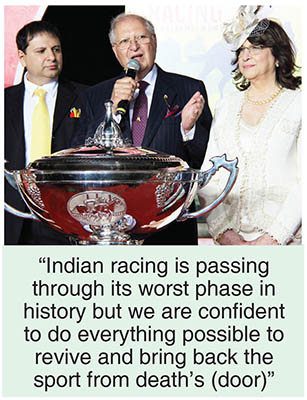
RWITC’s mounting losses are so "critical” that according to Zavaray’s analysis of the accounts there would be no cash flow were it not for the 10 crore rupees that came the preceding month following the settlement of a dispute with Gallops, the fine dining restaurant on its premises. The Club’s accounts being qualified by their auditors Deloitte who have also indicated their unwillingness to continue their association, Zavaray commented, "Indian racing is passing through its worst phase in history but we are confident to do everything possible to revive and bring back the sport from death’s (door) with constructive plans and actions.”