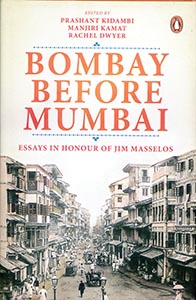
Bombay Before Mumbai: Essays in Honour of Jim Masselos edited by Prashant Kidambi, Manjiri Kamat and Rachel Dwyer. Published in 2019 by Viking, a part of Penguin Random House India Private Limited, 7th Floor, Infinity Tower C, DLF Cyber City, Gurgaon 122002; website: www.penguin.co.in. Pp: xxiii + 428. Price: Rs 999.
Edited collections of scholarly essays tend to be fairly tedious reads, worse when they are conference volumes, and even more so when they are festschrifts in honor of some senior scholar. Such books too often resemble mediocre smorgasbords: a wide variety of reheated dishes that go together poorly. This is not the case with Bombay Before Mumbai, which is a pleasure to read for anyone interested in Bombay’s history or in the experiences of modern urban life. What makes this book effective and appealing are its interpretive leitmotifs, especially the focus on urban public space, an orientation inspired by the work of Jim Masselos (pictured), in whose honor this volume was produced, out of a conference at the University of Bombay in January 2017.

The editors have brought together a fine collection of authors: excellent younger scholars, including Vanessa Caru, Danish Khan, Abigail McGowan, Dinyar Patel, Simin Patel, Robert Raman and Erica Wald, as well as prominent and accomplished scholars, including Preeti Chopra, Rachel Dwyer, Nile Green, Douglas Haynes, Manjiri Kamat, Prashant Kidambi, Jesse Palsetia, Murali Ranganathan and Ashwini Tambe. (A confession about my own perspective is in order here. Although I have been a history professor and author for more than 30 years, my field has been Russian and Soviet history. For the last few years, however, I have been conducting research on Bombay in the 1920s and 1930s as part of a comparative history of public life and moralities in New York, Odessa and Bombay.)
Every great city is distinctive and even exceptional. But as Masselos suggests in his brief afterword, a lovely personal reflection about his years of engagement with Bombay and its history, even a "unique” city can be thought of comparatively by looking at its experience through common forms of urban public space such as factories and other workplaces, sites of commerce and consumption, places for public sociability and entertainment, neighborhoods, and streets — all topics in this book. This attention to how people use, navigate and contest urban public space, so central to Masselos’s own work, is what drives this book interpretively and makes it compelling and important. In turn, these spaces are seen to be sites for working out questions of human experience: community, identity, power, culture, work and the struggle for alternatives to unjust and discriminatory forms of rule.
In his excellent introduction, Kidambi observes that a key "feature of Masselos’s historical writings on Bombay is his sharp awareness of the ambiguities, contradictions and tensions that structure the social worlds of the city.” Such recognition of history’s "empirical density” and "the messiness of everyday life,” while unarguably true, risks taking us down the rabbit-hole of a type of narrative history where every story is equally interesting and worthy. "Masselos’s suspicion of overarching theoretical categories and concepts” similarly risks leading us away from interpretive coherence and larger arguments. Some of the essays in this book admittedly lean toward such story-telling for its own sake. But most of the authors, like Masselos, do not lose sight of the need to turn the disorderly past into an interpretive history highlighting connections and meanings.
"Cosmopolitanism,” as so many writers about Bombay have observed, has been a story that this city has long loved to tell about itself. For some urban groups, especially the Parsi community, the cosmopolitan ideal defined their communal identity. And Parsis were not alone in embracing this vision. At the same time, efforts to define and police boundaries of difference — of ethnicity, religion, class, caste and gender — was an inescapable feature of how individuals and groups navigated and survived life in this exceptionally diverse and rapidly changing urban milieu. The history of Bombay cosmopolitanism is a crucial location for those "ambiguities, contradictions and tensions” in the social life of the city.
Much of this work of division and unity took place in urban public spaces. We find here an abundance of fascinating stories about local social spaces where larger urban, regional, national and transnational stories were being worked out. The variety of city spaces examined is wide: businesses, factories, philanthropic and civic institutions, social clubs, cinemas, theaters, hotels, neighborhoods, market stalls and corner shops and other spaces of commerce and consumption, domestic spaces (which were as much public as private matters), sports, mosques, temples, churches, chawls, brothels, streets, maidans. In all these spaces, though local in form, we see significant stories of identity, community, inequality, power, possibility, and desire playing out. (While the category of "the local” is ubiquitous, it is not conceptualized with the same thoughtfulness as space and place.)
Readers of Parsiana will find the chapters by Ranganathan, Palsetia, Simin and Dinyar, of particular interest, though the historical role of Parsis is woven throughout the book, as it was in the history of Bombay itself. Ranganathan’s chapter examines the social and business life of the "country trader” Mohammed Ali Rogay, including his important partnership with Jamsetjee Jejeebhoy. Dinyar tells the story of the once internationally famous Maharashtrian inventor Shankar Abaji Bhisey, especially the important enthusiasm and support for his efforts from Bombay’s civic, business and nationalist elites, particularly Dadabhai Naoroji.
In two essential chapters for understanding the history of the city and the role of Parsis, Palsetia and Simin examine the making of "community and identity” in the 19th century. Palsetia explores a wide range of topics: the rise and role of urban leaders (sethias), Parsi conflicts with colonial authorities but also increasing cooperation and integration, contributions to Bombay’s commercial and industrial development and important educational and philanthropic work. His evidence leads to a key conclusion, the significance of which is not limited to Parsi history: how communal identity and activity can encourage commitments to the civic life and welfare of a larger society. This was certainly the case in the history of the Parsis of Bombay. "Cosmopolitanism, social progress and change had become integral part of modern Parsi self-identity,” he concludes.
Steinberg is a history professor at the University of Illinois, Urbana-Champaign and an author for over 30 years.