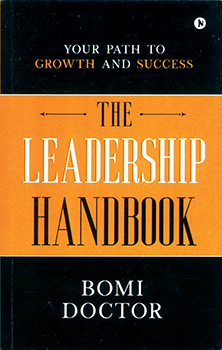
The Leadership Handbook – Your path to Growth and Success by Bomi Doctor. Published in 2021 by Notion Press, No. 8, 3rd Cross Street, CIT Colony, Mylapore, Madras, 600004. Pp: 216. Price: Rs 345.
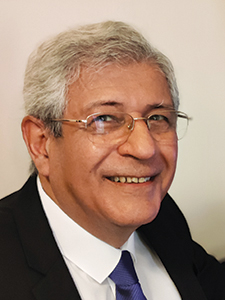
Leadership is a timeless skill that’s being tested now more than ever before. Contrary to popular belief, leadership is not innate: It can be taught and Bomi Doctor’s (pictured) book could not have arrived at a more opportune time than the present.
The author has a sales and marketing background and while one may tend to think that the job of such people is to sell a product or a service, in reality they are leaders vending a vision of what that product or service would do or how it would make people feel as a result of ownership. This is evident throughout the book.
 Whether a marketing leader or any other leader, the fact remains that a leader can inspire and inform. The ultimate choice of buy-in is of the customer or follower, as the case may be. The book therefore, literally opens with the author’s quote: "Leadership and learning are two sides of the same coin. You cannot have a leader who does not learn continuously.”
Divided into four key sections, the first part helps the reader understand the traits of a good leader such as: Is the person receptive to constructive criticism? Does the person adapt well to new situations? Does the person readily take up additional responsibility in his/her stride? Other indicators include caring about and valuing the team, not being afraid to make decisions, being approachable and having a positive mindset.
The second part deals with transition of an ordinary person into a leader; here the author aptly quotes American writer and lecturer Dale Carnegie: "The first step towards success is identifying your own leadership strengths.” The author rightly believes that a leader’s responsibility is to help people achieve their potential. "Give them their targets, let them strategize as to how they would achieve it and then leave them alone. Do not interfere unless you are asked for assistance,” the author asserts!
"All good leaders are necessarily ethical in all their dealings. This is the one characteristic that draws the most respect,” avers the author and we agree entirely.
The third part of the book focuses on qualities of an authentic leader — after all not all leaders are authentic even though any leader can grow into being one. In the words of former US First Lady Rosalyn Carter, "A leader takes people where they want to go. A great leader takes people where they don’t want to go, but ought to be.”
In this section, the author fleshes out some of the qualities of an authentic leader to include being an optimistic but realistic visionary, having gratitude and confidence with humility, self-discipline, integrity, adaptability, courage, empathy and an altruistic attitude.
We found the chapter on building trust through authentic leadership most relevant to our times. There is distrust all around and the author believes that trust and leadership are inseparable. Trust is not an automatic entitlement. It needs to be earned. Being genuine is the cornerstone of those personalities who aspire to gain the trust of the team and the organization.
Doctor feels that to demonstrate trust the leader must become human — admit mistakes, apologize and even crack a joke occasionally at his/her own expense. Sharing information and knowledge as also keeping one’s given word, showing interest and having passion helps to build and fortify trust.
 When trust is low, it creates suspicion in the minds of people. They start looking out for self-interest rather than investing their time and energy in cooperation. This results in wastage of a lot of time and energy.
However, the best truism is expressed in the chapter where the author clarifies that authentic leadership does not come wrapped in a title. A title can give one a position in the hierarchy but does not make one an authentic leader.
The concluding part of the book summarizes the knowledge, experience and wisdom shared by Doctor throughout this passionate labor of love. It starts with a poem whose final line we particularly liked: "To lead is to serve, to give is to achieve.”
This last section of the book is liberally strewn with the author’s own quotes — 52 of them — literally, one quote for every week for the whole year. A few nuggets of wisdom which we enjoyed picking up include: "A leader plans his work and then works his plan,” "In the final analysis, both responsibility and accountability are of the leaders,” "A vision is a vision only when it is crystal clear,” "A vision without a timeframe is a dream with no reality,” "A leader with empathy has a faithful following,” "Leadership is a choice, a decision, an attitude,” "Focus on the mistake, not the person who made the mistake!”
Overall, the book is worth a read. It leaves the reader inspired. However, what could have further enhanced its value would have been real stories of real leaders and case studies in authentic leadership. Also, throwing more light on where leaders go wrong or could potentially go wrong would have made for valuable reading. Also, the emphasis throughout appears to be on corporate leadership. A slight diversion to including social, political and even thought leadership could have further enriched the content of this otherwise interesting book. Finally, a few illustrations or memes and a touch of humor could have made reading more enjoyable.
The design and general layout of the book is good. The font size is just right. The quality of paper and binding is also good. This book can be of interest and importance to all aspiring leaders — especially students and young entrepreneurs.
NOSHIR H. DADRAWALA
An expert on charity laws, Dadrawala is the chief executive officer of the Centre for Advancement of Philanthropy and a trustee of the Bombay Parsi Punchayet.