Died: Navroze Rustom Contractor, 79, veteran photographer, cinematographer and biker; on June 18, 2023 in Bangalore following a road accident.
Nearing the end of a regular Sunday morning motorcycle ride with his friends, Contractor was allegedly hit by a drunken motorcyclist with two pillion riders driving at high speed on the wrong side of the road. "It was an ironic and tragic death for someone who had campaigned assiduously for safe motorcycle and car driving, for someone who was planning to mark his 80th year with one last long bike ride between Bangalore and his beloved Ahmedabad, before quitting two wheelers for good,” noted a tribute by filmmaker and writer Ruchir Joshi in his column in the Hindustan Times of June 20.
Within the Parsi community, news of his tragic demise, posted by automotive journalist and editor Adil Darukhanawala, was circulated on different WhatsApp groups. Darukhanawala described Contractor as "one of the greatest motorcycle enthusiasts of India, inveterate motorcycle adventurer, ace motorcycle racing photographer (who) covered Grand Prix races in the UK and Europe in the late 1960s and early 1970s…and a great friend who helped judge the motorcycles at the first Goa vintage and classic car and bike event.”
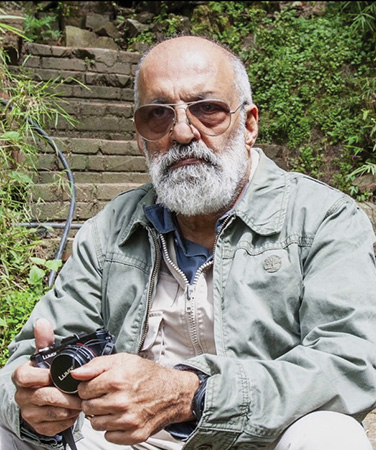
Navroze Contractor befriending young monks on his Bharat Parikrama
Taken on his maiden long distance bike ride from Ahmedabad to Ajanta-Ellora as a pillion rider by his elder brother Darius when he was 12, in the years thereafter Navroze undertook several daring road journeys. His most memorable rides were the ones from Bombay to London and the Bharat Parikrama when he circumnavigated India. Traveling a distance of 17,000 km in 57 days, he ensured he was within a distance of 50 km from the shoreline and national boundary at all times. "I always want to do something that people have not done before… I was able to prove that we are diverse people and yet one under a common border,” Navroze had stated.
To posthumously mark his 80th birth anniversary on July 7, Navajivan Trust in Ahmedabad organized a meet "Remembering Navroze” to celebrate "a life well lived.” Over the years, Contractor had held exhibitions, workshops and innumerable lecture series under the auspices of the Navajivan Trust. Those who spoke on the occasion included his peers, seniors and juniors from the film industry, from the fields of art, architecture and photography, and his school and college friends. Video clips from earlier interviews, talks and workshops had been incorporated in a 20-minute film shown at the meet.
"His wide view of the world and diverse experiences are reflected in the photos he shot, his documentaries… It gave him a lens to look at people. When I worked with him, I never had to mention what kind of shots we were looking for or what image size we wanted,” stated Sanjiv Shah who had availed of Navroze’s artistic eye for the feature and documentary films he directed Hun, Hunshi, Hunshilal; Love in the Time of Malaria; Famine 87. His journey as a cinematographer spanned experimental, feature as also documentary films.
Architect Prof Miki Desai was amazed at Contractor’s knowledge of diverse subjects, including sound recording and his ability to depict the various moods in one movie with the sounds of a ghatam (clay pot that serves as a music instrument). Ever willing to experiment, for Duvidha that was shot in a remote village in Rajasthan where the power source could not take the load of lights, he improvised using two sun guns and oil lamps. He even managed to anticipate the requirements of director Mani Kaul although the film had yet to be scripted. Since Kaul was a student of Dhrupad (school of Hindustani classical music) and Navroze, a jazz music buff, "when a camera movement had to be made, he would sing in my ear. That was (meant to be) my speed, the rhythm of the shot,” the cinematographer had related in an earlier interview.
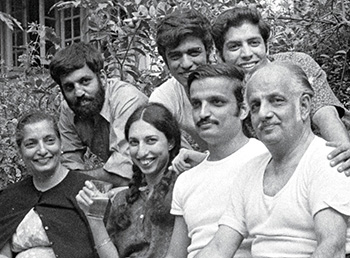
Meher, Navroze, Darius and Rustom Contractor (1st, 2nd, 5th, 7th from l)
Navroze with son-in-law Colin Scott, Mana Contractor and Deepa Dhanraj Photo: Mallikarjun Katakol
Navroze was involved in several other feature films that heralded the new wave in Indian cinema like 22 June 1897 directed by Nachiket and Jayoo Patwardhan; Percy by Pervez Merwanji; Pehla Adhyay by Vishnu Mathur. For documentaries, he worked with both international and national directors: Ballad of Pabu (George Luneau), Dreams of the Dragon’s Children [(Pierre Hoffmann), this title was also used by Navroze for his first book published by Penguin that related his filmmaking experiences in China], Are you listening? (Martha Stewart), All in the Family (Ketan Mehta), The Open Frame (Chetan Shah).
He was the cinematographer of choice for almost all the documentaries made by his wife Deepa Dhanraj including Kya Hua Iss Shahar Ko (What has happened to this city)? that captured communal violence in Hyderabad, Something like a War that analyzed the glitches in the family planning program in India, We Have Not Come Here to Die that sensitized viewers to the suicide of Rohith Vemula, a suspended doctorate student at the University of Hyderabad.
As noted a tribute to Contractor by writer, cultural critic and theater historian Shanta Gokhale for the Scroll publication, "I have come to recognize a Navroze frame by his striking use of light.” She quoted his statement, "In any location I go, for a film or otherwise, the first thing I notice is light. How is it falling in the room? How is it on faces?... I am obsessed with light.”
"He loved chilly, hing and miniature paintings,” attested Madan Meena, recalling the time they had spent together during the shooting of the documentary Jhadu Katha, directed by Navroze, to show the value of brooms in Rajasthani culture. Every year he planned interesting photo exhibitions in Kota. Fellow photographer Anuj Ambalal admitted that he was half the age of Contractor but "I had difficulty keeping pace with his hectic schedule” and looked forward to the senior calling it a day around 7 in the evening when he would say "ghanti waagi gayi (the last bell for the day has rung)” to signify time for drinks, relaxation and banter when "the master storyteller would captivate you with his anecdotes.”
Navroze’s still photographs were on view at several one-man shows in India and abroad. His images of jazz musicians are in the collection of the Smithsonian Museum, Washington DC and those of artist Bhupen Khakhar at the Tate Modern, London. In 2016 he exhibited a collection of photographs titled Kushti showing how and where wrestlers worked out in akhadas that had "the most basic equipment, hardly any light, a mud wrestling pit and a strict regime. The akhada is one of the few places remaining where there is no distinction between castes, religion or financial standing,” appreciated Navroze.
"Photojournalists are more than spectators in a historical grandstand. Being there is important. Being an eyewitness is significant. To bear witness is to make known, to confirm and give testimony to others,” photographer Himanshu Panchal recalled Contractor’s words.
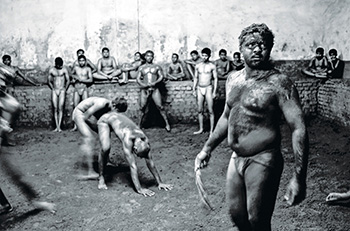
A view of an akhada photographed by Navroze
In the heyday of jazz, Navroze is known to have visited Bombay on weekends to enjoy live music played at four jazz clubs around Churchgate and happily filling in for the drummer at the Venice restaurant after midnight. At An Evening of Jazz organized by the Bangalore International Centre on July 4, 2023 as part of his piano recital, performer Sharik Hasan dedicated Round Midnight that he played for the first time to Navroze who was a great fan of its composer American jazz pianist Thelonious Sphere Monk.
Yet another informal celebration of his life was organized in Bangalore on June 29 "with a few readings, sharing of fond memories, a piano recital… and drinks and dinner, of course as he would have wanted,” reported his journalist friend Ammu Joseph. His daughter Mana read a humorous piece "What’s after all in a name?” written by Navroze for BangaloreMirror in 2009. Therein he recounted how people in Bangalore assumed Contractor was his profession and could not understand how it could be a surname: "Only the people who are of my generation, or cricket fanatics, know that there was another Contractor running around in the whole country... that’s Nari Contractor. Those who don’t remember him think I am completely confused or that my parents were total morons to give me a name like that…”
The younger son of the well-known puppeteer Meher, and Rustom, Navroze was raised in Ahmedabad. "His dad was the eldest brother. My dad, Jehangir, was the youngest brother of a large, very colorful family of six. Like the others in the family, he adored children and was extraordinarily good with them,” stated his cousin Dr Sanaya Nariman. Describing him as "a very warm, humane, genuinely kind and extraordinarily talented person,” Nariman mentioned that he had studied at Shreyas "where Madam Montessori herself had come to train the teachers! Here children could do no wrong and physical activity, out-of-the-box thinking and creativity was the center of all learning.”
After earning his BA in Fine Arts from the Maharaja Sayajirao University of Baroda, his interest in cinema took him to the Film and Television Institute in Poona where he studied direction and cinematography. The finer nuances of photography he learnt from Bhupendra Karia, advanced cinematography from Laszlo Kovacs in the US and video production at the Sony Corporation in Tokyo.
According to artist Gulam Mohammed Sheikh, "Navroze struck a chord with everyone, and even inanimate objects. Even though a perfectionist, he proved you can be completely immersed in your work yet enjoy it to the fullest.”
The cordial cinematographer is survived by his wife Deepa Dhanraj, and daughters Simin and Mana.
With inputs from Ammu Joseph