At the “Living with the Gods” exhibition at The Museum of Fine Arts, Houston,
the afarganyu featured prominently in the Fire section
Parinaz Gandhi
At the first ever installation dedicated to Zoroastrianism in the 100-year history of The Museum of Fine Arts, Houston (MFAH), the pièce de résistance was the silver afarganyu. It had featured in their special exhibition "Living with the Gods: Art, Beliefs and Peoples” open to the public from October 27, 2024 to January 20, 2025. Loaned by the Zoroastrian Association of Houston (ZAH), the afarganyu had originally served the dar-e-meher in Sukkur in Pakistan until its closure when the neighboring Quetta Anjuman took charge of its assets.
Above: Afarganyu on view at The Museum of Fine Arts, Houston (top) Photo: Wikipedia
The inscription in Gujarati indicates that the afarganyu was presented to the fire temple in Sukkur on January 28, 1917 by Pirojshaw Rustomji Mehta. He was a railway engineer. When ZAH needed an afarganyu for its prayer room, the Quetta trustees willingly obliged. The fact that the fire urn traveled from Pakistan to Houston was an indicator that people travel with their gods, observed the exhibition’s guest curator Neil MacGregor.
The timing of the exhibition, coinciding with the 18th North American Zoroastrian Congress in Houston in end-2024, resulted in many members of the community visiting the Museum. The World Zarathushti Chamber of Commerce (WZCC) – Houston Chapter had included a trip to the Museum on December 28, as part of its pre-Congress activities.
The afarganyu with the overhanging silver toran reflecting the Zoroastrian veneration for all creations featured in the "Fire” section of the exhibition, one of 10 thematic sections. Cosmos, time, water, animals, divine word, mysteries of life and death, helpers and protectors were some of the other sections that drew from regions like Egypt, Greece, Rome, Africa, Asia, Oceania, Europe and the Americas. More than 200 objects and symbols from these areas, both historic and contemporary, created over 4,000 years to help humans make contact with the divine, featured in the exhibition. "In every case the objects open a new dimension in the human search for a relationship with the divine,” it was stated on the Museum website, mfah.org.
"Living with the Gods” was "perhaps the most extraordinary exhibition in the history of the MFAH,” stated one pamphlet distributed to those entering the portals. Yet another leaflet served as a visitor map of the MFAH campus spread over five buildings connected by underground tunnels. The registrants who were granted self-paced viewing time of two hours were cautioned against losing their way on the premises for if they were not on time they would miss the bus that returned to the hotel, The Royal Sonesta Houston Galleria.
Top row and above: exhibits reflecting Zoroastrian culture;
far r: Vehishta Kaikobad exposing children to art Photo: mfah.org
New perspective
"In museums, many great objects can lose their original purpose which was spiritual. An exhibition of this kind can give that purpose back to them, allowing a new and deeper approach to great and familiar works,” believed MacGregor whose 2017 BBC radio series and book chronicled this enduring form of human expression. Acknowledged MFAH director Gary Tinterow and chair Margaret Alkek Williams, "We are honored that he brought that perspective to Houston making it visible through objects chosen from our own collections as well as some truly exceptional loans.”
In a video on the Museum website, MacGregor gave an overview of the exhibition. When introducing the section on Light and Fire he commented, "Fire gives us heat, food, purifies… It is the perfect symbol of the divine. Yet we can’t grasp it, can’t hold it, can’t touch it… For Zoroastrians, the flame was the nearest one could imagine the presence of God. Praying to the God of truth, God of goodness…”
Among the other objects that earned considerable attention was a large silver urn in the Water section. It was one of three commissioned by the Royal Palace, Jaipur in 1894 when Maharaja Madho Singh II was invited to King Edward IV’s coronation in London in 1902 when he was instructed to drink only Gangajal during his three months out of India. Nearly five feet in height and weighing around 800 pounds, the urn could hold 900 gallons of water.
During the nearly three-month duration of the exhibition, leaders from different spiritual traditions were given an opportunity to expound on their faith. Engaging with the audience on "Divine Fire: Zoroastrianism and Ritual Purity” was Vehishta Kaikobad, a Sunday School teacher at ZAH and an MFAH docent (guide).
Another room on the Museum premises showed Zoroastrian culture and legacy, displaying artifacts provided by the ZAH Library and FEZANA (Federation of Zoroastrian Associations of North America) Information, Research and Education System. Mementoes in the form of a silver casket given to the scholar priest Dastur Maneckji Nusserwanji Dhalla by the Karachi Anjuman, and a silver gift presented to Prof Kaikhosrov Irani’s father Dinsha Irani were the center pieces in the room.
Three rare copies of the Avesta aroused interest: a miniature version with leather binding and gold embellishment; another copy with a leather cover with gold decoration and gold-plated clasp; and a third that had a mix of paper, leather and gold leaf with an accompanying carrying case. These were personal copies that had traveled with the owners. A hand-written copy of the Vendidad, considered a guide for morals and ethics, was on display too.
Also seen was a traditional ses as also a red pugree. One wall was covered with distinctive textiles in the form of garas, jhablas and tanchoi. On the facing wall were old family photos of a bygone era.
Rivetna’s 90
The WZCC-Houston team led by Sharmeen Irani and Jal Sethna had arranged a light meal to be served to the two busloads of Zoroastrian delegates who visited the Museum on December 28. Making the occasion memorable was the cutting of two birthday cakes to felicitate WZCC founder president Rohinton Rivetna who completed 90 years in December 2024. As remarked WZCC past global president Edul Daver, completing 90 years is "a good innings without being bowled out. May you bat at least a century.” He gave Rivetna credit for leading the North American diaspora through the organizations he initiated like FEZANA, WZCC, Society for Scholars of Zoroastrianism. Added WZCC committee member Rustom Engineer, "Rohinton is the cornerstone of Zoroastrian associations in North America. He determines the need for an association, conceptualizes it, brings the right people together, writes the constitution, registers it as a non-profit organization, nurtures and guides it to ensure success. Roshan (his wife) works diligently by his side, helping Zoroastrians become a strong, recognizable generation in North America. Together they have created a legacy which will be remembered by posterity.”
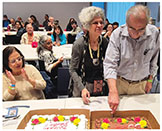
Rohinton and Roshan Rivetna at the cake-cutting
Delegates at the Port of Houston
Another interesting activity planned for the morning by the WZCC Houston team was a visit to the Port of Houston, the 10th busiest port in the world. The trip included a 90-minute educational boat ride with live commentary on the maritime activities of the Houston Ship Channel. Ferrying a variety of steel products and gas, the Houston Ship Channel is the number one port in the US for waterborne tonnage and the busiest waterway in the nation. More than 200 private and public terminals do business along this 52-mile long waterway. It owns and operates eight public terminals, including two container terminals that are considered its "bread and butter.” It is the fifth largest container port in the US and the fastest growing of the top 10, creating 1.54 million jobs in Texas.
Nearly 90 delegates had boarded the two buses in the morning. Fortunately no one missed the bus on the return journey. Actually the number of passengers was higher for some who had skipped the morning outing had come directly to the Museum.
Other sessions of the Congress will be covered in forthcoming issues of Parsiana.