Dadabhai Naoroji spoke of social reforms and the transition of the
community in a lecture at Liverpool in 1861
Parsiana reprints two extracts from Dr Dadabhai Naoroji’s papers "The Manners and Customs of the Parsees” read before the Liverpool Philomathic Society on March 13, 1861. The second extract will appear in a later issue of Parsiana.
The text was downloaded from Google Books but also features in a booklet printed by The K. R. Cama Oriental Institute in 2005. Included in the booklet is another paper "The Parsee Religion,” read by Naoroji before the Liverpool Library and Philosophical Society on March 18, 1861.
Naoroji was a social reformer, scholar, a member of the British Parliament, a founder of the Indian National Congress and co-founder of the Zoroastrian Trust Funds of Europe. He also headed both the organizations.
Under ordinary circumstances it may not be difficult to give a general account of the existing manners and customs of a people; but in the case of the Parsis, in the present transition state of their social and intellectual condition, it is difficult to say what the whole community generally observes and believes.
I begin with the class to which the staunch, orthodox, unchanged Parsi belongs, and which is designated the "old class” in contradistinction to the "young class,” by which name the educated and the reformers are known. The continuous struggles between these two classes during the past 12 or 15 years have made this distinction marked and expressive.
The kusti prayers play an important part in the daily religious observances. As I said above, he (the old class Parsi) says them four times before he ends his morning ablutions. The performance of the necessary functions of nature must every time be followed by the washing of hands and face, and the saying of kusti prayers. The ordinary prayers themselves are not valid unless preceded by washing of hands and face, and saying of kusti prayers. All meals must begin and end with the kusti prayer, in addition to grace prayers, which come in immediately before and after the meal. Before going to bed the work of the day is closed by a kusti prayer.

The apparatus for washing the hands, face and feet does notot consist of a washing table, basin, jug, etc, but a small copper pot. This, being filled up from a larger one kept for general use, is held in one hand, and the water poured out into the natural cup of the hollow of the other hand, and thrown over the part to be washed. When soap is used it is washed out in the same way. The mode of taking the bath is something similar. One large copper pot, containing about four gallons of water of the proper degree of warmth, or two pots, one of hot and the other of cold water, are placed on a ledge at the edge of a square flat bathing place, with an out let for water to run out. The bather sits on a stone, or a low stool, fills up a small copper pot out of the larger one, and pours the water over the body, rubbing it with his hands at intervals. When soap is used, it is washed out in the same way. This process goes on till the pots are emptied, or till the body is cleaned — at least to the satisfaction of the bather.
Resuming now the daily observances in their order: after he has performed his first ablutions and said his morning prayers, he takes his breakfast. I say he takes his breakfast, because the lady of the house does not join him. Other male members of the house, and little girls, may take their meals at the same time with him; but the ladies, as a matter of course, and from what to them is a sense of duty, attend to their own wants after the gratification of those of the lord of the house.
Suppose two or three were taking their breakfast, or any other meal, at the same time, each has his separate piece of mat, or any box or chest for seat, and each has a copper or brass plate, like a good sized tray, put before him, with the dishes spread over separately on it; just as if an English gentleman, instead of taking one thing at a time in his plate, took from all the dishes at once before setting to work. They often have the dishes, instead of being put into the large plate in heaps, served in small copper plates put side by side into the large one, like a number of small plates in a tray. They use no knives and forks, their fingers supplying the place of both. They sometimes do take their meals together from the same plates, but then they have to take care not to put the fingers in the mouth, or bite anything, but fling the morsel into the mouth from a little distance. Any one that did not manage to let the morsel go from his hand before the mouth caught it must wash his hands before touching the plate again, or no one else would eat out of that polluted plate.
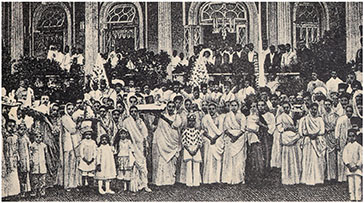
Top: Dadabhai Naoroji; above: Parsi wedding assembly in Bombay
While thus taking their meals together, the water also should be drunk without allowing the copper pot to touch the lips. It is poured into the mouth from a little height from the lips. At all times, whether at meals or not, the Parsi cannot touch the moist inner part of his mouth. The thing touched is defiled, and must be washed. If he has to drink out of a glass, and finds it would be inconvenient to wash his hands where he is, he holds the glass with his handkerchief. After the lord of the house is thus spiritually and physically prepared, he goes out for his day’s work. At noon he takes his second meal, preceded by the noon prayers, or at least by his kusti prayers. In the afternoon, after he is released from his day’s avocation, he goes either to the seashore, or to the fire temple, or to both, to say his usual evening prayers. He has again to say his night prayers, before taking his night meal and going to bed.
It is not that every Parsi of the class I am describing does say all the prayers at the various times mentioned, but that an orthodox religious Parsi does, as much as his opportunities permit, or would do all if he could. The daily religious duties of the ladies are of the same kind, but, being generally ignorant both of reading and writing, they do not, nor are they expected to, trouble themselves with saying all the prayers, except the indispensable kusti prayers.
I shall now as briefly as possible give you some idea of the Parsi customs on births, marriages, and deaths.
When a lady is confined, she has perhaps the worst part of the house allotted to her, on the lowest ground floor, sometimes in a room, but generally in a corner, with a thick canvas screen all round, and a flap for a door from one corner. She there remains secluded for 40 days, during which period her touch to any thing is pollution. The midwife, or anybody else who touches her, must bathe after leaving her, or cannot touch anything else. She is, no doubt, as well taken care of under the circumstances as affection could prompt. On the sixth day a piece of paper, an inkstand and a reed pen are placed within the canvas enclosure, for the Hindoo goddess Chhati to fix and write out the destinies of the child. The blank paper in the morning leaves to the fond mother the fullest scope to picture to herself as splendid a career for her darling as her heart could desire. On the 40th day of the confinement, she undergoes the purifying ablution, consisting of rubbing the body with nirang (consecrated bull’s urine) — drinking a little of it too, and a good deal of washing, both of herself, of her clothes, and of everything belonging to her bed. The bedstead is always made of iron.
Soon after the birth of the child, a Hindoo Brahmin, or a Parsi priest, not as a priest, but in the character of an astrologer, casts its horoscope, which serves at least one good purpose, besides whatever hopes it raises in the breasts of the fond parents — that of being the only register of the day of the birth, and of the names of the parents. When the child is seven years old, it is invested with the sudreh and kusti, the badges of Zoroastrianism, representing admission to its duties and privileges.
By the age of seven (maybe even in its infancy) the child is betrothed by the parents. The ceremony of betrothal consists in some ladies from the boy’s side taking a suit of clothes for the girl to her parents’ house, the presentation of which completes the contract. The parents of the bride make some suitable presents in return — either a suit of clothes or a ring for the boy. Mutual presents are made to the parents also, and oftentimes to other relatives. During the first year after the betrothal, presents of clothes are interchanged on every important holiday, even on some of the Hindoo holidays.
Then comes, according to the convenience of the parents, the celebration of the wedding. The auspicious day, however, should be fixed by the astrologer. Several days before, according to the directions of the astrologer, the foundation of the "wedding booth” is laid, accompanied with some ceremonies and songs. The booth, which is sometimes very richly decorated, is not always necessarily erected, as is the custom among the Hindoos, but the ceremony of laying the foundation is considered indispensable.
At these wedding feasts hundreds or thousands are sometimes feasted. There are no tables or chairs. A long strip of cloth about 18 inches wide is spread upon the ground, and the guests take their places in a row on it. Each is then furnished with a piece of the plantain leaf, which he spreads before him; and the servants, with each eatable in a large quantity in a basin, serve the line from one end to the other by means of a flat spoon. After every dish is served in this manner, eating commences; in the course of which all the toasts from "Glory to God” down to "Happiness to the couple,” and to the host, are proclaimed, with not half a dozen words of speechifying, by amateur toastmasters, and responded to by the party by emptying their little copper cups, ready filled by their side. As soon as one toast is drunk, a number of servants and friends of the host, with bottles in their hands, immediately replenish the emptied cups for the next toast. No speechifying, except perhaps an exclamation from someone of "May God bless them” "Thank God!” or something of the kind. On the feasts of all days, except the wedding day, mutton or fowl is served. The wedding day feast, however, is almost vegetarian, with fish, and what else of animal food could be brought in in the shape of various combinations of milk and eggs. To be continued