Pooling of expertise and resources
would contribute to the advancement of
the global community
Parinaz Gandhi
"Almost everyone in this room is a contributor. But are we giving enough? If we are not, why not?” asked Noshir Dadrawala, chief executive officer of the Centre for Advancement of Philanthropy. As the first speaker at the 16th annual general meeting (AGM) of the Global Working Group (GWG) and the Global Council of Zoroastrians Trust (GCZT) on February 2, 2025 he stressed on the importance of contributing "three Ts: time, talent (acumen) and treasure (of network).” Addressing leading representatives from the worldwide community who had assembled at Bombay’s West End Hotel, plus some others who had joined on Zoom, Dadrawala who is one of the GCZT advisors reminded the participants that when one contributes, "it gives a sense of purpose, productivity and prosperity.”
Regretting that "many in the community tend to be destructive,” he noted that "contribution should be collective and constructive. The general public thinks we are an elite community but we have islands of prosperity in a sea of middle class, and even poverty. Our religion advocates begetting wealth by righteous means and using it for righteous purposes. Poverty, disease, ignorance are considered afflictions of evil. Each of us has a role to play as a rathestar (warrior) asking what we can do for the community. Problems are a part of life. We need to see ourselves as solution providers.”
Urged GCZT chair Neville Shroff of Hong Kong, "Our global community is small and interconnected. Avoid divisiveness. A few individuals are spreading misinformation with malicious and vindictive comments. Foster a spirit of collaboration, focus on mutual respect and dialog, unite and work together with collective strength and unwavering dedication. Only together would we possess strength to shape the future. Let’s make Parsi Zoroastrians great again. That will only happen with perseverance.”
Empowering the next generation is paramount; equip them with skills, promote civic engagement, continued Shroff who considered educational support as a fundamental pillar of empowerment, alleviating financial burden on students. "Literacy, vocational training and skills development can lead us out of financial dependence with adequate networking, guidance and support,” he added.
From l: Neville Shroff, Yazdi Tantra and Sam Balsara
Trustees, advisors, regional representatives and invitees at the Global Working Group meeting
Historical and cultural preservation by collaborating with likeminded institutions would safeguard our heritage just as support to mobeds would ensure continuity of the religion. (The subject of demographics and mobed welfare was to be discussed by the GCZT trustees at a separate, private meeting the next day.) "Strive to operate efficiently and productively to maximize impact. Diverse expertise is vital as also pooling of resources to contribute to the advancement of the community,” he continued.
"GCZT has had a very successful and active year,” commented secretary Yazdi Tantra. "Patience is our hallmark,” remarked treasurer Sam Balsara, adding, "We started slow, opening a bank account in February 2023 after collecting Rs 1.31 crore (USD 150,724), of which founder chairman Burjor Antia contributed one crore rupees (USD 114,810). The current balance stands at Rs 1.40 crore (USD 161,080).”
Respect resources
The newly created Neuro Rehabilitation Center at Masina Hospital "is not seeing footfalls from Parsis despite being sandwiched between two residential colonies,” mentioned Homi Katgara, managing trustee of the Hospital and advisor on the GCZT health panel, urging the community Press to give it suitable publicity. (Parsiana had carried a feature at the time of the Center’s inauguration, see "The road to recovery,” October 7-20, 2024.)
"We need to look at health care holistically — physically, mentally and spiritually. We are blessed with good genes for longevity,” observed physician Dr Rati Godrej. She advocated a comprehensive look at health care that includes prevention and screening for early detection as also palliative care that is not just end-of-life care but even guidance on pain management or mobility challenges for those discharged from hospital. "Loneliness and isolation result in diseases, not only in the West but even in Bombay. We need to take care of this as also children suffering from obesity, mental health,” she advised. "We have the resources to care for our people. We don’t just want a long life but a healthy life that is purposeful and meaningful. We need health to chase wealth otherwise we will be using all our wealth to chase health.”
From l, 1st row: Noshir Dadrawala, Homi Katgara, Dr Rati Godrej;
2nd row: Homiyar Madan, Capt Percy Master, Maneck Dastur
Chartered accountant Homiyar Madan who also works with Dinshaw Tamboly on the World Zoroastrian Organisation Trust observed a certain apathy among the youth to work on trusts. They have identified three youth whom they are nurturing and preparing for greater community involvement. Besides inviting youth to GWG meets, he felt the speeches made by the guest speakers should be telecast live and shared on WhatsApp groups. He believed youth in India need a well-structured program for career guidance like the one initiated by the Bombay based Antarang Foundation. After aptitude tests and mentoring, internships are organized by the Foundation to help the youth determine whether they are well suited to the career they have opted for.
Recommended Dorab Mistry, trustee of the Zoroastrian Trust Funds of Europe (ZTFE), "Our aim should be to lower the age of leadership. The community will then be as vibrant as in the past. The youth always deliver if provided with right mentors and encouragement. We should not be throwing stones (at them).” He referred to ZTFE having brought in a youthful Paurushasp Jila as his successor nearly two decades ago. But "our community makes the role of a president so stressful that at the end of four years he requested that he be relieved from this responsibility.”
Arzan Wadia, immediate past president of the Federation of Zoroastrian Associations of North America (FEZANA) remarked, "It is easier to get the youth in through the door but it is difficult to sustain their interest.” He shared his experience of some youth in North America who may have been disenfranchised or disappointed with their local association but were happy to associate with FEZANA’s youth wing, Zoroastrian Youth of North America (ZYNA). Confident of connecting interns from India with professionals overseas, he felt the main role of GCZT need not be "to run programs but as a coordinating and networking body where associations can learn from each other.”
Bridges for the youth
Seven youth from across the globe — one in person and six on Zoom — shared their plans and enthusiasm. Representing ZYNA, Parshan Khosravi, Kimiya Shahzadi and Fravash Chothia referred to the massive resurgence from being a dormant body and the popularity of their retreats and dar-e-meher road trips. They were also hopeful of bringing the world youth together on a common platform.
From l: Parshan Khosravi, Kimiya Shahzadi, Fravash Chothia, Jal Canteenwala,
Siavash Mondegari, Benaaz Nanavati, Hoshaang Gotla
From the UK, Jal Canteenwala briefly alluded to the Young Zoroastrians, Xtra Young Zoroastrians, the Fun Club maintaining contacts through their WhatsApp Group and Instagram Page. He advocated the need to host a youth congress every two years instead of four. Siavash Mondegari gave an overview of the projects conceived by the Iranian Zoroastrian Youth Network, similar to the presentation he and his wife Shiva Ashtari had made in Houston (see "Hoo-ha with YaYA,” Parsiana, February 7-20, 2025). Hoshaang Gotla, founder trustee of the Xtremely Young Zoroastrians in Bombay, advocated the need for a unified youth organization that can align the objectives and efforts that are currently dissipated. Benaaz Nanavati who is the youth director of the World Zarathushti Chamber of Commerce (WZCC) said that they would have webinars between the youth in India and other regions. A youth meet in Lonavala or Udvada-Daman is being planned as also a trip to Iran in 2026.
WZCC being founded in December 2000, it will mark its silver jubilee with a jashan and dinner at the Saher Agiary, stated WZCC global president Capt Percy Master. The global conclave and AGM in its 25th year will be held at the Taj Land’s End hotel in Bombay.
Regional representatives
Bombay Parsi Punchayet (BPP) chairman Viraf Mehta spoke of their trust maintaining 4,400 flats in 22 colonies with further plans to develop properties in Mahim and Godrej Baug, as also Bharucha Baug where 80% of the permissions/compliances are in place. According to him, "The board has worked harmoniously with a focus on housing. Unfortunately, BPP as an institution carries a lot of past baggage.” They are in discussions with the Bombay Natural History Society to build an aviary at Doongerwadi but that would be subject to an alternative to diclofenac being developed, knowing that many seniors in the community are dependent on this drug which is lethal for vultures. They have provided for two large pits at Doongerwadi for rakhia (ash) disposal from fire temples since the Bombay Municipal Corporation (BMC) has banned disposal in the sea (see "Ashes to Doongerwadi,” Events and Personalities, Parsiana, February 21-March 6, 2025). "BPP has raised Rs 80 lakh (USD 92,045) as a kathi fund” to cover the cost of firewood at agiaries that do not receive adequate footfall,said Mehta. Their target is to raise Rs 1.5 crore (USD 172,585).
BPP’s "fairly eventful” activities included monetary support to 500 individuals; educational aid to 30 students; nominal amounts for the second and third child which, as Mehta remarked, "would not even cover the cost of diapers.” The Group Medical Insurance scheme supported by the BPP requires families to pay a premium of around Rs 25,000 (USD 287) a year to cover four members for Rs 20 lakh (USD 22,980). The major benefits from the group policy would be that no prior screening of patients is required and the cover for preexisting ailments is assured from the first day. Even community members living abroad can opt for this scheme as long as they pay the premium regularly each year and take medical treatment in India, clarified Maneck Dastur, senior vice president at K. M. Dastur Reinsurance Brokers. The community in Bombay sees 900 deaths a year as compared to 300 births, stated Mehta. (The number of deaths in 2024 were 658. The birth figures are not known as the BMC no longer provides a count of Parsi births. The last figure provided by the BMC in 2015 was 191. Today it would be between 100 to 150 — editors)
With Wadia’s four-year presidential term ending in 2024, FEZANA had "a change of leadership. It was all very civil, no storming of the capitol,” reported Wadia. His successor Kayomarz Sidhwa being unable to attend the GWG/GCZT meeting, Wadia referred to their youth actively participating in the World Zoroastrian Youth Leaders Forum and the Return to Roots program; giving scholarships of $ 100,000 (Rs 87 lakh) annually, by FEZANA with even a trade scholarship introduced; the FEZANA Journal which is the largest voluntary driven community publication; the welfare and critical assistance committee raising funds for applications from all over the world. They received two large endowments to provide critical assistance (see "Funding FEZANA,” pg __) Their advocacy committee with the cooperation of a Texas lawmaker succeeded in getting March 5 and 6, 2025 declared as Zoroastrian Days (March 5 at the Texas State Capitol in Austin and March 6 at the Rice University in Houston).
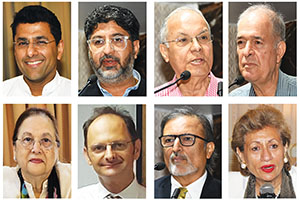
From l, top row: Viraf Mehta, Arzan Wadia, Dorab Mistry, Khodayar Attaie;
2nd row: Meher Bhesania, Dinshaw Avari, Firoze Pestonji, Farida Irani
Khodayar Attaie who spends six months in Iran and six in India, referred to the dharamshala in Tehran which is in a very dilapidated condition. The Anjuman there does not have funds to maintain the structure. If it is rebuilt, it could be used by Zoroastrians from the small towns of Iran and even from overseas. He reported he had "not seen any discrimination (in Iran) against Zoroastrians. All religions are respected and it is mandatory for Zoroastrian children to study the Gathas in school. They know their Avesta prayers with meanings better than those in India… My son is a medical engineer in one of the top government hospitals in Tehran. He is a nationalist and doesn’t want to go out of Iran,” stated Attaie.
"India has rituals, Iran has history,” stated Mistry. ZTFE sponsored the visit of Mobed Mehraban Pouladi of Iran to the UK before he came to India. Instrumental in publishing the Tamam Khordeh Avesta [512-page complete Khordeh Avesta in English compiled by Ervad (Dr) Ramiyar Karanjia] thanks to the sponsorship by Dr Zarthustra (Zar) Amrolia and his brother Prof Persis, ZTFE will now be publishing a tome on Zoroastrian customs and traditions. From their Zartoshty Brothers Endowment of UKP 400,000 (Rs 4.49 crore) that has now expanded to UKP 650,000 (Rs 7.30 crore) they have been supporting Zoroastrian students pursuing MPhil and PhD studies at the School of Oriental and African Studies. Having successfully hosted the 8th World Zoroastrian Youth Congress, they are keen to keep the youth engaged with the community. Their project, Care in the Zoroastrian Community (CZC), which serves the community seniors, celebrates10 years this year. For specially curated events, CZC volunteers drive the seniors to the Zoroastrian Centre or ZTFE subsidizes their taxi fare. ZTFE now has two celebrations each of Fasli Navroz in March and Shahenshahi Navroz in August. One subsidized event is held at the Zoroastrian Centre and another upmarket one at St James’ Court, A Taj Hotel, thanks to the arrangements made by Taj area director Mehrnavaz Avari.
"The community in Australia and New Zealand is still very young… making our presence felt,” reported Firoz Pestonji of Perth. All cities have their own mobeds and organize their own events, including muktads. Auckland has a prayer room. In Victoria which has a dadgah, their vision is to shift to bigger premises. There are around 20 mobeds in Sydney, reported Farida Irani who joined in on Zoom. They make efforts to raise funds for mobeds in India, convinced that "we must look after them.” Although they accept non-Zoroastrian spouses as full members at the Australian Zoroastrian Association in Sydney, the proposal to grant Iranian converts full membership was declined by the community.
1st row, from far l: at the Neuro Rehabilitation Center at Masina Hospital;
enclosed area for ash pits at Doongerwadi; center: at an Xtremely Young Zoroastrians event;
bottom: at the 8th World Zoroastrian Youth Congress
Efforts are continuing to form a Zoroastrian federation in Oceania, a long, elusive goal, and they are hopeful of making a breakthrough after Navroz.
There are about 1,700 Zoroastrians in the GCC (Gulf Cooperation Council comprising Bahrain, Kuwait, Oman, Qatar, Saudi Arabia and the United Arab Emirates) area, reported GCZT trustee Meher Bhesania from Dubai. A committee has been constituted to coordinate the activities of Zoroastrians in this region. "Dubai will be the best city to live in 2040,” she asserted. She was instrumental in creating a new film to highlight the presence of GCZT in five domains: health, helping the needy, empowering mobeds, youth, and community issues like demography.
There are 750 Zoroastrians remaining in Pakistan, according to Dinshaw Avari, chairman of the Karachi Parsi Anjuman Trust Fund who had joined on Zoom. His report referred to their need for two additional mobeds and two nassessalars for whom long-term and one-year contracts could be arranged. Since a few Zoroastrians in Pakistan want to visit the sacred atash behrams in India, he requested invitations and a predetermined itinerary from anjumans that have an atash behram.
"It is inspiring to see such dedication from across the world,” concluded Shroff. "Together we have taken significant strides. Let us collaborate, innovate and support each other.”