It’s in the notebooks and sketchpads
that artist Shiavax Chavda comes alive in
all his splendid variety
Geeta Doctor
He’s once again that young boy from the distant coastal town of Navsari entranced with capturing the world around him with the lines of his pen. They swirl across the page with the grace of the fishermen throwing their black nets into the waves of the Arabian Sea at daybreak catching the leaping fish. Or bound across the straight trunks of a coconut tree like a toddy-tapper clambering up to tap the sap from the thick stem of the green fronds. Or, the brush strokes capture the lilt of the music that Shiavax Chavda heard long before he set out on his journey as an artist into the world of modern art and living cultures.
Painting Darpanam (watercolor on paper)
Even while the political landscape was shifting all around him and the old certainties of artistic expression were in a state of flux, it could not have been a better or more exciting time for the 1914 born Chavda, the art student. He spent five years obtaining a Diploma in Fine Arts at Bombay’s Sir J. J. School of Art from 1930-35. He received a grant to travel to the Slade School at London where he was able to complete a three-year course in two years. Chavda spent another three years at the Martin School of London from 1936-39, with time off at the Académie de La Grande Chaumière in Paris in 1937. These years of apprenticeship gave him a very firm grasp of the importance of draughtsmanship, composition and naturalistic pictorial representation in the Western manner.
As he was to remark in a conversation with the art critic S. V. Vasudev many years later, "I had two very fine artists to guide me. There was Prof Randolf Shwabe and Vladimir Polunin, a Russian stage décor artist, a pupil of Leon Bakst.” Bakst worked for the legendary Diaghilev Ballet. It was through such contacts that Chavda himself stood at the sidelines of the great performing artists of that era, Margot Fonteyn, the prima ballerina, or Yehudi Menuhin, the violin maestro and captured the essence of their onstage greatness in his notebooks. This affinity for music and for dancers was to be a constant in Chavda’s life and work, particularly when he returned to India and found that his life partner was a dancer.
He also remarked on how he made it a point to immerse himself in the work of the Old Masters that were accessible to him in the splendid museums of Europe.
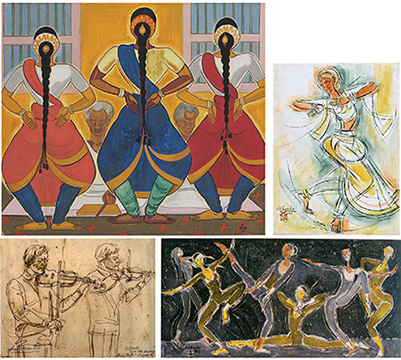
The artist’s works (L to R, top row): Bharat Natayam Dancers (watercolor),
and Bharat Natayam Dancer; (center) Yehudi Menuhin (ink on paper),
Merce Cunningham Ballet (oil on canvas)
Chavda (3rd from right) at his first one-man show at the Taj Mahal Hotel in 1947
with Khurshid (far left), Shirin Vajifdar (2nd from right) and friends
Or to quote him once more, "On my first visit to the British Museum, I studied Michelangelo’s work as well as the Indian miniatures to gain an insight into the classical and traditional methods of composition. I spent two years at the Slade drawing the human figure directly (from the life studies).”
These influences can be seen in some of the extant nude studies that Chavda painted with their solid, almost heavy emphasis on sculptural bodies that are a change from his ethereal leaping figures of costumed dancers. Equally interesting is to relate Chavda’s study of the Mughal miniatures and their depictions of animals and birds to his own ménagerie of farm animals, cockerels and hens that he delighted in drawing in finely observed detail. There are keenly observed studies of elephants, monkeys and the most cherished and yet taken for granted of all Indian bovines, the street cow contemplating eternity on a pavement.
As his wife Khurshid (née Vajifdar) was wont to remark when they settled down to a simulacrum of domestic life in Lonavla with a full complement of chickens, hens and cockerels, "We were looking forward to having a chicken curry for dinner, but what we got instead were drawings and sketches of our chicken coop.”
For it’s true, no matter how far he travelled, or how many diverse people and cultures he studied, for Chavda the only reason to do any of it was to capture the living throbbing life of those people on paper or canvas. As he confesses: "People and their ways of life have what has enthralled me in my travels.”
Chavda’s voyages of discovery took him to remote parts of the Indian sub-continent at a time when not many travellers were able to journey forth as we may do today. He travelled through the villages and market places of his native Gujarat, Rajasthan, or Assam, the Kulu Valley, Kashmir and South India, no less than the ancient sacred sites at Sanchi and Amarnath, the Elephanta caves, temple at Chidambaram and the mysterious old capital of Sri Lanka at Kandy. His sketches brought alive extraordinarily vivid portraits of the tribal folk at their festivals, or in moments of repose in their richly forested mountain retreats and villages. It’s from this period in the late 1940s and early ’50s that we see some of his best work. The village women of the state of Limbdi for instance, or the Missini women of Assam, the fisherwomen of Bombay, the sleepy gaze of an old farmer at his siesta in Bihar, or most vibrant of all, the splendid images of the Kandyan dancers and drummers, their frilled white skirts and the tasseled ribbons from their peaked headdresses creating their own drama of sound and spectacle.
In these early works one sees how Chavda’s compositions pulse from a point of complete rest to its opposite — sudden movement. One has to remember that this was a time when still photography and its later half-brother cinematography were not so easily accessible. There is a documentary quality to this early work that now has more of an anthropological interest than the purely artistic. The drawings reveal Chavda’s keen, almost scientific eye that strips his subjects, the Kandyan dancers for instance, into objects of pure movement, or energy. Every now and then, the artist intrudes and there is a delicacy in which he depicts one dancer’s foot bent backwards under the ripple of a skirt, perhaps, or the long nailed fingers waving like palm fronds in the wind. The dancer’s original movements may have been inspired by the slow slither of a snake, or iguana through the tropical grassland; the artist’s eye captures both the gesture and its source.
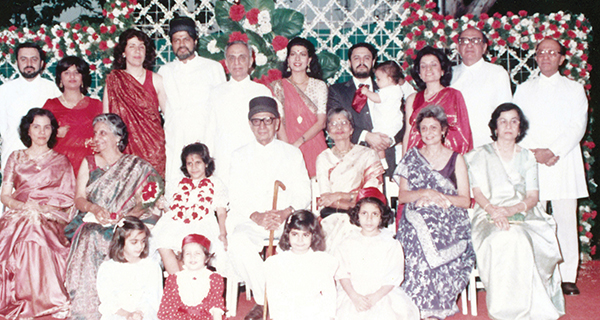
Chavda (seated, center) with extended family at granddaughter’s navjote
To quote him again: "From the point of view of art, I am attempting to tackle the problem of space and movement, the simplification of line and color. There is to me nothing throbbing with life, in a lightning release of energy as it were, as a serpent. I also feel the serpent is an ingrained symbol of Indian thought, religion and philosophy.”
We shall digress here to speculate on his marriage to Khurshid. She was part of a famous trio of dancers — the Vajifdar sisters. Not only had the sisters trained themselves in the diverse dance forms of the country, Kathak, Bharat Natyam, Kathakali and Odissi, created the costumes and accessories typical of each genre and performed on the stage, as also in the experimental medium of film, they were part of the new artistic and intellectual currents flowing through the city of Bombay. The Chetana Café on Rampart Row at Kala Ghoda was a meeting place for poets, artists, actors and dancers. The Café was started by Sudhakar Dikshit in 1946. A young journalist and editor from Patna, Dikshit chose to settle in Bombay, the city of the future. It became one of the first art galleries in the area.
The names of the early members include Mulk Raj Anand, future editor of Marg and a leading intellectual who married Shirin Vajifdar, the eldest of the three sisters, the poet Nissim Ezekiel, Evelyn and Kamal Wood and a sometimes visitor in the novelist Raja Rao who was to write the novel The Serpent and the Rope. The debates that the group discussed comparing Indian Vedantic thought to those of the new Existentialists in Europe, or of quantum physics and the tricky nature of matter, that could leap like Raja Rao’s image of the serpent that could as well be a piece of rope, must have appealed to the imagination of Chavda.
No matter what the truth of such speculation, as Chavda’s work developed he left behind his documentary skills to explore moments of pure movement, of pure color, or pure feeling, as in his Balinese Mask (1975); Red Symphony (1983) Dancer (1988). After a visit to South India he also embarked on a series of studies on the life of Christ. It must be kept in mind that all through his career as an artist, Chavda also painted a number of formal portraits, most significantly his delicate study of Sir Jamsetji Tata.
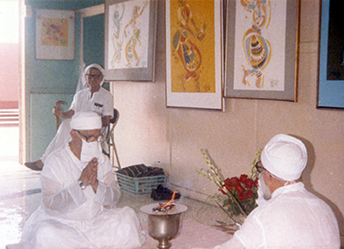
Chavda witnessing a jashan at his studio
The critic Dr Hermann Goetz was to write a monograph for the Lalit Kala Akademi (LKA) in 1960 in which he compared the lightness of Chavda’s touch to the spirit of the European artists Matisse and Duffy. To quote Goetz: "Chavda’s art has hitherto sacrificed the essence of things to their lively beautiful surface and had, thus presented us with that joyful lightness, that harmonious freedom which makes, for example, the art of Matisse and Duffy so enjoyable.” If there appears to be a tone of regret in such a remark it may be because Chavda had not got onto the bandwagon of the new generation of artists holding up a more disturbing mirror to the society that had gone beyond the promise of hope and a young Indian nation’s aspirations.
"There will always be a space for my paintings to be seen,” he would say to those who visited him at his Dhobi Talao terrace studio on the sixth floor of a building behind the Metro Cinema. He was not far from the rhythmic thump of the students who were being taught by Khurshid across the partition or on the fourth floor or the sound of the musicians accompanying them. Their daughter Jeroo was to become an Odissi dancer herself, while their son Pervez became an architect.
In his mid-seventies Chavda was given a commission by the National Centre for the Performing Arts to paint three murals that would be the culmination of his life’s journey. Painting them directly onto the walls, the three vibrant Mandalas that dominate the atrium-lobby have the majestic grandeur of Buddhist paintings tucked away in the remote fastness of a cave in the Himalayas and the vibrant exactness of abstract diagrams, that leads the viewer, through repetitive sound and dance patterns, into a contemplation of the divine.
In his own quiet way, Chavda, who passed away in 1990, had intuitively always been in touch with the divine in his art and in his life.