His estranged daughter Dina (Wadia) remained a memory locked in Mohammad Ali Jinnah’s heart, as were her clothes as a child and those of her mother, noted an article titled "The Footsteps of History” by historian and author Fakir S. Aijazuddin in Newsweek Pakistan dated September 13, 2018. The article noted that standing on the verandah steps (of South Court, the residence he lovingly built in Bombay’s Malabar Hill as a place to retire to with his sister Fatima) brought back memories of him instructing his servants to bring "a certain metallic chest” to his room. His driver knew what it contained: "It was full of clothes that had belonged to his dead wife (Ruttie, née Petit) and his headstrong daughter when she was a little girl. The clothes were taken out and sahib would gaze at them without saying a word. His gaunt, transparent face would become clouded. ‘It’s all right, it’s all right,’ he would say, then remove his monocle, wipe it and walk away.”
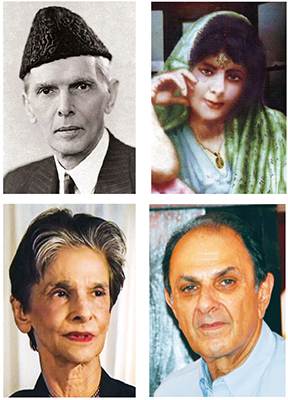
Clockwise from top (l): Mohammad Ali Jinnah,
Ruttie Jinnah, Nusli and Dina Wadia
The article noted that the politician "found it difficult to recall his chagrin at discovering, in 1938, that his only daughter had decided to marry Neville Wadia, a Parsi,” noted Aijazuddin. His own wife too had married against her Parsi father’s wishes, "but that — even for a lawyer like him — was not a strong enough precedent,” noted the writer.
"‘When he learned of (Dina’s) marriage, you could see grief on his face,’ his driver later narrated to (writer) Saadat Hasan Manto,” wrote Aijazuddin. "For two weeks, he would not receive visitors. He would keep smoking his cigars and pacing up and down in his room. He must have walked hundreds of miles in those two weeks. His brown-and-white or black-and-white brogues would produce a rhythmic pattern of sound as the night wore on. It was like a clock ticking,” noted the article.
It was on the verandah of South Court that in 1946 (late) Dina brought her two children for what would be their last meeting with their grandfather. "‘As we said goodbye, he bent down to hug Nusli,’ (was) her nostalgic memory of the occasion,” notes Aijazuddin. "The gray cap, which he wore so often that it now bears his name, caught Nusli’s fancy, and in a moment he had put it on his grandson’s head saying, ‘Keep it, my boy.’ Nusli prizes the cap to this day,” noted the article.